Showing posts with label SE Asia. Show all posts

Wednesday, July 04, 2018

A Malaysian Wedding Trip

Murals in Penang
Malaysia was Stop Three on my flight around the globe. Malaysia was originally going to be Stop One, as I was going to join up with a few friends to attend one of our (Denise's) weddings. But then my work trip was tacked on. And here we are.

Jetlag & Confused
When I arrived, I was confused about where I was ("Which country am I am? Who am I?"). I realized while in the immigration line that I had arrived a day earlier than I had thought and realized that the connecting flight I had to Penang wasn't until the next day.

My friends, mystified that I didn't know where I was or what day it was (and that I was a day earlier than I told them I'd be - surprise!), took me out for dinner at an outdoor market. We feasted on all kinds of fish and vegetables and chicken dishes. Eating with friends and soaking in the heat of KL melted my confusion.

I found a KL boutique hotel for the night in Chinatown that was beautiful and had outdoor bathrooms, which was delightful. My toilet and shower were in a private courtyard! There were shades that kept any guest staying above or below me to peek at me. There was rain falling down on the courtyard next to the courtyard when I showered.

The next day I hopped in a car with friends from Colorado for a road trip to Penang. We had decided to remove ourselves from the wedding chaos so Denise could have one less thing to worry about...and so we could travel around the country some.

Once we got out of KL, driving to Penang felt a lot to me like driving through much of the US, aside from the tropical vegetation everywhere. There was a lot of open space with small towns hugging the highway. Much of the drive to Penang was pretty uneventful.

In Penang
We got to the island of Penang and drove in the rain to the UNESCO town of Georgetown and waited for our Airbnb host. Our Airbnb was outside of the tourist areas, which meant that it was quiet and had a nicer view of the water. After we checked in, our host insisted on cramming us into his car and give us a tour around town for a while. While it was a nice gesture, we were starving and really weren't interested in getting a full-on tour. We wanted to gorge on street food, which is what Penang is known for! We finally got let out in a food alley, ravenous and eager to eat something. Anything.

Luckily for us, "anything" in Penang is worth trying. And so we did. We ate a lot of great things while in Georgetown: assam laksa, duck sausage noodles, chendol, laksa regular, nasi lemak, and so many other things of which I don't remember the names. Everything was fresh and bursting with flavor. I didn't know half of what I was eating....but I was pleased as punch with all of the the tastes.

We seemed to arrive there on a quiet day for the town. We saw a lot of tourists (which, with its UNESCO status, isn't very surprising), but things were not open for tourists to do. We managed to find a small museum - the Museum of Glowing Image - where we walked around under purple lights for an hour. It was ridiculous, but we had fun being silly while glowing in the dark.

We were still fighting off jetlag, so we went to a night market for a bite to eat and quickly walked back to the Airbnb to crash hard.

The next day we decided to drive around the island to see what is happening in Penang outside of the tourist-centred area. We visited the local snake temple (it is a temple with snakes in it, and you can hold them!) and got lost driving around because Google Maps gave us directions to roads that didn't exist (or were lost to the jungle overgrowth). That's when we stumbled upon the Tropical Fruit Farm. The title of the farm tells you exactly what the attraction was - a farm of tropical fruit...but we had a blast on the tour, tasting and learning about the plants along the farm.

We spent another day in Georgetown before heading back to wedding ceremonies. It was a supremely hot and exhausting day. We walked around to see all of the tourist sites like the murals, ate some not-so-local cakes, visited the Cheah house, and walked around the port neighborhoods with drop toilets on the edge of the docks. Walking around in 90F degree heat and 95% humidity, though, can be trying on the body. We slept early and hard that night.

Back in KL
The next morning we drove back to KL to get ourselves fitted in saris for the wedding and have amazing ice cream with the bride-to-be and some other international people. The couple had a group of us foreign friends attending their wedding, and we quickly became an international group of friends (I'll call them "The Friends"). We agreed to go touring around the next day to stay out of the couple's way while they ran last-minute errands for the wedding.

Batu Caves
The Friends arranged to visit the Batu Caves in the morning. We got there before it was too hot outside, which to be honest isn't saying much because it was still very hot.

The Batu Caves are an impressive sight because there is (1) a large, steep staircase to the caves (there are two) that loom above the tour buses and (2) a massive statue of Lord Murugan that guards the height of the stairs. The climbing....was treacherous. Not because of the number of stairs to climb - I mean, I'm a New Yorker and we climb stairs a lot - but because the stairs were narrow and uneven. To make our trip up to the caves more precarious, there was a mound of sand next to the stairs and a pile of small plastic buckets next to a sign requesting tourists to carry full buckets of sand to the top (for construction...which, of course, we did).

Once we reached the top of the stairs and went into the cave temple (the popular cave), we were all appreciative of the gaping hole in the mountain, but I kept thinking "...was this why I lugged two buckets of sand for?!" My travel partners agreed to go to the more sciencey cave (the other, less popular cave) and take a tour that walked us deep into the darkest crevices inside the mountain. We were loaned hard helmets and penlights, and off we went with a tour guide into the depths of the cave. It was beautiful and so well worth the expense. We got to explore different rock formations and got to an area where there was a skylight into the cave that lit up a gorgeous, quiet, mossy nook of the cave that made me think of some kind of magical backdrop to a fairytale.

Upon leaving we saw an armada of tour buses coming to the caves and watched hordes of tourists drip with sweat as they crawled up the stairs. I'm so glad we went early.

Before we made our train back to KL, we visited the only other tourist site nearby - the Ramayama Cave. This cave was ground level, and a wild(ly strange) sight to behold. There, the Hindu community took a natural cave and carved it out so that the inside of cave walls became platforms all along the perimeter to showcase a life-sized 3D display that unfolded the story of the Ramayama. With statues and paintings. Most of The Friends didn't know much about Hinduism, but even my knowing smatterings of the story didn't keep me from being bewildered and amazed.

Once back in KL, another friend of Denise and mine - Alicia - joined us getting our hands henna-ed for the wedding and partaking in essential tourist shopping in Central Market. Later on, she led us to a local restaurant that served Chinese food and ordered us a whole lot of foods that were delicious and fascinating and things many of us had never eaten before - smelly fish soup and congealed pork knuckles. It was family-style and a local hangout. We had so much fun we shut down the shop.

Wedding Time
The big day finally came - the day for Denise's wedding! And it was all day, so it was a big deal. Why was it so long? Because of the cultural mash-up that was going to happen; she is Chinese and he is Hindu, but both are also Malaysian. We had three different chunks of wedding celebrations to experience before the day was over.

The first part was Chinese. We arrived at Denise's family's house before the sun rose. We met a lot of bleary-eyed family members setting up the buffet (it felt so weird to eat spring rolls so early) and prepare the festivities. This part of the day was when the groom had to play games with the bride's family and friends and persuade them to let him into the house to find his bride. This took a few hours and a number of different "obstacles" for him to overcome. It was all in fun, luckily, and he was successful in retrieving his bride.

Once that happened, The Friends (and some of the bridal party) shuttled over to another home to get changed into saris and kurtas for the Hindu festivities, which were scheduled around lunchtime (based on the celestial alignments the Hindu priests deemed appropriate). The sari changing took a while - by the time we were fitted and ready to go we hurredly drove into town to the temple.

Once we got to the temple, we were pleasantly surprised to see one of our other girlfriends (Pritha). She flew just that morning there from India with her husband to attend this part of the weddings.

A few hundred other people also decided to observe the wedding at the temple.

It was fun to watch the Hindu wedding because it was a whirlwind of noise and processions that none of us understood (and apparently not even the couple fully comprehended). There was flowing music and vibrant colors that made it still exciting to witness. AND we all got snack bags during the ceremony. The Friends sat in a clump and were fortunate that a few of the older aunties sat near us and explained in English as best they could what on earth was going on. The rest of the crowd seemed just as bewildered about us being there as we were watching the ceremony.

The public wedding processions ended after a while and people grabbed plates of buffet food before heading off. The Friends slowly shoveled food in our mouths as we sweated it back out again and left for a long break before we rejoined the now-married couple. I napped the entire break

The final part of the wedding was the reception in a restaurant and felt a lot more Western than the rest of the day. There, we ate even more food and danced the night away. We also watched some of the FIFA World Cup game when we needed breaks from the dancing. It was a wonderful ending to the wedding, and more intimate than a lot of the rest of the day.

But I was exhausted and burned out. Not as burned out as the married couple was, of course.

The next day I requested a day alone. I went to the Patronus towers mall (oh the irony of finding quiet time in a big mall). After my break, we met up for dinner one last time with the married couple before my flight out. The dinner was a lot more low key than the rest of the wedding festivities - we hung out at tables in the groom's front yard and talked about nonsense, and caught up on each other's lives. What was so extra wonderful about this trip and wedding was that we ended up making more friends.

End Thoughts
The trip to Malaysia had a few themes that I will reflect on more as I continue my life of travel:

  • I prefer slow travel. This trip, albeit fun and action-packed, was not slow. A lot of my fellow travelers wanted to see everything, exploring all of the things and walk all of the roads. That path is not for me - I was exhausted so much of this visit. Instead, I like taking my time while I travel. Maybe I won't see everything (read: all touristy things), but I get to go at a relaxing pace and see the things that really mean something to me. And often, I don't find the touristy stuff very interesting. This does mean that I do more research about where I am going before I get there, normally. Oh yeah, and mid-day naps are the best, even when I'm missing out.
  • I love SE Asian food. I love the unique flavors smashed together in one dish. I love that the desserts are funky and not chocolatey (even though I love chocolate). I love the comfort in even the spicy soups. I love everything about them. It is amazing.
  • Hot and humid is hard. I already knew this from my previous trips in SE Asia, but it bears a reminder, especially after scaling Penang in 95% humidity and 95F heat. Hydration salts are my saving grace on those kinds of days.
  • Malaysia? It's Okay. Surprisingly, Malaysia is not my favorite place, despite it having amazing food and some very interesting spots to see. For me, it was culturally not too far away from the US, which to me is a mix of a bunch of cultures to the point where there is a missing keystone to the culture. It is an odd place of rigid laws and lax customs, which is a bit confusing. I can't say I would ever want to live in Malaysia, but I was glad I got to see more of it with my friends and see my friend at a joyous occasion in her life.

Wednesday, May 04, 2016

A Farewell (for Now) to Cambodia

A few days ago in Phnom Penh, I packed myself up, grabbed a tuk-tuk to the airport, and flew out of the country back to Australia. It was a bittersweet farewell.

Let's start with the bitter part....

A lot of my time in Cambodia was framed with unforgiving heat and constant sweating. By the end of my visit, Shana and I found ourselves sitting in our common room staring at each other with dazed expressions, carefully keeping body parts away from each other to allow for sweat to dry (I was always covered with rashes and blisters from the sweat).  And the oozing heat was combined with a dangerous ongoing drought that is beginning to threaten food security (read: looming food crisis). So I won't miss that too much.

Also, I dealt with the long and arduous rites of passage of white foreigners that are GI tract issues. I had amoebic dysentery and a number of food poisonings during my stay. Even during my last week, right when I began to feel nostalgic for a country I've learned to love, I was reminded not to love any place too dearly because of some rotten food. Shana and I found ourselves clutching to bathroom doors with food poisoning from a nearby restaurant. Back in Australia now, I can say that my GI is on the mend and I am thrilled to feel less likely to get ill from the food (though I'm still wary of leafy greens). I definitely won't miss that, either.

Overall, though, sweetly, I found Cambodia to be a lovely place to be for a while. It is so easy to be a foreigner there - the country is brimming with NGOs and development work, and the country (the city especially) caters to the palates and whims of Westerners at pretty decent prices. I never felt like my safety was compromised while I was there, and the Khmer I met seemed more concerned with my well-being than even I was. So many of the people were friendly and generous to a humbling degree.

Also, I discovered my love of bobor/congee, for which I am grateful - I have a new comfort food! I was fortunate that Virak took me to get two heaping bowls of bobor a few days before I left.

Sure, there's issues with corruption and more political issues than you can shake a stick at (I'd rather not get into it at the moment), but the country works and grows in spite of those challenges. The economy is shifting and booming, and the changes are easy to see even over a brief stint like mine. I mean, a Krispy Kreme was about to open down the block right after I left! I cannot imagine what Cambodia will be like in a few years.

In fact, those challenges helped remind me that no country is immune to problems - especially the US. Though I admit, I am happy to be back in the developed world and am enjoying the comforts of my upbringing - the air is fresh, the food is clean, and the streets are quiet!

Final thought: I look forward to going back to Cambodia sometime soon (though, I hope, with cooler temperatures!).

Saturday, April 23, 2016

A Quiet New Year

About a week ago was the Khmer New Year. Most of the foreigners (aka expats) fled the country for holidays in cooler climates, and locals headed into the provinces to visit family over the holiday. I, on the other hand, opted to stay in Phnom Penh and work on my research project, furiously coding transcripts and trying (with tired eyes) to interpret my codes into a tangible story. I’m still working on making sense of the data and putting together my analysis, so I’m glad I stayed behind.

People here asked me what the city was like during the week everyone was gone. Honestly, I didn’t venture out too much because of my research, but I did go outside here and there. Simply put, it was hot and empty.

Firstly, it was hot. Of course, this is not an interesting observation; it is consistently in the 30s C / 80s-100s F. But that week was exceptionally hot – most days wavered between 39C / 102F to 40C / 104F (and that is not including the increased degrees for the “RealFeel” measurement). I hid in my bedroom with the aircon  nonstop in order to avoid melting; going outside seemed extremely unappetizing.

Also, Phnom Penh was silent and empty. The quiet meant I could sleep longer into the morning, which I found rather pleasant. And the streets were free of parked cars and people; only a couple cars would be driving down the main roads, whereas normally it’s packed and congested traffic nonstop. The reduced number of people made it easier to walk down the streets because there was no competition for space.

Actually, this walking around on the street was short-lived. Whenever I tried wandering more aimlessly up and down the street, I would get some tuk-tuk drivers’ attention. Normally, this attention includes someone shouting, “Hey lady want a tuk-tuk ride?! Where are you going??”, trying hard to make a transaction. Over the New Year, though, the attention was more tuk-tuk drivers’ adamantly yelling for me to get back on the sidewalk and put my phone away. It seems that some people take the week’s emptiness as an opportunity to speed down empty streets recklessly. Also, someone mentioned that theft goes up in the New Year because people want nice things like smartphones and will ride down the street on their motorcycles to snatch your belongings if you’re too close to the street.

The tuk-tuk drivers weren’t asking to give me rides, they were just genuinely concerned about my wellbeing. Which was a strange change of pace for me, being used to politely declining constantly as I walk down the street.

Despite the emptiness, I did have a little bit of a social life. There may not have been very many things open or people around (every restaurant I like to go to was closed), but I had a few friends who stuck around as well, and we'd go out to enjoy each other’s company over cold beverages (Brown Coffee was open, of course).

One friend had a dangerous allergic reaction to some strange ingredient in a meal while in the city that week. I tried to help that friend find an EpiPen or some allergy help so that they could figure out what happened to them. Just to let you know: Cambodia doesn’t have EpiPens. Try all you might, you will not be able to successfully source EpiPens in this country (and if you magically can, I am going to guess it’ll cost a lot). Luckily, this friend went to an embassy and sourced an EpiPens that way, but otherwise was looking at having to go to a clinic for a stab of adrenaline if anything else happened. This medical mishap was alarming for me in some way. I wonder, if someone has a child who is allergic to some food, what do you do? If someone is deathly allergic to some kind of insect or surprise allergy (and is a baby?!), what happens? It reminded me how some things that work in countries like Australia and the US are far cries from how things work in countries like Cambodia.


Don’t get me wrong! Cambodia is progressing and evolving at lightning speed. There are so many developments happening here, even for the 3 months I’ve been here! And so much is happening that it’s very exciting to be here and watch it change and morph into a new kind of society. That said, I do miss the immediate healthcare of other places. 

Thursday, April 14, 2016

Field Research Fun

Cow grass
Last week I got into a quintessential expat vehicle (a white Jeep...with a driver) and drove a few hours out of Phnom Penh for interviews with local, rural government staff. Being the child that I am, as soon as the car started pushing out of the city, I fell asleep until my driver kindly nudged me awake in our first area for interviews, Kampong Speu.

During our few days in the field (meaning my friendly driver and me…and when I wasn’t lulled to sleep by the humming of the car), we spent many quiet hours having broken conversations with each other. We drove from Kampong Speu, out to the other side of the country in Kampong Cham, through Tboung Khmum, and back to Phnom Penh.

I’ve tried to learn Khmer while in Cambodia. Normally languages are pretty easy for me to grasp. Par example, je parle français (grossomodo). Some Spanish speakers have thought I can actually hablar español. I can read some Arabic like a first grader. By the end of my month-long stint around Thailand, I could hold basic conversations with people (krup koon kah). In Laos, visit to Isan proved good for me to understand a good amount of things (krup chai de). 

But when it comes to Khmer, even though it is of the originating family from which Thai and Laotian stem, I am utterly useless.

Khmer, for me, is incredibly difficult. I cannot for the life of me figure out how to remember the complex pronunciations and complicated consonants that surprise me when I hear people talking. I’ve managed to clutch clumsily around a handful of words - “Hello”, “Thank you”, “Stop”, and “Turn”- but for the most part what words I am taught dribble out of my brain as easily as football statistics. And it infuriates me!

This is especially problematic when in rural Cambodia, where English is not as important as it is in the city. Here, I am in the wrong for not trying to learn more Khmer, and I agree with that – I should be much better at the language by now. Alas, my brain has shut the vaults to Khmer, and my attempts to use Thai words as alternative vocabulary are kind of silly.

One instance while in Kampong Cham that was amusing around my inept Khmer skills was around my breakfast. My driver, bless him, after I rambled on about wanting bobor (aka rice porridge) found a place in the city where I could order it for breakfast. I have discovered a deep love and affection for the comfort food feel I get when eating it. They put ginger and scallions in it, and often meats, which make it basically like eating a nice, creamy, thick soup. 

I go into the restaurant and order a bobor. The waitress, being a good and thorough waitress, started listing off in Khmer the bobor options they had at the restaurant. I panically ask for, “English?”, which gets me a chuckle and more Khmer words thrown at me that lodge into my pride. A meekly repeated request for “Bobor….?” was met with the repeated list of options I couldn’t understand. I started to cluck like a chicken, using my hand to represent a beak, in hope that it would give the effect of my desire to have chicken in my porridge. After a pile of waitresses and patrons finished their giggling at the stupid foreigner’s chicken impression, the waitress gave me a knowing smile and walked away from me.

Soon after, I received my bobor, only with fish instead of chicken. Don’t get me wrong, it was a tasty dish! But after my embarrassing attempt to impersonate a chicken, I felt baffled that my performance was received with an animal that did not make any sounds at all. I went back the next day to try again my request for chicken in my bobor, armed with the word chicken from my caring driver, and I was successful in eating bobor muan.

Another amusing language mishap that happened in the field was a bit more costly for my interviews. Well, I have not confirmed that this is why the complications occurred, but I am assuming that this was the hiccup. 

Anyways. 

So, my name is Kim. Of course, in the Anglophonic world, my name is short for Kimberly, which usually doesn’t cause too much confusion about my identity. In Cambodia, however alarming, I have been mistaken for Korean a couple of times. If you know me, I look in no way Korean, nor Asian by any stretch of the imagination. I burn in 10 minutes, in the shade – my hair is a mix between blond and brown – my hips are most certainly not of their typically sleek physiques. And yet, I have had people ask me to my face if I am indeed Korean, upon hearing my name. It is a phenomenon that floors me every time.

How does this relate to my interviews? My interviews were arranged with the rural districts via email, where my name was indicated as “Kim” (because that is how I identify in correspondences). Kim, it so happens, in addition to being a Korean name, is also a common nickname for a few names in Khmer. It is not, apparently, a common name for visiting Westerners interested in going to rural areas to talk about government. 

Despite my supervisor’s Virak request for a translator for me, I think my name made that important request not register for people. I arrived to each district with a request for translators, and people looked stunned that I was who I was, and that I did not have a translator with me already (or speak fluent Khmer). 

Every district scrambled to find the most English-speaking staff member they had and thrust the poor soul in my direction. Some of the translators were good and knew how to navigate my questions for me in both language. Some of my translators were shaking a little bit as I spoke to them in a very slow, simplified version of English. Some of my translators kept apologizing, which did not boost my faith in their skills. Even so, they all did a decent job in helping me collect my data, and I thanked them for taking time to interpret the conversation between me and groups of government staff.

Oh yes, there’s that other thing, too. I had asked for one-on-one interviews with certain government staff, because it would make my data collection and analysis easier. All of the districts did not understand that, though, and my interview participants would end up collecting a few more relevant staff people to join us in the interview room. Stunned, I decided it was disrespectful to forbid the other people to participate, and my already anxious translators didn’t need to feel more stress with having several different conversations between me and other people (the less I talked, the better). So, in each of my surprise focus groups, I had everyone sign a consent form, and rolled with it. 

By the third surprise focus group, I was hardly surprised.

In the end, I now have twice as many interviews than I had expected, and I was successful in collecting some pretty interesting data from my field visit. Overall, a success.

Other things that I would like to note about my trip into the field for data collection:
  • I am left handed. I know that I am, but I didn’t remember that Obama is, as well. One of my translators remembered that, though, and mentioned it almost immediately after I picked up a pen to write down a note. “OH! You write like Obama!” It took me a few beats to figure out what he meant by that. I remembered some memory from seven years ago when someone mentioned to me that Obama was a southpaw. I wanted to ask him how, in all of the vast ocean of knowledge to remember, did he remember that one pretty obscure fact about POTUS?
  • I was interviewing people about their work around improving rural sanitation. At about half of the places I visited, I was surprised to see male staffers urinating either on/by one of the buildings, or on a neighboring tree on the compound. At one district of these districts I also asked to use the toilet. They hesitated uncomfortably, informing me that their toilet was not working very well. I found this ironic (and unsettling), considering the reason for my visit. I went into the broken toilet and did what I had to do as hygienically as possible. It was an interesting observation to have while working on sanitation-related research.
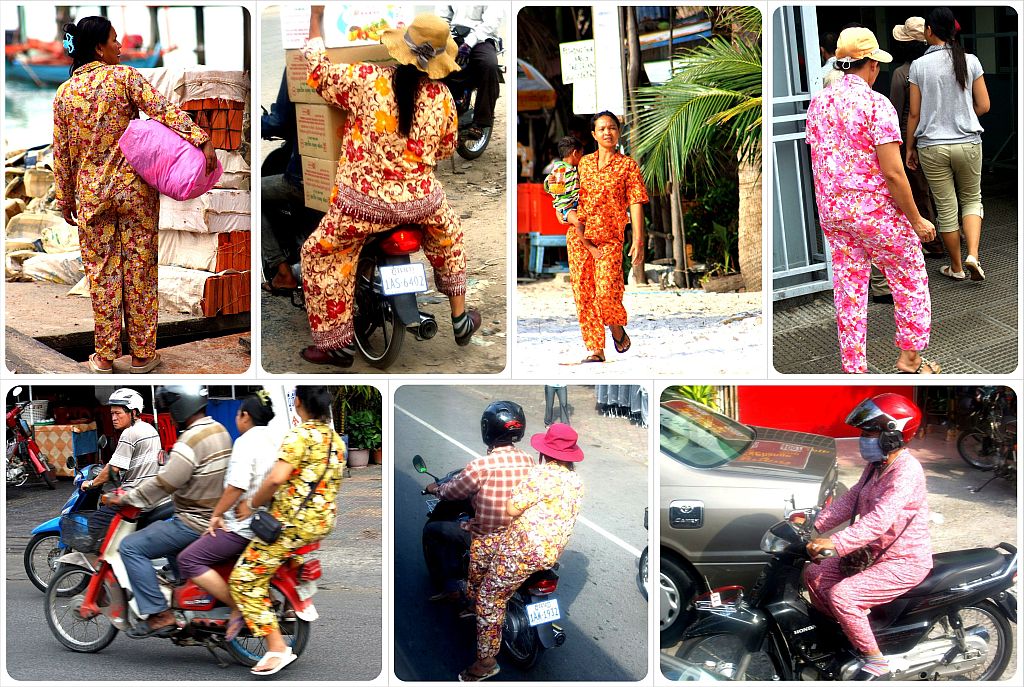
  • Something I love about Cambodia is the style where women where brightly-colored, fully-matching button-down pajama outfits while out and about in the steamy days. Some of them have penguins or flowers, depending I suppose on the person. They are always colorful and look nicely pressed when I see women in the pajama sets. Sometimes I’ve seen children in pajamas, as well, running around and hopping into motorbikes in superhero patterns. My hypothesis is that pajamas are cool and airy enough for the hot tropical weather…and they do have a certain pleasant air to them. It is unsurprising they are colorful, as everyone had to wear black pajamas during the gruesome Khmer Rouge regime.
  • While we drove, we went by countless weddings on the sides of the road, under wedding tents with vibrant colors and upbeat bands playing. Considering the dreadful heat and dust in the dry season, I asked my driver why weddings seemed so popular right now. He explained that people would rather be hot at a wedding than soaked/flooded by the rainy season, so dry season is the only decent time to celebrate marriage.


Tuesday, April 05, 2016

Stopped in Singapore

I went to Singapore for a few days last week. People ask me why I went, and I could give a few answers…truly, it was merely a visa run. I would be lying, though, if I said I wasn’t also eager to explore another nearby country; I could have just as easily booked the visa run in Thailand, but I chose Singapore. And I wanted to meet up with an organization. And I wanted to see an old friend I knew while in Kigali (Singaporean Kiran – who let me crash her couch while there). Lots of reasons.

I arrived in the middle of the night and took a speedy car through the wide highways to Kiran’s home. I then quietly slipped into the couch covers for a brief night’s sleep, before my busy 3-day schedule.

To me, Singapore could fit very nicely as a big city in Australia, if only it was closer. I felt like the city that was a mix of Sydney, Melbourne, and Brisbane. In fact, if Singapore called itself Australian, I don’t think it would have phase me. And yet, it was still very much Asian. It’s hard to adequately explain my feelings.

If I had to sum up Singapore in 3 words, they’d be comprehensive, clean, and baller.

Now, hear me out.

Firstly, Singapore is pretty comprehensive in the sense that it’s a tiny country, yet it packs a punch. One minute I was walking downtown between skyscrapers and the next minute I hopped off a bus and ended up at a bay with gardens. Thirty more minutes and I was in front of a massive reservoir where people were fishing in a densely forested area (only a few blocks away from apartment complexes and restaurants al fresco). Kiran lives in a very sweet suburb area with beautiful little houses and a bunch of charming shopfronts. I was impressed with how much stuff is in Singapore, and such diversity in a small plot of land.

Second, Singapore is clean. Very clean. I know it’s famous for its cleanliness, but I have to verify this truth. In some ways, I felt like in some areas it was the kind of cleanliness you would see at an anal retentive cleaner's area (bleach bottle and all). Some areas were not as immaculate as this, of course, but a lot of it was very well kept. The UNESCO-endorsed Botanic Gardens, as an example, was extremely well managed but not sterile. 

I must admit that it was hard for me to remember all of the rules in Singapore in order to maintain cleanliness, such as no food or drink in many public areas and absolutely no chewing gum. Still, it was a really nice place to walk around because it was so clean in many different ways – I could walk around freely without being worried about getting hit by debris or people (then again, it was a weekday period, not weekend).

Finally, Singapore is baller. I know, this is an odd adjective to describe a city, but I kept thinking it when I was visiting. Singapore is baller because it’s got a lot of fancy things, and it’s super expensive. It’s, of course, the most expensive in the world today, and I choked back some tears when I went out for some meals and electronics shopping (A $35 burger?! really?!). 

But, it also has a lot of very nice things. Very, very nice things. The cars, for one, are fancy. And, the country is kind of like a massive, beautifully designed mall. Malls are omnipresent in Singapore, and a lot of the shops are luxurious. The less-expensive places I went into, even, were done out really glamorously – kind of like there’s a mindset of “go big or go home” to how business works here. 

It’s also baller because it’s clearly got so many model aspects to the country – the economy is a model for some countries like Rwanda, their wastewater treatment is world-renown as the best of the best, and even the gardens are created to be state-of-the-art and award winning. Kiran and I talked about this, and she explained with a sigh that the country is run like a business to the extreme; everything needs to be optimized, and everyone is on board. I could see what she means in the country’s overall aura of almost dogmatic efficiency, but I must say I’m still impressed.

But I did stuff. Let me share.

My first day was a work day. I went to the World Toilet Organization to network with the staff and chat about their role in and perceptions on the future of WASH. Afterward, I traveled to the incubator office called Impact Hub - I often work in the Phnom Penh office, and was able to arrange a desk for a day while in Singapore. The Phnom Penh office is intimate and a lovely space to connect with other entrepreneur spirits; the Singapore office was like being in a member’s only club! They had a nap room with beds and pillow-full couches, a kitchen with free ice-cream, several different areas for working, and a full-on café area where you could eat gourmet food while talking to people on sleek couches (this is also what I mean by baller). I got to network with a bunch of really interesting people doing very similar work to what I hope to do in the nearby future.

Also, I made sure to nap in the designated room after I finished up my working for the day.

I ate at a hawker stall for lunch, too. Hawker stalls are kind of like food court vendors run by small families, (cleanly) crammed into small spaces together. It was tasty and affordable, don’t worry.

A lot of my trip was around shopping for electronics. Part of this was intentional, since I was in need for a charger and some earphones that would last past my trip to Cambodia, and I got those things. I also had to get a new phone because early into my trip my phone decided it had had a good (albeit far too brief) life and pulled its power cord permanently. Many hours between Kiran and me were stuck in Samsung waiting to see if there was any hope of revival. When there wasn’t, we spent more hours hunting down people selling their unused phones on and in local marketplaces. We walked through the labyrinth of massive interconnected malls from one meet-up spot to another, searching for phone sellers. Fortunately, I got the same model as my own phone, but it wasn’t without some suffering (and sweating).

Oh yeah, Singapore was in a heat wave while I was there, so there was much sweating.

On my second day, I walked around the arcades of Burgis Street, roamed a bit of CBD, and walked through Little India for some sightseeing and eating. I also strolled up and down the shopping hub of Orchard Road while hunting for electronics.

I walked around the massive quay called Marina Bay Sands. It’s essentially another massive high-end hotel and mall – with a Venetian-inspired boating experience in the middle of it! – that hosts a lot of water-inspired art throughout the place. I admired the skyline, and ended up going to the Art Science Museum to escape the heat. 

Going to the museum might have been the best decision of the entire trip! The museum had an interactive exhibit full of bright colors and fun creative installations that allowed me to draw my own art and have it become part of the display for a little while. There were walls that changed shapes when touched, and brightly-lit balls that changed colors when rolled to hit each other. I cannot remember the last time I felt such childlike joy.

The museum was followed by a brief visit to the Gardens by the Bay. By this time I was getting tired of walking around and took a bus ride through the major center of the country before heading over to the Singapore Zoo for a tour of the Night Safari. This zoo area is specifically open at night only, where you board a tram that trucks you around the zoo to see the more nocturnal animals in dimly-lit open enclosures chilling out. It was a pretty neat idea, though unfortunately I had the luck of going the one day the zoo was having a children’s overnight party, and there were screaming/crying children surrounding me in this what-should-be-adults-only zoo area at 9:30PM.


A final note: would I live in Singapore? I’m not sure. I loved visiting the place, and I would love to visit again more to explore it in more depth. Living, there, however, would be a different story, I feel, and I’m not entirely sure I’d survive in such a pricey place. Also, I'm not sure my quirky lifestyle and crunchy needs would necessarily fly in such an economic masterpiece. But really, who knows?

Thursday, March 24, 2016

Weekend in Kampot

After feeling down and impatient in post-amoebic Phnom Penh, I decided to take a weekend holiday in go the south of Cambodia, in the riverside of Kampot.

Kampot is a place the French established as a favorite holiday spot when they controlled Cambodia for a little while. It’s also where a lot of the famous pepper called “Kampot Pepper” is grown.
I got off the 4-hour bus and found myself in a smaller city that was quiet, clean, and peaceful – a much different atmosphere than the dusty, bustling, and loud feeling of Phnom Penh. The town is lined with a Riverwalk that made me feel like I was strolling down a familiar town near home, with a broad boulevard that was spotted with trees and pink-flowered bushes. The river also provided a cooler wind and temperature buffer, making it a few degrees cooler than the capital. I really enjoyed it there.

Kampot is a bit quirky, too. For one, there were a wide range of tourists around me, including backpacking-hippie types and older pot-bellied bald guys (or frayed, greying wavy locks) walking alone with local women. Not completely foreign to tourist spots, though it was surprising for me at the time. Another quirk specific to Kampot was one specific roundabout/rotary in the town – the center of the roundabout held a large statue of a durian standing amongst smaller pineapples and coconuts. Durian is grown in the area, I understand that; but if you’ve encountered durian in the way I have and feel the same way I do about the stench/taste, you may be as equally surprised/concerned as I was upon seeing it revered in the middle of a main thoroughfare.

As soon as I checked into my simple hotel room, I took a tuktuk an hour out to the nearby beach town of Kep. Kep is known for glorious beaches and wonderful seafood. I have previously explained my dislike for sand and being on hot sunny beaches for too long, so I did not tarry in Kep for very long. I was in Kep, specifically, to eat seafood – not just any seafood, either! Kampot pepper crab, which is a fantastically delicious thing. I cannot fully describe the amazing tastes I experienced when eating the peppered crab (with a drizzle of curry on it) in Kep, but it was worth the moments of silence I gave it. It was amusing, though, because the crab shack I went to on the beach did not have crackers for opening the crabs, and I had to use my teeth and hands to tear apart for the meaty goodness. Behind me were a bunch of American girls who looked disgustedly at their whole crabs, pushing them around on the plate seemingly confused about how to eat them or refusing to get dirty. I was an absolute mess when eating the crabs, but they were worth it. Waste not!

If you need a tuktuk driver in Kampot...
Back in Kampot, I went to a spa and read while getting apedicure for which my feet thanked me. I took my dazzling nails and me afterwards to a Portuguese restaurant a bit further out and ate some of the finest gourmet food I have had in months.

The next day my trusty tuktuk driver took me around the countryside of Kampot to a number of interesting places.
  • Salt fields: During the dry season (now), they drain sea water into flat fields and coax the salt out of the water so they can sell it as sea salt in Cambodia and abroad. It was a really interesting set-up to look at; there are rows and rows of shallow water with glittery white chunks floating to the edges of the fields that are raked out, dried, and stored in long buildings that have salt coming out of the corners and doors.
  • Pepper fields: We essentially walked through someone’s property to these tall vines of pepper being grown in a small chunk of land. The peppers grow as green, and are then dried or pounded a certain way to become black or white.
  • Caves & Lakes: My tuktuk driver led me through a scorched field next to a hill, over a bridge, and through someone’s backyard again. At first I got nervous about why we were walking through backyards and in the middle of some of the quietest scenery I’ve been in for a while. He then led me to a clearing where there was a grand staircase guarded by monkeys. After shooing away the monkeys politely, we hiked up the stairs and I found myself in a beautiful cave in the hillside. The cave had smooth yet dramatic curves. Walking into the cave, I saw a small, ancient temple propped on one of the walls. The tuktuk driver mentioned it was older than Angkor Wat, and was originally a Hindu temple. He also took me to a very quiet area with a lake for a cold drink before getting back to the town. It was nice. It was a quiet, small lake.
In the evening, I took a boat ride that slowly rode up and down the river during sunset. Aside from the occasional obnoxiously-shouting tourists on the boat, the ride was a lovely exploration of the river. As we floated through the lush riverbanks, the sun set right behind the Bokor Mountain, giving the sky spectacular warm golds and yellows. We also went into one of the more swampy areas of the river at the end of the ride so that we could watch some fireflies for a few minutes.


On the last day in Kampot, it became extremely hot. I decided to preserve my energy in the heat by reading more while sitting in some of the town’s cafes, and I took a leisurely stroll up and down the Riverwalk, admiring the flowers and panorama views.

Tuesday, March 15, 2016

Update on Being Sick

There’s not too much report right now. After a week in bed with a really bad cold, I was in bed for about two more weeks with amoebas battling it out with my GI tract. I will simply say, being sick in a foreign country without anyone around me sucks. Lots.

I got out only a few times while I was sick.

One time was for an evening where I gave a talk about the history of toilets to a large group of nerdy expats in a fancy bar (I stuck to ginger ale). I shared with them my desperate plea for everyone to wash their hands and use the toilet always because of my amoebic afflictions and joked about Thomas Crapper and other fun trivial facts about toilets. People loved the talk and came up to tell me this before I uncomfortably made my way to the bathroom. Despite my abdominal discomfort, the praise was nice while I continue tackling complications with my health and research project (far too many complications to mention in a blog post...also, too discouraging for me to want to explain cogently).

Another time I left my bed, right before I made a second trip to the doctor for more stomach medication, I went for a little walk around one of the parks near the Riverside area of Phnom Penh. It was just after sunset when as I walked slowly down the boulevard, and the air was cooler. I heard a thudding of modern electronic pop music in the park and looked around to see a few lines of people dancing in relative unison with a semi-choreographed jig. I kept walking and came across another group of line dancers, this time mostly young adult men (with some young adult women), bouncing and bounding to the music coming out of the big speakers. I didn’t know it then, but apparently this is a normal ritual for physical activity in the city. It was a lot of fun to see them, but I winced at the idea of joining them in any active movements other than my slow stroll.

I also went out for a few hours to go to a Reiki circle with a great group of local practitioners. I loved getting to know some people through my preferred method of meditation, even if only an hour or so. The group helped me feel more supported than I have felt since I got to Phnom Penh. I don’t mean that my friends and family elsewhere are not supportive (they have been very much so there for me), but it is a different feeling to have people physically with me and being supportive. I really needed that.

I have figured out that there are four types of foreigners here in Cambodia:
  • Tourists – People who are in hotels and passing through within a few days or weeks
  • Short-term expats – Like me, who stay only for a few months for research or a consulting gig
  • Long-term expats – People who have a year or two of a contract here, then leave
  • Lifers – People who move here for an undetermined amount of time and stay for over 2 or 3 years

Being a short-term expat, it is hard for me to figure out my place. I’m here too long to feel inclined to partake in most tourist activities, yet I’m not here long enough for building meaningful friendships, which I want/need. I have a few friends here, of course, and those people are wonderful and fun to talk with, when we have time to see each other (and are well enough). And I rent desk space at the incubator Impact Hub so I can be around other people more often; I enjoy getting to socialize with the group of researchers and entrepreneurs when I work there every few days. But, I had been sick for about 3 weeks and did not really see many people during that time. Those few weeks have definitely taken its toll on my overall pleasant outlook.


I really do like Phnom Penh, and I am not feeling dread staying here like I did in another place I lived in the past. That said, I look forward to being home with supportive loved ones for a while, and being able to eat a gluten free fudgy brownie.

Wednesday, March 02, 2016

Field Work and Amoebas

Last week, while fighting a really nasty viral infection (in my nose), I got invited to join some development agencies and government officials on a field trip a few hours east of Phnom Penh to the rural areas in Tboung Khmum and Kampong Cham. The field trip was a way for national government guys to come and see how water and sanitation is working on the ground in rural villages (because guys working in Phnom Penh have little context of what’s going on), and talk about ways to improve the sector’s work with local governments. It is really important for national government figures (and researchers like me) to go out and see the action happening because sometimes it’s impossible to fully understand the picture when there are no faces to picture for policies and work being done.

What is your research, Kim? Well, I’ll tell you. The national government here has been giving more responsibility to local governments (read as: decentralizing) around water and sanitation. My focus is sanitation. The problem is that local governments here lack a lot of skills and knowledge needed to do what the national government is (vaguely) telling them. So, I’m trying to figure out what kind of roles the local government needs focus on for improving sanitation in rural areas, and what capacity is needed to do that work. Did you follow that?

Back to the trip, I should point out two complications I had during those two days: (1) I felt like I was dying from the viral infection, as my nose screamed fire and throat scratched with all of the gross internal residues coming out of me; and, (2) I was the only non-Khmer (aka Cambodian native) person in this field trip, so the conversation was mostly in Khmer – some generous development workers took turns translating for me what was happening. So between my spacing out with delirium and translation, I’m almost certain I missed key pieces from the conversations that happened. That said, I did get a pretty good idea of some of what’s going on for my research.

We drove for hours down roads that were dusty and very dry. It is dry season here, but it was very clear that the drought the country currently has is taking a toll on agriculture; fields were charred and crackly with dryness, and gusts of winds blew through the open spaces, pushing dust into swirls in the air. The houses we saw were simple wooden structures, balanced mainly on tall stilts – presumably to avoid floodwaters that are currently unfathomable with how dry it was.

Going through the rural community we visited, I noticed that trash was strewn around the land everywhere; I saw debris in the open well, in the straw-like weeds near the village hall, in front of houses, and in the dried up waterways near some houses. This village also had about half of the population (of about 100 or so households) defecating out in the open, so wasn’t a surprise that trash management was not going too hot. Some people had bought the building blocks for a toilet, but many had the structure pieces lying in piles near their home, unconstructed and abandoned. Buying the toilet itself is pretty cheap – most of these people can buy a toilet for about $25…the problem is the structure in which to build around the toilet, which can be about $200. For a lot of rural families, that is half of a year’s income.

The people were brought together into the village hall so the local government could tell them about the benefits of buying a toilet and play games to highlight the consequences of going out in the open. I told Mr. CT Lawyer about this meeting in more detail earlier; based on his reaction to my story, I will spare you the rest of what was discussed.

I found it interesting that the demographics of the village at the meeting were mostly elderly people and little children. I saw this in rural Thailand as well; the younger people, including parents of babies, set off to cities like Phnom Penh and Bangkok to work in the factories in hopes to send money back to their destitute families in rural areas from their better-paying livelihoods. Grandparents raise grandchildren, and parents try to support families so they don’t starve. The livelihoods of simple rice and other kinds of agrarian farmers just do not provide enough for survival anymore in much of the world, especially as climate change intensifies.

We stayed overnight in the city of Kampong Cham, right on the Mekong. A few of the people helping me with my research and I went out for BBQ at a local restaurant. After BBQ, though I had thought we were done eating, the group moved on to another restaurant for rice porridge (they put salted eggs and fish in the porridge). Cambodians are thin people, but I (with my generous hips) could not keep up with the group’s appetite – I struggled with the porridge while some of them took seconds and thirds of porridge. I asked them how they could pound back the porridge so easily, and they explained that it was more for the socializing around the porridge they enjoyed. Apparently there are lots of restaurants in cities that are open until early the next morning just so groups of friends hanging out late can enjoy some porridge together. They had wanted to go out for Karaoke after porridge, but my ashen face was very clear to them and they (thankfully) put me in a car to go back to the hotel and crumble into my bed.

Many of our meals were held at some tables under a roof held up by a few poles that sat on the side of the road, and were given meals from pots on a table near the road, or from a kitchen hut in the back of the roofed area. For the days we were on this trip, I did not really understand what I was eating most of the time. A lot of it looked like stews or stir fries of some sort, but the contents were beyond my comprehension. My helpful supervisor, WASHy Virak (my trusty translator and key advisor while I’m here), would explain to me what was going into my mouth if he was next to me. When he wasn’t near me, I would squint my eyes and point at things with a look of confusion to nearby eaters. One thing I ate looked like mushroom stems but was much chewier than I had anticipated. I got adamant responses from other people like, “No mushroom!”, but not much explanation of what it actually was. A while later, Virak explained to me it was pig’s intestines. Another thing I thought were mung beans turned out to be squid. I clearly am not good at the guessing game.

It’s been a few days since the educative trip out in the field. Somewhere between there and the rest of my current visit in Cambodia I have eaten something that was unclean, most likely from having some kind of fecal matter on it and not washed off before I ate it. Last night I got a tuktuk to drive me to the International SOS Clinic to figure out if my fever and the amazing amount of pain was from dengue fever or something else. As they hooked me up to an IV drip and took blood and other samples from me, we discovered I am currently suffering from amoebic dysentery (read as: parasites, likely not from the rural trip). I’m glad that I don’t have dengue, but I cannot say that this amoebic infection is any better (nor do I want to find out ever). The doctors pumped me with medicines and handed me over a very fancy bag full to the brim with several different types of medication to help me manage and eradicate the amoebas from my body. I am currently in very close relations with my bathroom.


I told my Australian supervisor (Bronwyn) about this, and she replied with, “Ah yeah, I’ve been there.” I also got a few notes from other development workers recently with similar stories of sickness as a result of being in the field doing work. Dengue fever, malaria, tapeworm, food disease (been there), amoebic dysentery (on it), etc. It seems almost like a rite of passage for people working in development work to get super sick (often)…an occupational hazard. I keep thinking to myself, And we all signed onto this?! I love working and feeling like it makes a difference, I love learning about contexts I normally would never dream of, and I love how interesting it all can be. However, I have been so sick so often in my travels the last few months, I have my doubts about continuing this work for the long haul; I don’t know if my body can handle it forever. It is clearly an easy target for germs.

Monday, February 22, 2016

The Life of an Isolated Expat

I’ve been in Phnom Penh about two weeks now. I haven’t had much more to report about my experience here yet, as I’ve locked myself indoors to work on my research for my thesis and my social life here is close to nonexistent (except for my ever-patient roommate Shana). And because I’m currently battling a viral infection that apparently is going around the city. But here is an update.

I am not good at being an expat. This is mostly because I don’t particularly like bars or drinking. I had forgotten that expat communities’ social settings in some countries revolve around bars and clubs. This had been the case in Rwanda, and it seems to be the case in Cambodia, too. I have gone out for a few drinks in the last weeks, but I don’t go out as much as would be useful to help me build up my social network.

And I’m nursing a sore throat, so the idea of pumping alcohol into my body at the moment is about as appealing as volunteering for a mosquito-related study.

Also, when I am around people, it has been almost exclusively the expat community. Part of this I know is because I don’t speak Khmer, and not all Cambodians speak English comfortably enough to have conversations with people like me. The Cambodians I have talked to have been either teaching me Khmer in language classes or pleasantly chatting to me while I purchase a product or service from their business. It’s bizarre to me to be living here and look up from my rental desk at the local incubator and see a sea of faces like mine. To be fair, there are a couple Khmer at the incubator using the facilities.

I went to a Zumba class over the weekend to see if I could better socialize in active settings. The class was inside a mall, Aeon Mall, which was (to me) shockingly fancy and high-end. I kept thinking to myself, Aren’t I in one of the poorest countries in the region? How does this exist here? There were very nice brands (Mango, Yves Roche, etc.) being sold in shiny stores on 3 floors of shopping. It reminded me how palpable growing inequality is in so much of the world (the US absolutely included), where only a few minutes’ drive would bring me towards much less fortunate circumstances. I know there is a growing middle class in Cambodia, and I suspect these areas are built more for them and the ever-present expat communities here…but it still stuns me how many fancy places are built in the city when one in five Cambodians are still in poverty. In fairness, I guess I could complain the same way about many other places, like NYC...and cities are normally not a country's normal, anyway.

The Zumba class was fine, mostly expats wanting to sweat to some meringue songs, and run by a friendly French guy.

Also, I did not realize just how big Phnom Penh really is until this last week. I’ve been sticking to my little area within the city (mostly to save money on travel and get better acquainted with my surroundings). I did venture out a few times, though, and drive through long streets with shops and restaurants for much further than I had anticipated. It’s a far bigger town than I had stomached, and now I realize how foolish I’ve been for my initial analysis of town, and I’m a bit more overwhelmed than before. I guess it’s still vaguely like Queens in some ways, but parts of the Bronx and Manhattan are also mixed in a bit.


Shana invited me out one night to a bar to meet some of her German group of colleagues. The tuktuk ride swept down the long road Monivong and we ended up on the other side of town – scootering past lots of lighted shops and hotel areas to Lakeside. Lakeside was once the hostel backpacker central area and used to have a big lake, apparently, but a few years Cambodia brokered a deal with China for some high-rise development there instead. They filled in the lake and force moved most of the settlements by the lake to other areas of the region (without compensation). The lake is still wet, so no development has occurred yet, but we drove to the one village that remains in the area and has a reggae bar in the middle of many beautiful graffiti pieces on the walls of the surrounding buildings.

Sunday, February 14, 2016

Introduction to Phnom Penh

After a few hours of listening to screaming and puking children, we stepped out of the minivan from Siem Reap and into the stream of tuktuk drivers on the streets of the Cambodian capital - Phnom Penh.

While Marion was with me, we shyly explored the town, as the heat kept us hidden away in cooled-off cafes, and I was settling into my new housing here. My roommate, German Shana, kindly helped us get acquainted with the city when we felt brave enough to go out. This included a trip to the grocery store where Marion and I got a bit over-excited from seeing familiar foods imported here for our delicious enjoyment.

We were surprised at the amount of Western food shops and restaurants in the city; we went to posh restaurants with salads and gourmet meals with vegan, paleo, raw, and gluten-free options. As a Celiac, I was particularly pleased to find that I could go to places with dishes specifically catering to the gluten free. Southeast Asia is pretty forgiving for my dietary restrictions, however having specifically gluten free meals can be like going home for my stomach. Raw zucchini pesto pasta? I don’t mind if I do. Tasty home-baked gluten-free bread and pizza? Oh my goodness, yes please!

We stayed at one restaurant for a few hours one day and listened to some talks that were part of a local wellness expo. People talk about essential oils, the meaning of yoga, and the importance of having a personal mission statement. Unfortunately, I missed the talk from the Reiki lady in town, but I connected with her about hanging out (and getting some Reiki).

I hadn’t realized that Phnom Penh was in some ways a hub for yogis interested in living a different lifestyle overseas while eating organic and healthy food (often imported from the West).

Marion and I went to the Tuol Sleng Genocide Museum in order to better understand the horror people had here a few decades ago with the Khmer Rouge revolution that killed so many. The museum is a former school that was turned into a prison during the genocide; the specific location was the most secretive and brutal prison in all of the country’s interrogation units. We were guided by an audio guide through the museum, seeing pictures on walls of the victims who were bludgeoned to death in those rooms we entered and walking through the claustrophobic prison cells, divided by tiny spaces in one room with haphazard brick walls. The museum was very well done and appropriately somber. It was hard for me a little bit to walk through some of the exhibits that were more graphic.

I seem to find myself in developing countries with a recent history of genocide….and I end up living a few blocks away from the genocide museums. How odd.

Marion finally left me for Kabul, and I found myself lonely and with my final project as the sole distraction from a not-so-robust social life here. It has been a week since she left, and I am slowly making my way out and about, discovering the city a more little by little, since the city is more expensive than I had anticipated.

I went to the airy National Museum to admire the history and sculptures of the Khmer Empire. I stuck around the museum until the evening, where I watched a traditional dance show that was beautiful and fun to watch. I don’t know how the dancers can move so slowly with their hands stretched out to curl backward, but they made a magical atmosphere as the band drummed along to their subtle choreography.

With all of the Western bars and restaurants and chic shops, it doesn’t really feel like I’m in a developing country...well, aside from the dirt roads and occasional corrugated shack on the side of the road. I discovered that part of it is because I am in what some people here call the “Expat Bubble” – that is, the thick padding around Westerners in specific areas designed and maintained for Western tastes and expectations, not representative of the true culture or circumstances in the country.  

The city here, as German Shana has described to me, is broken up into different areas depending on the inhabitants: BKK1 (our location) is expat/middle class central, where we have more expensive restaurants and bars, as well as Adidas and coffee shops such as Café Bene; Riverside is where the backpackers and tourists stay, with dirty and cramped streets that house restaurants and clubs with prostitutes; and, Russian Market is where the more hipster expats live cheaply around locals. The local Cambodians who are not fortunate enough to be part of the rising middle class seem to have been pushed out to the sides of the city, often living in overcrowded yet large apartment complexes that look like they haven’t been renovated since the Cold War.

So far, despite these quirks and intolerable heat, I like being Phnom Penh because of the food options and busier life around me. It is like living in a tiny section of NYC for a little bit, where I can go get cheaper food after watching a movie at the expat-run movie house. In Brisbane, for example, things close much earlier.

Friday, February 12, 2016

Siem Reap (Welcome to Cambodia)

Marion and I landed in Siem Reap and were punched in the face with heat. We both had read that Cambodia would be hot, but after the cool (and often cold) climate in Myanmar, we were shocked with just how hot Cambodia is (and it’s only “winter” here). I’ll be here for a while, so I took an internal note that I would have to endure the heat for a long time. We were layered in DEET because of the intense mosquitos and the lingering threat to malaria/dengue fever/chikungunya.

We found our tuktuk driver outside of the terminal and began sweating our way to our guesthouse in Siem Reap.

Siem Reap was a fun and strange initiation into Cambodia, as it is heavily tourist-centric and brimming with foreigners with nice cameras walking through souvenir shops, and expensive backpacks on travelers drinking in bars. Tourists are watched and solicited by tuktuk drivers on every corner, waiting eagerly for some business. Fancy restaurants that look like they are cut out of the streets of Manhattan welcome tourists into air-conditioned comfort. Lounge bars with artistic lighting and plush couches were crammed on the streets. Organic soap shops battle for space with spas and artisanal market spaces, selling goods in strictly USD and speaking good English. It is still clearly a developing country, but it felt like a strange mix of poverty and Disneyland when we walked around.
We had been warned before coming that the abject poverty in the area was depressing and visible, but I was surprised how contained it seemed to be. I had expected to be overwhelmed by begging of all ages, including children for milk (as a lot of tourists have described this phenomenon), but it was not nearly as bad as I had worried. Sure, there were shacks in some places, some naked children running around tourists at bigger jungle temples, some unpleasant smells of poor sanitation, and some beggars here and there, but it was not unbearable to me. Maybe I am too used to the signs of poverty because of my travels and work.

Our trip was not for partying and fraternizing with fellow foreigners; we were there to take in the sights of Angkor Wat and the surrounded ancient Khmer temples. If we hadn’t had our fill of temples in Bagan, we were completely saturated with temples in Siem Reap. Temples are everywhere and gorgeous, just like in Bagan, only completely different in design and architecture and meaning. Hundreds (Thousands?) of years ago, the area had a slow mixing and evolution: from the original beliefs in Animism to Hinduism; then, Hinduism dominating yet cohabiting peacefully with Buddhism; and finally, to Buddhism taking the lead in religious appreciation. The temples, even the main Angkor Wat, had evolved with the beliefs, and Hinduism was mixed and substituted with Buddhism in ways that I only understood by reading a tour book while walking through. The different marriage of religions in the temples renewed my interest in temples for a little bit, and I was fascinated to explore the bas-reliefs. Some of the jungle temples were part ruins (or all ruins) as well, making it particularly mystical and romantic to walk through.

We woke up one morning at 4 AM to get into a tuktuk and join the long parade of tourist tuktuks going to Angkor Wat. We all wanted to get to the temple in time to nab a spot before the other tourists could obstruct our views of the sunrise. With a few hundred tourists all having the same idea, this was a futile effort for most; fortunately, we were early enough to grab a sitting space right on the water, while the other tourists filled in the back of us. It was an annoying few hours of darkness, though, with camera flashes going off in the darkness in vain, blinding us for a few seconds, and the flashlights that never let us truly experience a starry darkness. I was also sad to see almost everyone’s faces tilted down, dimly lit with the glow of smartphones, instead of just being there and enjoying the fact that the sun was slowly rising above one of the most wondrous temples on the planet. I am not completely immune to the lure of the smartphone, but I am able to put it down, especially for experiences like that. Once the sun started coming up, some people looked up to enjoy the silhouette of the temple backlit with the rich and changing colors in the sky.

We visited many temples so it is hard for me to remember all of the names and descriptions, but my favorite was definitely Bayon, with the massive faces smiling peacefully on each side of the temple towers. We climbed to the top of the temple to get a better view of the faces; they were beautiful. The faces were hacked out of the stone after the construction of the temple, making it all the more impressive to me. I mean, someone had to stand up on some kind of ladder for days/weeks/months pounding away at rocks to make smooth godlike faces, times FOUR.

I also really liked Ta Phrom (also known lovingly by tourists and tuktuk drivers as the TombRaider temple). The Wat is in ruins, so it was difficult to get around the place without crawling on big rocks or ducking into a little hole. What was so cool about this temple, though, was how massive trees had taken over the area and had woven themselves into the rocks of the ruins, making the ruins look like something out of LOTR (or, I guess maybe TombRaider).

We tried to get through the temple tours early in the morning because of the unbearable midday heat. I napped in the afternoons once we were done stumbling through old places. We reemerged from our cool room in the evenings to eat good meals and meander through the Night Markets and Pub Street.
We also got a few massages that were quite good from a local spa. I am a very delicate creature, and most of the time massages hurt me more than help. I did get a head massage at this place, though, that felt amazing.


After few days into our Siem Reap, we got ourselves into a minivan with a number of other Cambodians. In the van, we took the 5-hour trek through the drought-ridden countryside, and into Phnom Penh. Here Marion would be leaving me in a few days, while I stay around for some research.

Sunday, January 31, 2016

Inle Lake and the End of Myanmar

We landed in Heho, the Inle Lake airport, and found ourselves both cold and wet. It may be the dry season, but the lake region was getting soaked by full-on rain on our arrival. For our first day or two there, because of the rain, we were stuck in the hotel and read/napped. Fortunately, our hotel was small and the hotel staff was extremely attentive while we lazed around, offering us juices and teas regularly – they even gave us a full plate of fruit, including a whole papaya!

When the rain finally let up, we quickly discovered that there was not much to do in the town and took a cab to the winery on the outskirts. The winery was an open house looking over a vineyard by a lake; it felt almost like we were in Napa Valley or the south of France! And yes, Myanmar has wineries – though the grapes are young and the wine is not fully developed – and we were given a tasting menu each as we lunched at their open restaurant.

While we enjoyed our wine, we came to talking to another pair of lovely ladies. They happened to also be from NYC; being homesick, I relished the conversation around US politics and NYC haunts for a few hours.

I was wrong about my initial analysis of Burmese food. Marion and I found a restaurant that served Shan-style food (an eastern state and tribe in Myanmar), and I was blown away by how tasty the food was! We went back every day in Inle Lake to have fried yellow tofu (from the same vendor), and at least once a day I savored Shan-style sticky noodle soup (spicy and peanuty goodness!) that every restaurant offered.

In Inle Lake because we repeatedly saw people using the extremely polluted waterways for domestic purposes. The water was a hazy, opaque green, yet people would squat on piers and clean. This cleaning included laundry, teeth, and general bathing. Marion was disgusted and confused as to why people used the water when it was so clearly unacceptably gross; I tried to explain how sometimes they do not have another choice, either because they cannot access clean water at home yet, or cannot afford it. It is clear, though, that Myanmar has miles to go in terms of giving people access to clean water supplies for daily domestic purposes (one of the UN Sustainable Development Goals).

One day, we climbed into a longboat and sat on two precariously-stationed chairs in the middle while a boatman drove us around the Inle Lake. We started in the murky canal waters and made our way to the vast main lake area, where fishermen fished everywhere. The water seemed surprisingly shallow and full of high water weeds (so sometimes I was concerned the boat would bottom out). The mountains surrounding the lake rolled breathtakingly for 360 degrees.

The boat driver was a funny guy, but he had a strict schedule for us – mostly including cottage industry shops set up in the floating villages. As foreign tourists, I feel it is seen as our duty to buy as many souvenirs as possible to stimulate local economies, and we were shuttled through shops that carried handmade silver, silk weavings, wood carvings, rolled cigars….you get the picture, we saw a lot of different shops. In some places, we happily obliged buying a couple unique crafts, but in many, we politely walked through the shops and rushed back to the boat. One of the shops included some long-neck (Karen tribe) women weaving, their necks elongated by heavy metal coils and swaying with the rhythm of the looms. It felt awkward for us to watch them weave, partly impressed by their hand skills and partly in awe by their necks – I did not feel comfortable taking pictures as they scowled at us.

Cruising through the floating villages was a strange thing; it felt often like we were driving down the roads of a normal village, only the roads were made of water and our car was actually a boat. There were electricity poles and wires dangling above the streets, like any other place, except if you ran into these poles you might get electrocuted more severely. We also got off of the boats and walked through towns on more solid ground, where many of the temples were guarded by lines of souvenir stands manned by the locals. There were other temples that were accessible only by unstable, wobbly bridges over which we had to walk.

We also went to a village off of the lake some ways, called In Dain. There, we hiked a little bit to the top of a hill for a view of the lake. In the village, we also went to a pagoda. Most pagodas we visited in Myanmar had a long parade of souvenir shops you had to walk by to get to the center, as I’ve mentioned briefly, but this pagoda had nearly a kilometer of shops. The center had a forest of stupas of different styles/ages/sizes we walked through before reaching the Buddha. The place was lovely, and walking on the ground for an hour or so was a nice change from the rocking of the boat.

We ended the day watching the sunset in the middle of the lake. Some costumed fishermen (or were they just businessmen, we are unsure) posed for the tourist boats in the traditional way the lake’s fishermen balance – with one foot pushing an oar into the water and the opposite hand managing the fishing cage. It may have been contrived, but the effect on the water with the sunset in the back was beautiful, as they teetered on the edge of their boats in the golden light.

Our last night at Inle Lake included a movie at the local French café. The visuals in the movie were great, but the plot was a bit confusing and too much like a soap opera. The movie was about a monk who worked in a hospital and fell in love/knocked up a patient dying of cancer. The lady died in childbirth, and her brother brought the baby to the monastery, telling the monk secretly that he was the baby daddy. No one else knew the secret, though, and when the monk was in a coma from a fever, the child ended up getting adopted by a loving family with a crippled son, leaving the monk alone and heartbroken. What a show! And what a way to remember the Shan state.


We flew out to Yangon as our last stop before Cambodia. Yangon is the antithesis of what we experienced in the other areas of Myanmar – it is flashy, congested with cars and people in more Western clothing, and cramped with stores of all calibers and restaurants of all types. We found out there was even a Yves Roche store somewhere in town! And people were selling everything you could think of on the streets, including remote controls in piles. We visited the Shwedagon Temple (a headliner pagoda for Buddhism), which was massive and golden, but we had seen so many temples by then on our adventures that we were not as excited as we could have been. Otherwise, we spent a lot of our time picking up last-minute souvenirs and eating Shan noodles before we left for other countries.