Showing posts with label language. Show all posts

Sunday, December 19, 2021

Short Stay in South Korea

A few weeks ago, I ended up in South Korea to support a water conference. Yes, it was during the never-ending COVID pandemic. Let's walk through the process to get past immigration, and the week I was in the country.

With all of the COVID-related restrictions and requirements, getting into South Korea was....hard. The conference had managed to file for attendees to have guarantee exemption waivers, which was where most efforts went. I filled out tons of forms (multiple times). I had to rearrange my schedule for the trip to make sure I was compliant with the quarantine rules since I was only allowed to stay up to 2 days before and after the conference. Major bummer. Had we not had the quarantine exemption forms, I could have stayed much longer....but I would have had to be quarantined in a government-run COVID hotel for about 2 weeks (that I'd have to pay for) before the conference. Which wasn't really an option for me. I still had to isolate for a day with the quarantine exemption to make sure I wasn't sick. I only got this form a week before the trip, though, so I hadn't planned much for the trip.

On the plane, I was oddly surprised to see that the Korean Air plane had to make a large detour around the borders of North Korea. I wasn't surprised that it happened - I am well aware of the tensions between these countries - but I was surprised just how real the tensions were. We had to add another hour of flying to ensure we didn't bother anyone up north.

Once we landed in Incheon Airport, there was a 3-hour process of waiting in lines and going through several immigration checks (I think I counted 5?) to ensure our COVID paperwork was in order and our regular immigration forms. Those who weren't quarantine exempt were shepherded to a blocked-off area to wait for the quarantine bus. Luckily, I was allowed to continue my travels. Unfortunately, I wasn't done traveling to get to my destination.

I had to take a 90-minute subway ride to Seoul Station from the airport, where I would grab a 2-hour KTX train. The conference was in Daegu, a large southern town coined as the country's water hub. I grabbed a gimbap surprisingly loaded with wasabi and got on the night train south. After the train ride to Daegu, I immediately got my PCR test that would confirm my quarantine exemption in 24 hours and shuttled off to my hotel. To wait.

I like to stay in hotels that are not big traditional chains like Marriott and Hilton because I feel like I lose some of the experience of immersing into a culture. I had chosen to stay downtown at the Toyoko Inn. It felt like a hotel geared towards Koreans, which I enjoyed experiencing. It wasn't super fancy, but I wasn't looking for that - I just wanted a bed and a toilet. The hotel had an electric bidet seat (to my delight!), and breakfast was a bunch of Korean items like kimchi, seaweed soup, and rice. People wore the hotel's slippers in the lobby and canteen area (I also observed a lot of slipper wearing on the plane). They also had a lobby locker that offered hotel-owned pajamas, though I didn't use them.

Once I got the PCR all-clear, I went out on my second night to walk around downtown Daegu. Daegu has about 2.5 million people, so downtown was full of people shopping in stores and walking the chilly winter streets. Daegu is a traditional herbal medicine center, and I walked around the city and saw a mix of flashy shops and humbler herbal stores. 

While I was walking around, I stupidly realized how much Korean script would be everywhere, which meant I really had little idea where I was, what I was doing, or what urgent instructional signs wanted me to do. The Koreans with whom I interacted mostly struggled with English (fair enough, I was in their country, after all), which often meant I was on my own to figure out if (and pray that) I was complying with rules and customs.

I was cloistered off at their large conference venue for much of my time in Daegu, supporting the conference. Frankly, the conference was kind of sucky for many reasons I don't want to get into. I questioned why I was in Korea a lot during the conference. What I will share from the conference I'll share was their struggles with food. On the first day, they had forgotten to provide vegetarian lunches - a lot of us international people were vegetarian, so this became a problem. My food restrictions are medical, though (I'm intolerant to land meat now). When they found out mine wasn't a choice, the conference team began to panic to figure out how to feed me. Coming up mostly short for over an hour, they came back to me with a bowl of canned tuna on rice. They also gifted me a surprisingly heavy brass goblet to apologize for the flub, which they explained was a traditional point of pride for Koreans. So now I have a brass goblet.

I ended up hanging out with many Africans during the conference - most of them are studying in Korea for their PhDs, so they were used to the seemingly confusing and complicated systems and protocols. I had mentioned my surprise with how confusing things felt in Korea. One Tanzanian guy (who wasn't studying in Korea) lamented that he felt he was basically dumped in the country and left to figure it all out. The students acknowledged that, sadly, that is a Korean feature - there seems to be some unspoken assumption that everyone will just figure out how to get by in Korea, alone. Much of the conference's downtime included comparing notes about what worked, what didn't work, and what not to do from our experiences. I suspect this could be cultural, which means Koreans also have to learn to fend for themselves. This could explain why Korea has one of the highest suicide rates in the OECD nations, since young people may be left to their own devices and struggle.

I did get to escape the conference for a day to attend a Christmas Fair in the conference center. It was fun to walk around the stalls and see what kinds of things Koreans were buying for the holidays. They had bidet seats (yessss), dog outfits, gadgety toys, and lots of dried fish. My favorite find was an orange sweater that said "Montana - Pinot Noir". I don't associate those words together ever, but sure!

On the last day of the conference, we went on social tours of the region. I picked the temple food cooking class at Donghwasa Buddhist Temple. It was fun! The temple has been around for over 1500 years, and we got to see a very old Buddha carved into a rock wall. The place was very peaceful, and though there were more stairs to climb than we had expected, the location is surrounded by beautiful natural sights.

On the same day, I returned to Seoul and went to bed early at the hotel. I had things to do!

On my only free day in the country, I hired a car to drive me around. The first stop was Suwon, a 40-minute drive out of Seoul. As we drove to Suwon, I realized how densely packed the country is. I saw clusters of high-rise apartment campuses everywhere, especially outside the city. Korea is one of the most densely-populated countries globally, but I hadn't realized it meant that people even living in the suburbs had to live 30-40 floor complexes.

In Suwon, I visited the Mr. Toilet House (read the blog about that here). It was a really neat family museum about toilets, and I enjoyed walking around in a quiet area of the country before getting back into the thick of people. While I was in Suwon, I also visited the UNESCO heritage site that is the Suwon Hwaseong Fortress. Suwon was a big fortress in the 18th century, and the wall around the original city was huge. I enjoyed walking along the wall, seeing dogs playing around on the old steps, and peaking into old fortress huts with elaborate green-pink floral designs. I also visited the Temporary Palace for the king in Suwon, which was neat; instead of European fortresses all inside heavy stone walls, this palace was a bunch of modular wooden rooms connected by large outdoor walkways.

I returned to Seoul for the rest of the day after that. I did some shopping before walking through the old Bukcheon Hanok Village (a traditional Korean village pre-Japanese occupation) and visiting the Changdeokgung Palace during golden hour. The palace grounds were similar to the temporary palace I saw earlier in the day, but it was much grander (unsurprisingly). The shopping was ample; I had to remind myself that I didn’t have the luggage space, though Korea is a very affordable place and has ample handcrafted and beautiful things.

Before I left Korea the next afternoon, I also visited the Cheonggyecheon area, which is a revived stream that they made into an artistic walkway for people to enjoy. It was really beautiful - I highly recommend visiting it if it's not too cold near the water. I wish I had had more time (and energy) to see more before I left, but I feel like I got a good crash course in Korean culture and sightseeing before I left.

Some of my other general observations when walking around Daegu and Seoul:

  • MASKS: Everyone wears masks in public spaces, even when walking outside. Korea's mask mandate seemed pretty strict and likely enforced, and people dutifully wore their masks properly and without fuss. Honestly, it made me feel very safe while in the country, and I was happy to oblige with wearing a mask all day. 
  • MEAT: People gush about Korean food, and I can see that it probably is heaven for people who can eat meat. For me, the food was tasty and fine, but I wasn't super enthralled by everything I ate. Temple food is vegetarian, of course, but I found there weren't many temple food restaurants available during my visit. Those were booked up weeks in advance.
    For example, I went to one restaurant and requested several times to make a cheese bibimbap with "NO MEAT." They happily confirmed "no meat" on the dish I ordered. Once the hot pot came out, I saw a pile of ground beef on the top. When I asked them why they included meat when I said no meat, they said, "Oohhh we thought you meant no raw meat!" They held a bowl  for me while I scooped the meat off of the dish. 
  • FERMENTED: Most of what I noticed with the food I could eat was that the vegetables were mostly served pickled or fermented with chili pepper (hello, kimchi for every meal!). It makes sense, considering Korea has a history of sandy soil that isn't always the most nutrient-rich. I suspect the vegetables they do have they need to ensure are preserved - hence, fermentation. Still, I really missed fresh veggies by the end of the trip.
  • SENSORY OVERLOAD: When I walked around in the commercial areas, Korea felt overwhelming to my sense. The shopping areas were full of flashing lights from different storefronts. Different shops blasted music or audible welcomes on the streets, competing for sound space. This was compounded by the additional Christmas displays shining and singing everywhere. A lot of the big displays I saw around shopping areas contained cartoon teddy bears, too.
  • SUGAR: I also smelled sugary baked goods everywhere, which makes sense considering Korea may have one of the higher diabetes rates out there. Being a celiac, I couldn't try any of these sugary treats, but they smelled really decadent.
  • UNDERGROUND: I was surprised to see that, while there was a lot of shopping happening outside on the streets, a lot of the shopping was available underground in subway terminals. This ranged from bakeries to electronics shops, fashion shops, and bookstores. I like the idea, especially as the weather continued to get colder over the days of my visit.

Would I go back to Korea? I wouldn't mind it if there were other conferences there I needed to attend. However, I would rather see other places again before seeking out Korea.

Wednesday, July 04, 2018

Taipei Layover

Toilet tourism!
My final leg on the 2-week, around-the-world adventure was a 24-hour layover in Taiwan. I arrived late in the evening and was really worried that I wouldn't be let in the country, despite having researched entry requirements three times. Why? Guess.

Luckily, I was let in without anything more than a sniff at my passport.

The train ride to Taipei from the airport was longer than I had expected, but it was clean and quiet (like much of the city), so I didn't mind much.

The youth hostel I stayed in was clean and quiet (and after the long trip I've had, I was looking forward to some quiet). One of the hostel volunteers offered to take me out to a night market nearby so I could try some street food before bed. I drank papaya milk and ate stinky tofu (I liked it) and a few other things.

Then I went back to the hostel and passed out for a night's sleep.

The next day was a whirlwind. My 24 hours was halfway over (thanks, sleep) and I needed to pad the end of my trip with an extra 4 hours to get to the airport in time for my international flight back to the US. I had to be very clear about what I was going to do for 8 hours in Taipei before I returned to the airport.

I wasn't that clear. Well, I thought I was clear, at first...until I went outside and felt the amazing heat early in the morning that was not mixing well with my stomach (I discovered after returning home that I was battling giardia). I improvised once I took notes on where I could be near toilets while adventuring (fortunately, that wasn't too much of a compromise).

I first hopped over to see some of the old temples around the Taipei Confucius Temple, which was also Confucius' original residence. Their toilet was very nice.

Right next door was the Dalongdong Baoan Temple, which was old and quiet and beautiful.

After the temple visits, I tried to hail a cab and go to some art village I had heard about. I never made it there; it seemed that it either wasn't open or was mythical because people had no idea what I was looking for and there appeared to be no English signs.

This was when I realized how disadvantaged I was visiting Taiwan without any knowledge of Mandarin. The signs were almost all hanzi character-based and many had no English translations or very poor translations that only confused me more. Also, despite many business people understanding English in the city, the cab drivers I happened to hail were not knowledgeable in English. With my inability to speak Mandarin, this led to a lot of confusion about wherever I was trying to go. Apparently there are translation services for situations just like this in Taiwan (it must come up a bit), and many of the cab drivers called a number, talked on the phone, handed the phone to me with a pleasant English speaker on the other line asking me where I was going to, and then taking back the phone with the other side of the line translating. In other attempts, I would show Google Maps on my phone to the driver to indicate the place I wanted to visit; this was only sometimes successful.

So here I was, with only a few hours left in Taipei, realizing I was at a real disadvantage to getting where I wanted to go. I decided to make things simpler and go to only big places that tourists were expected to visit and with easily-translated names. That worked!

So I walked around a few more temples and went to the Lin An Tai Ancestral House, which is an outdoor museum that educates people about older customs and living arrangements in Taipei back in the 18th/19th century. It wasn't crowded, which meant I got to take my time reading plaques, loitering bridges over ponds, and tastefully spying on a couple taking wedding photos.

The piece de resistance of my quick visit to Taipei - nay, my entire trip! - was the lunch reservation I had at a restaurant called Modern Toilet. The restaurant is, as you may have guessed, themed around toilets...and very tongue-in-cheek. The food was served in different kinds of toilet- and latrine-shaped containers and the food options were essentially curries and french fries (which means it looked like stuff that should actually be in toilets). And they had a little booth by the hostess stand that sold anything toilet or poo related - lighters, pens, erasers, legos, etc. It was kitschy, fun, and amazing. I had an absolute blast! The best part was the dessert - chocolate soft serve in a small squat latrine-shaped bowl. It was actually very tasty! And of course, was meant to test people's stomachs with its aesthetic. I saw another table order some monstrosity of a dessert with flan and jellies and all kinds of strange items - it looked like an overflowing toilet!

I've officially lived my best life.

After sating myself with toilet-inspired cuisine, I walked back to the hostel to pick up my stuff and head back to the airport. I passed by some popular-looking shopping areas. Amongst the shops included outlandish things such as penis-shaped pineapple cakes on sticks.

My trip to Taipei was too short, but I still found it interesting even when I was confused and lost! I think it's a place worth inspecting more in-depth at some point. I hope to visit again so I can see the areas outside of the city center, too.

Saturday, September 09, 2017

Montreal for a Weekend

For Labor Day, Mr. CT Lawyer, Chloe (our pup), and I went to Montreal in Canada. We were planning on going to get some tasty food, explore some pseudo-French culture, and relax in another country for a while. Sure, it was the start of fall and it was rainy and cold for much of our trip, but we still had a pleasant time.

I had been to Montreal a decade before for the Jazz Festival, and I recalled Montreal as a vibrant, buzzing city full of culture, European style, and buzz. What I didn't realize was that a lot of my perceptions about Montreal were actually about the festival. Montreal as a city was still charming, but a lot smaller and quieter than what I had remembered. It felt French, yet American at the same time; I am still not sure how that is possible. In a way, it reminded me of the quiet, subtle urban sprawl of Portland, with a bit of the tired industrial look of Cleveland or Detroit.

We both have varying levels of French knowledge (I used to be quite fluent), but we struggled with the Quebecois French. It didn't sound like French at all to me! Almost everyone we interacted with there initially spoke to us in French rather than English, which was fine except I would speak in European French and apparently spoke well enough that they would start spinning away in Quebecois French. Soon afterward I became lost and confused about what I was hearing (was that FRENCH?!) and sheepishly asked the same question in English. We gave up trying to converse in the local language and advertised our foreign tourist-ness for the rest of the trip.

We had hoped that Montreal would be more dog-friendly, but aside from two VERY dog-friendly cafes (Le Doggy Cafe and Hot Dog Cafe), there were limited options for us to bring our pooch. We improvised with a lot of chilly outdoor walks - such as going up Mont Royal to the lake and meandering in Old Montreal's cobble-stoned streets - to keep her active and part of our little adventure.

We had some fun highlights to our trip without Chloe:

  • We explored the Biodome's animal habitats for a few hours.
  • We went to a bustling local market - Jean Talon - and ate delicious crepes, cheese, and bought some amazing fresh strawberries and ciders.
  • We had really good food at two notable restaurants: Elda was a nice local bistro where (we got a sandwich and a beef dish) and Toque! was fancy and whimsical food that was delicious (we got a price-fixed meal with a duck dish and some other stuff).
The highlight of the highlights was our adventure to a food truck festival. We stumbled upon the event - there were dozens of food trucks and a swarm of people in lines and drinking/eating on little plastic chairs and tables around the stadium. Most of the food trucks offered poutine (the Canadian specialty and favorite - french fries with gravy and cheese), which we tried and politely moved on. We also got some pretty amazing lobster dishes, ribs, raclette, and ice cream. It was a delightful evening and helped us better see the local culture in a more authentic way. People were pleasant, clumped in their groups of friends, and very interested in beer and poutine. As we left, we found ourselves paying $10 to go into an ax-throwing truck (where you throw axes in the truck at targets a few times) and really enjoyed failing at ax-throwing (okay, well I sucked). Only in Canada would this truck work out.


Would we live in Montreal? Neither of us felt a confident "yes" to that question, but neither of us said definitely "no", either. Montreal has some cleaning up to do on its infrastructure, the "francophone elite" culture clashed with the overall Canadian-friendly vibe, and it seemed like they have more in common with Broken Industry America than they wish to admit. We found this article that better expressed some of our not-so-swell observations of the area. That said, the people were pleasant, the vibe was peaceful, and we would both happily come back for another visit.

Thursday, June 01, 2017

Ghana

Berekum, Ghana
It's been months since I went to Ghana. I've been wrapped up in the grief of losing a parent and the whirlwind of a changing job. I'll try my best to recollect my trip to Ghana, though I'm sure a lot will have been warped with the months. But later is better than never?

I got off of the 10-hour plane ride (riddled with crying babies the whole trip) and found myself walking into a wall of heat. It was like my welcome to the country included an invisible welcome crew who cloaked me in a layer of heat that would stay with me the whole trip. My office's driver met me in the front of a sea of people, looking around confused and tired for their arriving guests. Once he found me, he escorted me to the office truck and shuttled me to the office (because I got in too early to check into my Airbnb).

The office is a large 2-story house, converted into office spaces and hallways for our overwhelmed Ghanian colleagues. It was a similar situation in Rwanda, so I wasn't very surprised that it was a practice elsewhere. People were surprised with me, though, because I was in the office as soon as I landed. I didn't have much choice!

Once I got to the Airbnb place around lunchtime, I did crash into a nap for a healthy amount of time before returning to the office. It was a huge apartment with a few rooms that were rented out to short-term guests like me. The amount of money we were spending per day for such a large (and very polished) place made me feel like we should have insisted on paying more, especially given our living conditions in NYC. The complex where the apartment was had a good-sized gym I paid for every morning so I could sweat on the cardio machines with the other well-to-do Ghanaians and non-Ghanaians before going to work, which was a 5-minute car-ride.

While driving around the area with the office drivers for lunch and dinner, I was highly amused while reading the restaurant names we passed - or rather, most of the storefront names for any kind of business. We got Turkish food that was named DNR (surely, an innocent abbreviation for doner, though still alarming!), God Is Great, and (my favorite) Jesus Made It! Restaurant. This was a constant source of entertainment for me while I floated around Ghana for the 10 days - I was constantly amazed by the inspirational business signs I would see. Apparently, the culture deems shop naming as a way to express religious enthusiasm.

What's more, I was surprised to see numerous healing signs for local witch doctors. These signs were amusing in design (a serious image of a man holding strange objects over people's heads, or simply posing with a drum) as well as the list of ailments that were stated curable by these magical people. The signs would range from topics such as "get rich quick" to "HIV/AIDS problems" or "barrenness". Or even something so medically reasonable as "snake bites".

Foodwise in Ghana, I was always served far more than I could stomach, and the flavors of the country were okay but not always things I enjoyed eating. I went to an upscale local dining place in the center of Accra called Buka for groundnut soup and banku (mashed up/balled up fermented maize) and found that the food was decent, but I am not quite used to the aftertaste from eating gelatinous balls of carbs. This was a common characteristic of the meals I ate. In particular, locals found it especially amusing to watch the random foreigner swallowing down fufu (mashed up/balled up plantains and cassava), which I found rather tasteless.

I quickly found out I was not eating their food appropriately, though - banku and fufu are not made for chewing, they collect flavor from stews and then are supposed to slide down the esophagus in a rather effortless way of filling up. The feeling of not chewing and gulping down something gooey was odd for me (and a bit confusing)...I admit it was not my favorite thing in the world. That said, there was always ample food in my stomach and I was stuffed most of the time.

I didn't spend a lot of time traveling around Accra - I went to field visit some of our stations nearby in outer Accra areas for a day or two, but I didn't tour the city to see what was going there.

In fact, on my weekend I took a domestic flight to Kumasi to visit my graduate classmate Salley and his family. I understood that he lived about a 3-hour bus ride away from Kumasi, but I found out it was more like 6 or 7 hours on the way to his home (closer to the Cote d'Ivoire border than anywhere else) in a rural part of Berekum. It was very hot there in the rural area with chickens and farms hung out. His family was very sweet, and invited me into their house with open arms and hearts. It was simple living there, with unfinished rooms lingering in their newly-purchased plot of land, but we had a nice time.

I will note that foreigners are not a common occurrence in the area, though -we took a trip to the local market to pick up food for dinner, and I turned somewhat into some kind of walking spectacle for the community. People wanted to touch me and interact with me in some way, though I didn't know how to speak with them (they spoke Twee, I don't). I sipped on an apple juice box while we traveled around the area and it seemed to cause quite a reaction with people who stared at the car; some people started to laugh and run with the car, others pointed in shock. I guess it's not common to see random white folk sucking on juice boxes.

On my way back to Accra for another week of work, my plane got canceled due to rain and we got stuck in Kumasi for a night. We walked around the newly-opened mall in the area, which was pretty much the busiest and most chaotic shopping experience I've witnessed outside of Black Friday in the US. We got nearly smothered in a grocery shop - where people were in full gowns there shopping for cheese and tea - and I nearly wept at the number of people who kept on barreling into me as we looked around.

A final note, Ghanaians are some of the nicest people I think I have worked with yet. Whoever I met or approached was extremely pleasant and accommodating to me while I blundered around the hot, new country.

Thursday, April 14, 2016

Field Research Fun

Cow grass
Last week I got into a quintessential expat vehicle (a white Jeep...with a driver) and drove a few hours out of Phnom Penh for interviews with local, rural government staff. Being the child that I am, as soon as the car started pushing out of the city, I fell asleep until my driver kindly nudged me awake in our first area for interviews, Kampong Speu.

During our few days in the field (meaning my friendly driver and me…and when I wasn’t lulled to sleep by the humming of the car), we spent many quiet hours having broken conversations with each other. We drove from Kampong Speu, out to the other side of the country in Kampong Cham, through Tboung Khmum, and back to Phnom Penh.

I’ve tried to learn Khmer while in Cambodia. Normally languages are pretty easy for me to grasp. Par example, je parle français (grossomodo). Some Spanish speakers have thought I can actually hablar español. I can read some Arabic like a first grader. By the end of my month-long stint around Thailand, I could hold basic conversations with people (krup koon kah). In Laos, visit to Isan proved good for me to understand a good amount of things (krup chai de). 

But when it comes to Khmer, even though it is of the originating family from which Thai and Laotian stem, I am utterly useless.

Khmer, for me, is incredibly difficult. I cannot for the life of me figure out how to remember the complex pronunciations and complicated consonants that surprise me when I hear people talking. I’ve managed to clutch clumsily around a handful of words - “Hello”, “Thank you”, “Stop”, and “Turn”- but for the most part what words I am taught dribble out of my brain as easily as football statistics. And it infuriates me!

This is especially problematic when in rural Cambodia, where English is not as important as it is in the city. Here, I am in the wrong for not trying to learn more Khmer, and I agree with that – I should be much better at the language by now. Alas, my brain has shut the vaults to Khmer, and my attempts to use Thai words as alternative vocabulary are kind of silly.

One instance while in Kampong Cham that was amusing around my inept Khmer skills was around my breakfast. My driver, bless him, after I rambled on about wanting bobor (aka rice porridge) found a place in the city where I could order it for breakfast. I have discovered a deep love and affection for the comfort food feel I get when eating it. They put ginger and scallions in it, and often meats, which make it basically like eating a nice, creamy, thick soup. 

I go into the restaurant and order a bobor. The waitress, being a good and thorough waitress, started listing off in Khmer the bobor options they had at the restaurant. I panically ask for, “English?”, which gets me a chuckle and more Khmer words thrown at me that lodge into my pride. A meekly repeated request for “Bobor….?” was met with the repeated list of options I couldn’t understand. I started to cluck like a chicken, using my hand to represent a beak, in hope that it would give the effect of my desire to have chicken in my porridge. After a pile of waitresses and patrons finished their giggling at the stupid foreigner’s chicken impression, the waitress gave me a knowing smile and walked away from me.

Soon after, I received my bobor, only with fish instead of chicken. Don’t get me wrong, it was a tasty dish! But after my embarrassing attempt to impersonate a chicken, I felt baffled that my performance was received with an animal that did not make any sounds at all. I went back the next day to try again my request for chicken in my bobor, armed with the word chicken from my caring driver, and I was successful in eating bobor muan.

Another amusing language mishap that happened in the field was a bit more costly for my interviews. Well, I have not confirmed that this is why the complications occurred, but I am assuming that this was the hiccup. 

Anyways. 

So, my name is Kim. Of course, in the Anglophonic world, my name is short for Kimberly, which usually doesn’t cause too much confusion about my identity. In Cambodia, however alarming, I have been mistaken for Korean a couple of times. If you know me, I look in no way Korean, nor Asian by any stretch of the imagination. I burn in 10 minutes, in the shade – my hair is a mix between blond and brown – my hips are most certainly not of their typically sleek physiques. And yet, I have had people ask me to my face if I am indeed Korean, upon hearing my name. It is a phenomenon that floors me every time.

How does this relate to my interviews? My interviews were arranged with the rural districts via email, where my name was indicated as “Kim” (because that is how I identify in correspondences). Kim, it so happens, in addition to being a Korean name, is also a common nickname for a few names in Khmer. It is not, apparently, a common name for visiting Westerners interested in going to rural areas to talk about government. 

Despite my supervisor’s Virak request for a translator for me, I think my name made that important request not register for people. I arrived to each district with a request for translators, and people looked stunned that I was who I was, and that I did not have a translator with me already (or speak fluent Khmer). 

Every district scrambled to find the most English-speaking staff member they had and thrust the poor soul in my direction. Some of the translators were good and knew how to navigate my questions for me in both language. Some of my translators were shaking a little bit as I spoke to them in a very slow, simplified version of English. Some of my translators kept apologizing, which did not boost my faith in their skills. Even so, they all did a decent job in helping me collect my data, and I thanked them for taking time to interpret the conversation between me and groups of government staff.

Oh yes, there’s that other thing, too. I had asked for one-on-one interviews with certain government staff, because it would make my data collection and analysis easier. All of the districts did not understand that, though, and my interview participants would end up collecting a few more relevant staff people to join us in the interview room. Stunned, I decided it was disrespectful to forbid the other people to participate, and my already anxious translators didn’t need to feel more stress with having several different conversations between me and other people (the less I talked, the better). So, in each of my surprise focus groups, I had everyone sign a consent form, and rolled with it. 

By the third surprise focus group, I was hardly surprised.

In the end, I now have twice as many interviews than I had expected, and I was successful in collecting some pretty interesting data from my field visit. Overall, a success.

Other things that I would like to note about my trip into the field for data collection:
  • I am left handed. I know that I am, but I didn’t remember that Obama is, as well. One of my translators remembered that, though, and mentioned it almost immediately after I picked up a pen to write down a note. “OH! You write like Obama!” It took me a few beats to figure out what he meant by that. I remembered some memory from seven years ago when someone mentioned to me that Obama was a southpaw. I wanted to ask him how, in all of the vast ocean of knowledge to remember, did he remember that one pretty obscure fact about POTUS?
  • I was interviewing people about their work around improving rural sanitation. At about half of the places I visited, I was surprised to see male staffers urinating either on/by one of the buildings, or on a neighboring tree on the compound. At one district of these districts I also asked to use the toilet. They hesitated uncomfortably, informing me that their toilet was not working very well. I found this ironic (and unsettling), considering the reason for my visit. I went into the broken toilet and did what I had to do as hygienically as possible. It was an interesting observation to have while working on sanitation-related research.
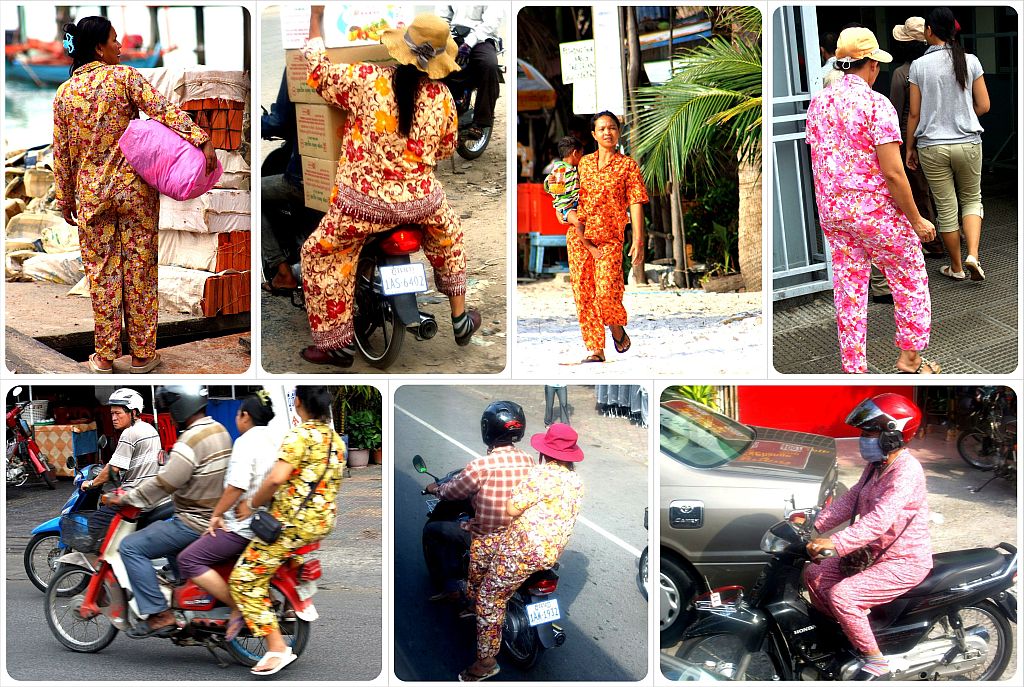
  • Something I love about Cambodia is the style where women where brightly-colored, fully-matching button-down pajama outfits while out and about in the steamy days. Some of them have penguins or flowers, depending I suppose on the person. They are always colorful and look nicely pressed when I see women in the pajama sets. Sometimes I’ve seen children in pajamas, as well, running around and hopping into motorbikes in superhero patterns. My hypothesis is that pajamas are cool and airy enough for the hot tropical weather…and they do have a certain pleasant air to them. It is unsurprising they are colorful, as everyone had to wear black pajamas during the gruesome Khmer Rouge regime.
  • While we drove, we went by countless weddings on the sides of the road, under wedding tents with vibrant colors and upbeat bands playing. Considering the dreadful heat and dust in the dry season, I asked my driver why weddings seemed so popular right now. He explained that people would rather be hot at a wedding than soaked/flooded by the rainy season, so dry season is the only decent time to celebrate marriage.


Tuesday, January 19, 2016

Last Week in Bangkok

In my last week in Bangkok I had a pretty horrible day. I won’t get into the details of everything that went wrong, but I’ll tell you one of the long, drawn-out stories from the day. It wasn’t anything particularly telling about the city of Bangkok's character; instead, it was more about having a lot to do in a place where I was still not completely comfortable yet and not fluent in the language.

It started after a Thai language class, when I needed to go to the Cambodian Embassy to get an extended visa for my upcoming trip. My teacher had told the cab driver a specific address to smooth the communication and get me more easily to the embassy. About an hour or so of being stuck in the ever-stagnant traffic of Bangkok, we finally got to the address my teacher had supplied, which ended up being on the opposite side of town (one of the numbers was confused in the location, I think). Instead, my cab driver was trying to drop me off at a local hospital on a dirt road somewhere I didn’t know. Frustrated, I got the correct coordinates for the driver and, both aggravated, drove through traffic for another 45 minutes to get to the embassy. 

Of course the embassy was closed by the time I got there. (Don't worry, I got there the next day and everything was settled.)

If you know me in person, you probably know that I am not someone who hides my emotions well when feeling things. Steam was coming out of my ears and I was thinking about getting a little cry out while on the streets of Bangkok in front of the Cambodian Embassy. Sweetly, the motorcycle drivers around me rushed over to try to help me feel better; some offered cigarettes, one gave me his seat, and others offered to get me some water. I finally realized I just wanted to be back at Lorena’s place and sulk for the rest of the day, and asked for one of the drivers to ride me home.

Something about Bangkok to know – motorcycle guys have zoned areas when it comes to their business. In some organized way, motorcycle taxis are permitted to work within a certain area, and understand to not go beyond those areas. My place was easily a 30-minute car ride through Bangkok to get to from where I was at the moment, and very much so out of this area's zone by a lot. One guy agreed to take me, still, and took off his orange taxi shirt and agreed. He took a pretty big risk to bring me home, and for that I am grateful he was able to bring a weepy girl home.

The ride, however, was terrifying. He sped through the streets and cut into parking lots to help save time. He also got on the highway and rode 80km/h, weaving between the cars flying off of every bump. Though I had a helmet, I clung onto him for dear life. I thought to myself, this was possibly the stupidest thing I could have done in my life. I was sure I was going to fall off of the seat and meet my demise on the roads of Bangkok. Thankfully, I got home safely, though shaking.

I failed to mention that the driver also held the motorcycle handlebars with only one hand because he had tried to hold one of my desperately-clutching hands while he drove. I felt the dread a woman can feel when in need of help from a guy and know that they’re trying to make something more out of it. I couldn’t change the situation because I was praying to get home safely, but I told him to drop me off a bit further away from the apartment just in case, so he couldn't follow me. He got off of his bike and kissed my hand a bit too enthusiastically (and tried to kiss me while I was walking away), and confessed my beauty and his love for me (after a 30-minute bike ride I’m not sure how that was possible). He asked to call and kiss me multiple times as I slowly inched away towards the complex. Precipitously, that day at class I had asked how to say “I have a partner” in Thai ("mii fan") and I repeated it until he finally rode of disappointed. I tiredly and weepily ran into Lorena’s place, and felt so completely spent and dejected that poor Lorena came home with a bunch of sweet bananas for my sad (emotional) consumption all night.


But my time in Bangkok has ended for the time being, and I feel like it requires a final note before I move on. Overall, I like Bangkok quite a lot. Aside from the overbearing humidity and heat (that I got used to), and aside from the oppressive pollution, I could stay in Bangkok for a while. I feel like that is a place that, like NYC, takes years to understand without simply scraping the surface of commonly visited areas. I’m not sure I would feel alright with staying there for the long term because of some cultural differences, but Bangkok is cosmopolitan enough that I felt comfortable there. Also, the food really is fantastic. I look forward to seeing it again.

But I'm in Myanmar now, which is a different story.

Sunday, January 10, 2016

Lessons on Culture

I will be writing about my time with The Boyfriend soon, but as it is two weeks of a story I have to figure out how to tell, It is taking some time. For now, I need to tell people about my lessons in culture through the Thai language.

I have asked my Isan translator, Rose (we’ll name her Ajaan Rose now) to teach me some basic Thai while I’m around Bangkok for the next week. Happily, she has agreed and our classes started yesterday.

I am already frustrated with the Thai language, mainly because there are up to six different ways to say the same sound (they have short and long vowels, they have tonal differences, etc.), which means that there are five potential words that you can accidentally say in a sentence if you don’t say the right variation. Rose is patient with me as I protest and growl when I try to repeat her over and over again during our classes, but I know I will probably not get very far in this language for now with only a week and my inability to understand the tones.

It has been interesting to read her language book because often I am confused by the way the structure of the dialogue is presented to the student (a.k.a. me), or why people say certain things at certain times in the structure of the book. Rose is super smart and has taken time to answer each of my questions, and I feel my mind blow a little bit every time she gives me surprising information about the Thai culture.

Why do people respond to a question with “Hi” and not an answer? The answer: because it’s just a polite question to acknowledge someone in a brief greeting, and not needed answering.

Also, the wai is a particular piece of culture that most falang get wrong. The wai is when you press your hands together and bow to someone in greeting or gratitude. Falang do it for almost everyone that passes by us, which is very much unnecessary. It should happen, though, when a person is junior to their current company – either in status or age. The senior person should wait until the junior respects them with the wai, then give it back in return to be polite. You can also do it as a polite way to show respect to some acquaintances, but apparently my giving wai to the motorcycle guys that drive me around is unnecessary. I am still wrapping my head around how these social rules play out. If you did not pick it up, the culture relies on hierarchies and social status to a larger degree than I’m used to, and I find it fascinating. I also mess up regularly.

And, why does everyone have a nickname? The naming system here is interesting; everyone has a nickname that everyone uses to call them. I asked Rose (her nickname is Rose) why there was such a high prevalence of nicknames, and she explained to me the history of names in Thailand.
Until the early 1900s, Thai people were not required to have last names; historically they were not common. The nicknames were the original names, which were based on the parents’ favorite tree, flower, object, characteristic, etc. that was identified at birth. People had only these identifiers for most of Thai history.

Only when colonization became popular of neighboring regions did Thailand pass a law requiring surnames, in a strategy to deter colonization from western countries who presumably saw surname-holding societies as “civilized”. The surnames were created by talking to monks and consulting astrology rules to determine the best combination of syllables and sounds. Around this time (I think), Thai people decided, why not create official first names as well (you know, the names that are complicated to read/pronounce for westerners)! These first names have been normally based on the astrological details of the person, to kind of sound nice and official. But the original, and first, name of people here are what we call their nicknames.


I look forward to learning more things about this very complex place while botching every word I learn.

Monday, December 14, 2015

Learning in Isan

After Bangkok, my classmates and I took planes to the Northeast region of Thailand – Isan – in a city called Ubon Ratchathani. There, we loaded up some buses and drove off to a rural village (Baan Kor Tai); there we would live for 1.5 weeks.

An hour out of town, we began driving into dustier and sleepier communities before we finally slowed down and parked in our one-street village. We unloaded and got divided into our homestays throughout the small community of 150 houses.

The first word I can think of to describe the village is rustic. The dirt path led us to houses on stilts, slatted with wooden planks for walls. Some houses were made of concrete bricks, but where I stayed was more of the wooden type with open walls serving as ventilation and windows. Our kitchen consisted of a small charcoal stove, and our bathroom had a scoop bowl in a water storage basin we used for everything next to the squat toilet we patiently used without toilet paper. (As a side note, I’m currently nursing a wound from slipping off of that squat toilet and ripping my skin open on the brick wall. Leave it to me to get injured by a toilet!) We walked through mud and dirt and other natural litter on the ground, in flip flops. Some of our walks were impressively long and dusty. By the end of our visit, my feet were caked in dirt and my nail polish had gone from bright pink to dark brown.

The second word I can think of to describe the village is delicious. Each of our maes (“mother”) knew how to cook us a feast three times a day, and each time we were stuffed to the gills with treats I cannot figure out how to make nor describe. While the food was often eclectic for our mostly-Western taste buds – cricket soup, grilled fish chips, stuffed frogs – our class complained about gaining a lot of weight from the trip because the food was so amazingly tasty. I really enjoyed each and every meal we shared with our family, and I still think about this egg dish our mae made (“Son-in-law eggs”) because it might have changed a little part of my personality for the better. There was a lot of sugar in our foods, too….but…it was so good!

The third word I can think of for the village was wonderful. The community members were some of the warmest most genuine people I’ve ever met. Our mae was a quiet woman, but happily answered any wild questions my roommate (Kenyan Jackie) and I could think of. She was concerned about me when I got heat exhaustion from the 90F+ tempeatures, and laughed when I would try to (mis)pronounce words to her in the local dialect. She was so sweet with me, even though she couldn’t completely talk with me. Also, the other community members always smiled at our class members, and fully laughed with us, even when we barely did anything interesting. They welcomed us into their homes, they shared what little they had, and always made sure we were comfortable. I now consider the village a place I wouldn’t mind visiting in the future, just to see the people again.

Our class was an intensive learning course; we woke up early every day and started our learning process by 8:30am at the latest, and ended around 6pm as the sun set. We went on epic walks under the harsh sunlight, and visited rice fields to learn about the way of the farmers in the community. We rested on boats along the Mun River (situated in the village) and talked to fishermen about fishing and how it is impacted by the development of dams (specifically, the controversial Pak Mun Dam). We interviewed Buddhist monks about Buddhism and visited forest temples. We chatted to women about the roles of village women and menstrual hygiene. We observed children singing at school to impress the falang ("foreigners") observing them.

I personally got to experience the care of health volunteers in the village – essentially basic healthcare workers who help with basic community health before a hospital is needed – to make sure I didn’t need medical help for my body’s poor response to extreme temperatures. Most days were steaming hot, and we all felt it to some level. I think I reacted very poorly to it – I guzzled water and got intense headaches from the heat. I also had blood pressure problems because of the incredible heat (I’m fine now, don’t worry). But it didn’t lessen from the rich experience we were getting in the village.

How did we talk to the villagers, if we didn’t speak Thai/Isan/Lao? Our teacher from the local university, Ajan Kanokwan, and a handful of translators who came and lived with us to translate each and every sentence said while in that village. I cannot imagine how hard it must be to go between three languages like they had to for us to get points across. My translator was Rose – a spunky yet patient lady doing her PhD on prostitution in the Ubon area. I admire her because while we got to take breaks in conversation because of the gap of language, she was going between our mae and us constantly, explaining and translating stuff for everyone every waking hour. She was also a great teacher, as I am an insatiable student and insisted on learning some of the local language while I was around her. I pointed to everything and asked for its local name, repeating words like a toddler learning how to talk. She graciously humored my interests in language, and we would have deep, rewarding conversations about life and cultural differences when she wasn’t busy exchanging words to our mae for us. She’s great – I wish you could meet her.

The other translators were fantastic, too! Rose had to sleep next to me and listen to me get up for the toilet ever night, and she deserves special appreciation having to put up with me nonstop for so long. Gai, one of the other translators, was like the class cheerleader – he would pep us all up before an interview and lecture, easily making the flow of conversation seamless. Tuan, also, was patiently listening to everything said and filled in the crucial gaps that would happen in others’ translations. Ploi was putting together our interviews behind the scenes, and taking pictures for our memories. Seth was the comedy relief who would also explain to us how to ask culturally-appropriate questions, and Ing was the sweet yet sassy companion that helped us get a hold of children for interviewing. Our translators, for the whole class, were a perfect group of people, and I am so glad they chose to help us and put their lives on hold to give us communication.

If you’re curious, we were doing interviews partly for a general assignment we have on how the community develops in several ways, and how water plays a part in that development. We also were interviewing for a presentation on a specific topic we had to put together before leaving the area. My team’s topic was on community hygiene, and I was impressed by how much material we got out of the community in such a short time span. I never would have thought that trash management would be such a crucial part of domestic hygiene for the village, but everyone mentioned that before they got trash bins, flies were everywhere and people got sick a lot faster. We also talked about water hygiene, food hygiene (they clean their vegetables), and handwashing (the older guys are not good at it).

We had a day off somewhere in the middle, too. Well, by day off I mean we got out of town and went site-seeing all day long. We went to where the Mun River meets the Mekong by the border of Laos (Khon Chiam?), and saw that the convergence of the rivers looks like two different colors mixing together. We went to Pha Taem National Park and hiked under the sweltering sun to see some ancient cave paintings on the walls, and beautiful views of the hillside. We visited the 3000 Holes, where rapids during the dry season are climb-able. We ended the day with eating on the water some traditional meals (Larb, fish soup, sticky rice, omelets…). The day, sadly, was too hot, and we paid for our outside excursions the next day with more heat-related stomach aches and headaches.

Our last day came as a surprise to us. We were all wondering if we’d make it through the week in simple living, but when the day arrived, we felt like it was too short of a visit. The village had prepared a Buddhist ceremony for us – phuk siao. The ceremony was a way to bind our souls to the villagers’ souls, and keep us connected spiritually. In some ways, it was also a way to tie us souls to our Thai “homes”. It was a beautiful and humble ceremony, with an altar and singing, and the tying of strings on our wrists while village members individually gave each of my classmates and I unique blessings. The whole ceremony was moving, and I wept quietly through most of it (I was not alone in the crying though!). For me, I hadn’t realize how much of my heart I had given to the people in the village until they performed that ceremony, and I felt a bit heartbroken that I was leaving them. I haven’t taken off the strings yet.

After our village experience, we stayed in Ubon for a few days and ate lots of food at the town’s night market, got massages while local women howled with laughter when we tried to say some things in Isan to them, and relished drinks on the Mun River before we left the area. I personally felt a lot of loss, since it was the beginning of my solo journey throughout Southeast Asia, and I won’t see my classmates that I love like family for months.


But now I’m in Laos with other journeys to share later.

Wednesday, October 28, 2015

The Accent That Never Was

I've been in Australia for a bit under nine months. Normally, when I live abroad, it takes a couple months (three or four) before I can start picking up how to speak like a local. In London, after a while I could confuse locals with my British lilt and pronunciation of "schedule". In Paris, I learned how to say certain words quickly with a Parisian accent, so as to avoid head spins in local shops.

By now I had expected to be speaking with a curly Outback drawl and abandoning the hard "r" and use of the word "afternoon" (Aussies read this as "arvo").

This time, though, I can't for the life of me get the accent.

While I hang out with locals and practice the accent (by obnoxiously repeating everything they say under my breath), I sound like an American doing a horrible job at a British accent. Sometimes, I start channeling several different types of Aussie accents with snippets of words in my otherwise very General American Accent.

What is frustrating about not acing the accent is that whenever I'm in public interacting with strangers, it becomes obvious I'm not from here. This means that, more often than not, the Aussie talking with me will pause somewhere in the exchange (whether it's ordering a smoothie, attending a yoga class, or networking) and ask me, "So, what are you here for exactly? Are you from Canada or USA?"

With an infuriatingly perfect Aussie accent!

On a side note: It is seen as polite to always ask Canada before considering a US passport, because Canadians can get sorely offended to be asked if they're American.

This exchange always takes some wind of of my sails because it reminds me of my temporary status. It also reminds me of my incredible failure at assimilating through adjusting my accent, something at which I'm normally so good.

And yet all Aussies I've met have nailed an American accent effortlessly, which only adds to my fury. They attribute it to Hollywood. I'm still not pleased.

For one thing, American voices are just plain loud, so compared to the more breathy accents of Australians, my voice nicely echos off of the buildings in the nearby suburb. We audibly stick out, and sometimes that is not what I'm going for.

Another thing is, I don't think my brain has been able to completely discern between the soft, mumbled accent of a Queenslander (where I am studying) to the more harsh twangs of a Victorian or New South Wales person. And bogan accents (aka hicks) are the ones I understand the best because of my watching of Kath & Kim when I was sick a few months ago. The accents here by region are subtle, yet noticeable after living here a while, and I still don't fully understand how to tease each separate type apart from the others.

I just saw an article come out about how the Aussie accent(s) first came to be. It says that it could stem from the early settlers being avid imbibers of alcohol, and their British accents got drawled out and warped by their drunkenness. I admit, this makes me feel better, as I reason that my decent British accent has not been able to develop into the complicated Australian one because I am not one who enjoys the spiked beverage very often, and therefore have little understanding of how to shift the "r" sound from regal to rough.

Maybe I will never be able to accomplish the Australian drawl. For now, I keep my conversations brief and end with a "Ta!" (which means "thanks"), mumbling as much as I can when asked for my order before running away.

The Australian accent is really difficult.

Sunday, March 29, 2015

On Language

A note about yesterday's fun: Some of us from class held a picnic at school by the campus' bucolic lakes so we could go to the university's Earth Hour celebration later in the evening. We were looking forward to see some good music while stargazing when the lights and electrical devices would be turned off for an hour. Welp, our experience was not quite what we had in mind, as UQ decided to not participate in the hour and left the school fully lit all night. That also meant that few people felt inclined to turn off their mobiles, and you could see people texting and shooting pictures when Earth Hour should have happened. And we heard one-too-many aspiring Bob Dylan's, as most of the music was performed by undergrads playing hippie-influenced acoustic songs about sadness and other profound topics (I'm not hating on hippie culture, it just is not my music of choice). There were also a few petitions making circuits on the lawn, hoping to sway massive corporations to change their ways with the signatures of a handful of students. So my people left early, mildly confused from the experience.

Photosynthesis Drew brought up the good point that UQ probably could not participate because the campus hosts a heaping ton of fragile lab experiments with refrigeration and lighting that mustn't be disrupted for academic studies. Still, it was frustrating to see these young students unable to unplug their phones for even an hour, even if they were discouraged from the university's decision. We did not even bother turning off our phones, because there didn't seem to be a point, and we left shortly after the hour started.

Now, back to language. Or rather, languages.

It is going to be pretty amusing when I come back from Australia having learned to speak fluent Spanish during my studies. I believe this will happen for two reasons. Firstly, there is a good amount of Latinos in my program, and I get to hear them speak with each other in Spanish between class sessions. Secondly, my roommates come from Ecuador and Peru, and they are in a constant stream of conversations en espanol, and they encourage my meager efforts to participate with the Spanglish I have in my brain. Living in NYC has prepared me for this experience, with Spanish signs plastered in all of the subways, and I feel I am up for the challenge. But still, it's not at all what I had anticipated for my living abroad experience Down Under.

As for the Aussie version of English, I am facing small snags with my integration of language and dialect. There are words they use in different ways than us in the US, and it's sent me into some pretty amusing arguments about which is the correct word to use for the context.

Some fun examples:

  • Squash vs. Pumpkin - We got in a long debate over the picnic about this because I brought some spaghetti squash to share (They did not know what spaghetti squash even was! I bought it at the market yesterday, so I know it exists here, but they were awestruck by my dish.). When I announced the dish and its ingredients, they asked what I meant exactly by a squash. It seems that Aussies use the word "pumpkin" for all squash. To them, squash isn't really a word except for one or two specific kinds of squash (which I believe are also called zucchini in the US). The orange pumpkin we love and carve/bake in autumn in the US is probably a species they don't know here, which is pretty depressing. But how on earth is a spaghetti squash supposed to be called a spaghetti pumpkin?! That just seems ludicrous. Butternut squash I can see might get away with the word "pumpkin" in its name, and maybe even acorn squash. But spaghetti squash?! Never. Denver Meg and I battled it out with Kylie, Chris, and Drew for a long while, and we left it moot.
  • School vs. University - Okay, I'll let them have this one. University, though an education and schooling facility, is a better way to indicate what level of "school" you're in. But it's a hard habit to kill.
  • Casserole vs. Stew - When discussing cultural dishes, I've told many people about how in the Midwest we are all about the casseroles. I've gotten a lot of tilted heads when I mention this, and I recently found out it's because Aussies use the word casseroles for stew-like concoctions. It makes sense now why people seem flabbergasted that I'd bake a casserole in the over, but I'm not sure why a stew would be called that. I mean, a casserole just *sounds* like something that wants to sit in an oven for a while and roll around in a baking dish. I feel like I should educate these poor souls sometimes in the obsession of the Americans that is a big, creamy casserole.
  • Lightbulb vs. Globe - Imagine my disappointment when I was first walking through aisles in grocery stores here and did not find big world globes happily sitting on shelves, waiting for my amusement. I get it, it's shaped like a globe, but they are not globes. They are bulbs of light! I was devastated that my desires to spin a globe in a supermarket would remain unaccomplished.
  • Gas vs. Petrol - Another one I have to give to them. Gas, while a simple monosyllabic word for all to enjoy, means other things in science that can make it a bit confusing. We put petrol in our cars, because it's petroleum. I can stand behind that one.

Also, Aussies love to abbreviate stuff. I know I've mentioned this before, but it is worth repeating as it's starting to become like a new language in my head. I was listening to the radio a few days ago and realized I didn't understand half of what was going on because every word in the sentence was amputated at the end and had an "o" or an "ie" glued onto the stump. My favorite example is how afternoon somehow magically became arvo, which still flustered me as there is no "r" or "v" in "afternoon" and I'm not sure what inspired that.

Sometimes I wonder why they even bothered to commit word massacres - a lot of the words that are chopped up remain the same number of syllables, just with a different endings. Like bikkies (biscuits, aka cookies). And Brissy (for Brisbane). And brekky (breakfast). I've heard an incredible amount of words that are no longer their originals, though, especially when I was listening to the radio. It seems like they are tired of the ever-so-common English and just want to make their own language. If they were going for efficient slang, though, they have not succeeded.

Saturday, February 21, 2015

Moving in Rain

I’m alive! It’s a miracle, I’m alive!

Alright, maybe it isn't quite a miracle. None of my fears came to being.

Cyclone Marcia pleasantly disappointed us here in Brisbane. She came to the northeast of Queensland at a level 5 (with fire and brimstone), but quickly realized she was well beyond her league once she touched down, and scaled her power back to more of a level 3 or 2. What that means for us here in good old “brisy” is that she has graced us with a weekend-full of torrential rain, mild flooding, and cancelled plans. Simple, obnoxious rain.

That doesn't mean I didn't freak out yesterday morning. I encouraged my host to take me to Coles Supermarket to hastily get some canned food, in case Marcia got angry somewhere on her journey down the coast. With fear in our eyes, we paced the aisles looking for water jugs and easy-to-open canned tuna. Strangely, though, we seemed to be the only ones panic buying for a storm and not on a normal Friday stroll through the stores. There was a calm among our fellow patrons.

Once back, I watched the news and followed the storm coverage. That, too, was surprisingly peaceful, considering the storm level people were anticipating. The media were concerned, but it kind of sounded like everyone – even the locals further north – were saying in chorus, “We've got this.” This took me by surprise; I feel like when us NYC folks (and Americans in general) hear about a large storm headed their way, we go all out. Supermarkets are emptied. Media is frantic. Officials bite their nails. Crisis mode! High alert! We all, in some sense, become Doomsday Preppers.

And yet here, during what seemed to be during a pretty unusual storm cell, everyone kind of shrugged and said, “It’s a bit wet then, yeh?” I kind of like that. Everyone knew what was coming, and weren't fazed by the unknown too much. People reassured each other that this storm wouldn't be like the detrimental storm they encountered in 2011. Indeed, they judged this one pretty well.

The downside is that the big orientation my program was going to have this weekend at Stradbroke Island was canceled because of all of this rain. The island was going to be impossible to get to via ferry.

But hey! Yesterday I was able to move into my long-term apartment! During the storming and all. I’m so brave.

Not really, actually. It truly has not been that big of a deal.

Anyways, I hired a cab and brought all three of my bags to this gorgeous place I’ll be renting for the next while. It’s a newish, large apartment complex on the Brisbane River, and is really close to both UQ and CBD. There’s a pretty neat bar & cafe nearby, which I foresee my friends and I visiting during the school year. I’ve already used the complex gym, which is situated in a room outside right next to the pool. I’m just telling you because I’m bragging.

But really, I’m just glad to have settled in. There is something so relieving about moving into a place of your own. Once I got my goods into the apartment and unpacked my things, I realized I couldn't care less if Marcia would pass through with vengeance or not. So what if it floods downstairs and I’m stuck in my room for the weekend? I have a long-term room! I relished an evening getting acquainted with my new roommate and my cozy, fancy room.

That said, the rain is still obnoxious.

Today I had to go out to get some more things for my room, like a mattress pad and internet. (Internet here, if you’re wondering, can come as a USB modem – it chills out in your laptop and asks you when you want to connect to the rest of the world.) The rain didn't care about my errands, though. It made large, healthy puddles on my walk to the bus - for both me and the cars. On the sidewalks, I just happily trotted through the puddles with my unfashionable Crocs (I’m so glad I bought these atrocious things). For the cars…well…I had a Bridget Jones moment a number of times. Rather, I had walls of water poured over my foolish, squealing self whenever a car passed me. It happened maybe seven times before I wised up and made a large detour to a less popular road. I decided that, while being soaking wet wasn't so horrible, I didn't want to put myself through more showers on my way to get expensive technology. I chose the safer way – the train – and went to a different and dryer part of Brisbane for my errands.

My errand going confirmed for me that it’s definitely back-to-school time here. As I combed Kmart for some affordable kitchen and housewares today, I noticed I was surrounded by excited teenagers and their stressed out parents. Buying the same stuff that I was buying in the same stores. Because I’m also a student. Oh my goodness, I’m a student again.


Another side note: abbreviations. Aussies absolutely loveabbreviations. Brisbane turns to brisy. Afternoon turns to arvo (no clue how they came up with that one). Want to watch a bit of footy (football) this arvo (afternoon) in brisy (Brisbane)? Maybe eat a bikie (bisquit) and sip a coldie (cold beer) while you’re at it? On ya (Good on you)! I just made that whole scenario up, but the slang is very much real. It makes listening to Aussies a bit challenging at times because sometimes the abbreviation is far away from what I think they mean. Economic, yes. Understandable, not always.