Showing posts with label thoughts. Show all posts

Tuesday, March 10, 2026

Celebrating My 40th in Greece


Let me set the stage first: we are not peak-season travelers. The thought of waiting in a two-hour line at the Acropolis while being elbowed by a selfie stick is not something I enjoy. So when we decided Greece would be the destination for my 40th birthday, we went in January. No crowds, some closed restaurants, intermittent rain, and—as it turns out—more feral cats wanting cuddles than I have ever encountered in my life. I am allergic to cats. This becomes relevant.

We started with a brief layover in Munich, which I want to flag because I was genuinely surprised by how much the city's administrative center looks... Soviet? The blocky, imposing architecture caught me off guard. I should have known better (I did not know better). 

What I did know better was to eat at Augustiner, a traditional German pub that's been around forever, where I had the best vegan sausage of my entire life. I also had a vegan curry that was so good I'm still thinking about it. Munich: would recommend for the sausage alone.

CRETE

Here is why I chose Crete as our first stop: it has a 6,000-year-old toilet at Knossos Palace, home of the ancient Minoan civilization, and I wanted to see it.

I did not see it. It was closed for preservation purposes. But, I understand. If I had a 6,000-year-old toilet, I'd want to protect it too. That is a reasonable and correct decision by the archeological preservation community. It was still a big bummer.

What we did get to see at Knossos was genuinely spectacular. The Minoans were building sophisticated structures and drainage systems millennia ago, and walking through the ruins—even partially reconstructed after centuries of earthquake and fire damage—made me stop and think about just how long humans have been trying to figure out how to live well. The frescoes on the walls were beautiful in a way that made me wonder why we stopped doing that. My walls have paint and a few framed things. The Minoans had elaborate, colorful painted murals that came out at you in a kind of 3D effect. Are we regressing?

The next day at the Museum of Heraklion cemented this opinion. The Minoan pottery alone—including one piece with a gloriously chaotic squiggly octopus on it—was more impressive to Alex and me than the later Hellenistic Greek work. I know that's maybe a controversial take. I stand by it.

We also toured an olive and dragon fruit farm, which but was actually one of my favorite parts of Crete. It was just us, wandering through ancient olive orchards with a sweeping view of the island, learning about sustainable farming practices amid water limitations, and how Crete is one of the world's main olive producers! We brought home olive oil and dragon fruit jam. 

Food in Crete was quiet—it being off-season meant a lot of restaurants were closed, and we had a few nights of hunting around in the near-dark for somewhere to eat. We found a good spot by the pier in Heraklion that hit the spot. The food didn't blow us away overall, but Crete won on vibes. It felt like Puerto Rico: a little chaotic, island energy, deeply beautiful.

MILOS

Milos is a small island in the Cyclades, and we were almost certainly the only tourists there. We stayed in a fisherman's house right on the water. It was picturesque and rainy and covered in cats.

The cats of Milos do not care about your allergies. They are grieving the loss of the tourist season, and they are looking for affection wherever they can find it. Multiple times, Alex had to gently but firmly remove a cat from my person before I started sneezing. One cat found us in the airport while we were waiting for our flight out and immediately started making biscuits on my lap. Greece is simply a country that has decided cats are everyone's problem now.

Despite the cat situation, Milos was wonderful. We had one full day where a water surge warning kept us inside—the water levels around our house were expected to get dangerously high, so we were essentially storm-locked—and we read, napped, and ate groceries we'd walked up a long hill to buy the day before. It was deeply restorative. I didn't realize how much I needed a full day of doing nothing until I had it.

When the rain calmed, we tried to visit the Byzantine-era catacombs on the island, only to find them closed. (A theme emerged on this trip.) However—and this is one of those travel moments you can't plan for—the person who managed the site happened to walk by while we were standing there processing our disappointment. They let us in anyway. It was just us three wandering quietly through these ancient burial chambers, taking in the carved walls in near-silence. Absolutely worth the wet walk uphill.

We also hiked up to see the ruins of an old amphitheater and the hillside where Venus de Milo was originally found. It was a bit treacherous—soggy and steep—and I was genuinely concerned about both of us sliding down at some point. We did not slide down.

ATHENS

We flew from Milos to Athens on my actual birthday. I turned 40. Athens greeted me, reminding me very much of San Francisco: hilly, dense, hard to park in, full of scrappy energy and beautiful chaos. We drove around trying to find parking for what felt like a significant portion of my birthday. We found it.

My bff Marion joined us that night, and we went out for a spectacular birthday dinner. Too much food. Plates that were too big. Every bite is perfect. That is exactly how a 40th birthday dinner should go.

The next morning, we took a mythology tour of Athens, which started with a climb to the Acropolis to see the Parthenon. Every friend who'd been to Greece warned me about the tourist crowds at the Acropolis. Reader, we did not wait in a single line. January in Greece is something else. We walked right up that hill—and as San Franciscans, we did it without complaint while watching the rest of the tour group struggle—and stood in front of columns that have been standing for thousands of years.

It was a genuinely spiritual experience. The views of Athens from the top are sprawling. You can see the port from up there. Alex, who has spent years reading about ancient Greece, got quietly emotional about finally being there, which I found very moving to watch.

Worth noting: the carvings and reliefs you see on the Parthenon are replicas. All the original artwork has been moved to museums for preservation. So anything you see in situ is an exact copy. I found this both a little deflating and also completely correct from a preservation standpoint. A recurring theme.

After the Acropolis, the tour ended at the Athenian Agora, an old Greek market-turned-public park that I could have stayed in for hours. On our walk afterward, we stumbled into a tiny, ancient Byzantine church sitting improbably in the middle of a city square—just plopped there, quietly protected, surrounded by the modern city. We walked in. The interior was covered floor-to-ceiling in colorful artwork. I loved it.

I also found a figurine in the flea market that has nothing to do with Greece, but it made me very happy.

Our tour guide rolled her eyes when we asked about Patisserie Artemis and their baklava gelato. She called it a tourist trap. I went anyway, because I am a person who makes her own mistakes. Friends - it was not a tourist trap. It was just us alone in a quiet patisserie, eating the most satisfying combination of flaky, creamy, crunchy things I've had in recent memory. I brought some back for Marion. I would go back to Athens specifically for this ice cream, and I am not embarrassed about that.

The Acropolis Museum was one of the highlights of the whole trip. Underneath the building are the ruins of a second-century BC community—visible through glass floors throughout the museum—and I found that more compelling than almost anything upstairs. (The pipes! The infrastructure! I cannot help myself.) The museum itself is airy and impressively curated, and they had an exhibit showing the original color of the marble sculptures. Turns out, ancient Greek statues were brightly painted—vivid colors, not the white marble we associate with classical antiquity. Seeing reconstructions of how they actually looked was a genuine revelation.

We also took a marble-carving workshop with an old craftsman who barely spoke English and, for the first part of the session, seemed mostly to be messing with our heads through cryptic commentary on creativity. I was suspicious. But then he handed each of us a three-pound slab of marble and told us to carve something. Carving marble is hard. Alex took to it surprisingly well. I was overambitious. Marion, who insisted she wasn't creative, made something beautiful. Two hours of feeling connected to thousands of years of craft.

DELPHI

For our final adventure, Alex and I drove out to Delphi for the Temple of Apollo. On the way, we stopped in a small, nearly empty roadside coffee shop where the owner had an enormous painting of San Francisco's Painted Ladies on his wall. We took it as a sign.

I had absolutely no idea there was skiing in Greece. And yet: near Delphi, there is a mountain ski resort town where, apparently, all of Greece had gathered. We'd expected to be alone again. We were not alone. The town was full of alpine energy, meats and cheeses, and a notable absence of the salads and oils that had been the backbone of our diet everywhere else. The mountain views were breathtaking.

The next morning, we visited Delphi itself—empty, as expected—including the archeological museum (griffin statues, very well preserved, highly recommend) and the walk up to the Temple of Apollo. In the rain and snow. The stadium at the top is closed due to the weather. Still absolutely worth it. Jagged columns reaching into a cloudy sky, cliffs all around, no crowds. It was the right way to end the trip.

One more observation about Greece: the street dogs. They are everywhere, clearly being fed by their communities, and extremely good at demanding affection. At one point, a dog caused an actual traffic jam by sitting in the road to be petted by tourists on a passing bus. Alex and I spent the entire drive back to Athens joking about which dogs we would steal and bring home. We did not steal any dogs. We thought about it.

The Verdict

Greece in January is good. We ate incredible things (the dolmas! the salads! the lukumades! the baklava ice cream!), saw thousands of years of history with almost no one else around, got into closed catacombs through sheer luck, carved marble, got sneezed on by cats, and I turned 40 in a city that's been doing this whole civilization thing for a very, very long time.

Both Alex and I came home genuinely recharged. I was ready to go back to work. That almost never happens.

We'd go back to Milos, to more of the Cyclades, maybe to Athens when it's warm and alive. And I would absolutely go back to Knossos to try again for that toilet. They can't close it forever.

Monday, January 01, 2024

Rwanda Redux


This will be brief, but I feel like logging it somewhere.

I went to Kigali for the first time in over a decade since I moved there in 2012. I went to a conference, which was fine.

I was shocked by how much Kigali had changed, yet not at all. When I lived there, the roads were nice and clean - and that's still the same. But so much of the city had been built up since I was there! There were stores and restaurants everywhere - I remember struggling to decide between 4 restaurants back in the day. There were more commercial buildings, flash, and everything you'd expect in a Southeast Asian country - which obviously Rwanda is not. But you can tell it's working on the economic side of things. 

There are also many fancy hotels—a Marriott, a Radisson Bleu, and a Sheraton. In the past, there were guest houses and the once-upscale Serena Hotel (now seen as old and tired). The conference center is small but effective, whereas there used to be none.

On my last day, I went to Nyamirambo for a food tour. There wasn't much there, except for a bus stop where I lived. Now, it's like a downtown area hopping with businesses and restaurants. I was walking down streets that used to be trees or empty spaces. There's even a car-free street with street art and open-air cafes. The food was fine, though I never considered Rwanda a culinary haven.

And yet, the things I frequented when I lived there were also there - the Chinese restaurant, the Japanese restaurant....all of them. It was like the city plunked around its existing infrastructure, a bunch of new, shiny stuff that buttressed and competed with the older stuff.

While so much had changed, I could still see the trauma of the genocide seeping out of some of the shiny new structures. People were shy or nonverbal, and a lot of people who were working in the shops and such still stared at me like I either did something wrong or was super novel to them, though there were white people everywhere.

What surprised me most about Rwanda was how much I had changed since then. The things that used to bother me—the idiosyncracies of the road laws, the stares, the inability to get certain drinks or foods—didn't anymore. Several things that would have triggered me while living in Kigali only made me roll my eyes and sigh while smiling before moving on while I visited. 

I'm a much more seasoned traveler now, taking much more stuff in stride than I did back then. So much upset me when I lived in Rwanda, and I think, I didn't know better in many ways and hadn't yet developed acceptance or coping mechanisms to deal with the differences. 

So, while Rwanda has clearly changed and grown and become a more sophisticated destination, I have, too.

Sunday, December 19, 2021

Short Stay in South Korea

A few weeks ago, I ended up in South Korea to support a water conference. Yes, it was during the never-ending COVID pandemic. Let's walk through the process to get past immigration, and the week I was in the country.

With all of the COVID-related restrictions and requirements, getting into South Korea was....hard. The conference had managed to file for attendees to have guarantee exemption waivers, which was where most efforts went. I filled out tons of forms (multiple times). I had to rearrange my schedule for the trip to make sure I was compliant with the quarantine rules since I was only allowed to stay up to 2 days before and after the conference. Major bummer. Had we not had the quarantine exemption forms, I could have stayed much longer....but I would have had to be quarantined in a government-run COVID hotel for about 2 weeks (that I'd have to pay for) before the conference. Which wasn't really an option for me. I still had to isolate for a day with the quarantine exemption to make sure I wasn't sick. I only got this form a week before the trip, though, so I hadn't planned much for the trip.

On the plane, I was oddly surprised to see that the Korean Air plane had to make a large detour around the borders of North Korea. I wasn't surprised that it happened - I am well aware of the tensions between these countries - but I was surprised just how real the tensions were. We had to add another hour of flying to ensure we didn't bother anyone up north.

Once we landed in Incheon Airport, there was a 3-hour process of waiting in lines and going through several immigration checks (I think I counted 5?) to ensure our COVID paperwork was in order and our regular immigration forms. Those who weren't quarantine exempt were shepherded to a blocked-off area to wait for the quarantine bus. Luckily, I was allowed to continue my travels. Unfortunately, I wasn't done traveling to get to my destination.

I had to take a 90-minute subway ride to Seoul Station from the airport, where I would grab a 2-hour KTX train. The conference was in Daegu, a large southern town coined as the country's water hub. I grabbed a gimbap surprisingly loaded with wasabi and got on the night train south. After the train ride to Daegu, I immediately got my PCR test that would confirm my quarantine exemption in 24 hours and shuttled off to my hotel. To wait.

I like to stay in hotels that are not big traditional chains like Marriott and Hilton because I feel like I lose some of the experience of immersing into a culture. I had chosen to stay downtown at the Toyoko Inn. It felt like a hotel geared towards Koreans, which I enjoyed experiencing. It wasn't super fancy, but I wasn't looking for that - I just wanted a bed and a toilet. The hotel had an electric bidet seat (to my delight!), and breakfast was a bunch of Korean items like kimchi, seaweed soup, and rice. People wore the hotel's slippers in the lobby and canteen area (I also observed a lot of slipper wearing on the plane). They also had a lobby locker that offered hotel-owned pajamas, though I didn't use them.

Once I got the PCR all-clear, I went out on my second night to walk around downtown Daegu. Daegu has about 2.5 million people, so downtown was full of people shopping in stores and walking the chilly winter streets. Daegu is a traditional herbal medicine center, and I walked around the city and saw a mix of flashy shops and humbler herbal stores. 

While I was walking around, I stupidly realized how much Korean script would be everywhere, which meant I really had little idea where I was, what I was doing, or what urgent instructional signs wanted me to do. The Koreans with whom I interacted mostly struggled with English (fair enough, I was in their country, after all), which often meant I was on my own to figure out if (and pray that) I was complying with rules and customs.

I was cloistered off at their large conference venue for much of my time in Daegu, supporting the conference. Frankly, the conference was kind of sucky for many reasons I don't want to get into. I questioned why I was in Korea a lot during the conference. What I will share from the conference I'll share was their struggles with food. On the first day, they had forgotten to provide vegetarian lunches - a lot of us international people were vegetarian, so this became a problem. My food restrictions are medical, though (I'm intolerant to land meat now). When they found out mine wasn't a choice, the conference team began to panic to figure out how to feed me. Coming up mostly short for over an hour, they came back to me with a bowl of canned tuna on rice. They also gifted me a surprisingly heavy brass goblet to apologize for the flub, which they explained was a traditional point of pride for Koreans. So now I have a brass goblet.

I ended up hanging out with many Africans during the conference - most of them are studying in Korea for their PhDs, so they were used to the seemingly confusing and complicated systems and protocols. I had mentioned my surprise with how confusing things felt in Korea. One Tanzanian guy (who wasn't studying in Korea) lamented that he felt he was basically dumped in the country and left to figure it all out. The students acknowledged that, sadly, that is a Korean feature - there seems to be some unspoken assumption that everyone will just figure out how to get by in Korea, alone. Much of the conference's downtime included comparing notes about what worked, what didn't work, and what not to do from our experiences. I suspect this could be cultural, which means Koreans also have to learn to fend for themselves. This could explain why Korea has one of the highest suicide rates in the OECD nations, since young people may be left to their own devices and struggle.

I did get to escape the conference for a day to attend a Christmas Fair in the conference center. It was fun to walk around the stalls and see what kinds of things Koreans were buying for the holidays. They had bidet seats (yessss), dog outfits, gadgety toys, and lots of dried fish. My favorite find was an orange sweater that said "Montana - Pinot Noir". I don't associate those words together ever, but sure!

On the last day of the conference, we went on social tours of the region. I picked the temple food cooking class at Donghwasa Buddhist Temple. It was fun! The temple has been around for over 1500 years, and we got to see a very old Buddha carved into a rock wall. The place was very peaceful, and though there were more stairs to climb than we had expected, the location is surrounded by beautiful natural sights.

On the same day, I returned to Seoul and went to bed early at the hotel. I had things to do!

On my only free day in the country, I hired a car to drive me around. The first stop was Suwon, a 40-minute drive out of Seoul. As we drove to Suwon, I realized how densely packed the country is. I saw clusters of high-rise apartment campuses everywhere, especially outside the city. Korea is one of the most densely-populated countries globally, but I hadn't realized it meant that people even living in the suburbs had to live 30-40 floor complexes.

In Suwon, I visited the Mr. Toilet House (read the blog about that here). It was a really neat family museum about toilets, and I enjoyed walking around in a quiet area of the country before getting back into the thick of people. While I was in Suwon, I also visited the UNESCO heritage site that is the Suwon Hwaseong Fortress. Suwon was a big fortress in the 18th century, and the wall around the original city was huge. I enjoyed walking along the wall, seeing dogs playing around on the old steps, and peaking into old fortress huts with elaborate green-pink floral designs. I also visited the Temporary Palace for the king in Suwon, which was neat; instead of European fortresses all inside heavy stone walls, this palace was a bunch of modular wooden rooms connected by large outdoor walkways.

I returned to Seoul for the rest of the day after that. I did some shopping before walking through the old Bukcheon Hanok Village (a traditional Korean village pre-Japanese occupation) and visiting the Changdeokgung Palace during golden hour. The palace grounds were similar to the temporary palace I saw earlier in the day, but it was much grander (unsurprisingly). The shopping was ample; I had to remind myself that I didn’t have the luggage space, though Korea is a very affordable place and has ample handcrafted and beautiful things.

Before I left Korea the next afternoon, I also visited the Cheonggyecheon area, which is a revived stream that they made into an artistic walkway for people to enjoy. It was really beautiful - I highly recommend visiting it if it's not too cold near the water. I wish I had had more time (and energy) to see more before I left, but I feel like I got a good crash course in Korean culture and sightseeing before I left.

Some of my other general observations when walking around Daegu and Seoul:

  • MASKS: Everyone wears masks in public spaces, even when walking outside. Korea's mask mandate seemed pretty strict and likely enforced, and people dutifully wore their masks properly and without fuss. Honestly, it made me feel very safe while in the country, and I was happy to oblige with wearing a mask all day. 
  • MEAT: People gush about Korean food, and I can see that it probably is heaven for people who can eat meat. For me, the food was tasty and fine, but I wasn't super enthralled by everything I ate. Temple food is vegetarian, of course, but I found there weren't many temple food restaurants available during my visit. Those were booked up weeks in advance.
    For example, I went to one restaurant and requested several times to make a cheese bibimbap with "NO MEAT." They happily confirmed "no meat" on the dish I ordered. Once the hot pot came out, I saw a pile of ground beef on the top. When I asked them why they included meat when I said no meat, they said, "Oohhh we thought you meant no raw meat!" They held a bowl  for me while I scooped the meat off of the dish. 
  • FERMENTED: Most of what I noticed with the food I could eat was that the vegetables were mostly served pickled or fermented with chili pepper (hello, kimchi for every meal!). It makes sense, considering Korea has a history of sandy soil that isn't always the most nutrient-rich. I suspect the vegetables they do have they need to ensure are preserved - hence, fermentation. Still, I really missed fresh veggies by the end of the trip.
  • SENSORY OVERLOAD: When I walked around in the commercial areas, Korea felt overwhelming to my sense. The shopping areas were full of flashing lights from different storefronts. Different shops blasted music or audible welcomes on the streets, competing for sound space. This was compounded by the additional Christmas displays shining and singing everywhere. A lot of the big displays I saw around shopping areas contained cartoon teddy bears, too.
  • SUGAR: I also smelled sugary baked goods everywhere, which makes sense considering Korea may have one of the higher diabetes rates out there. Being a celiac, I couldn't try any of these sugary treats, but they smelled really decadent.
  • UNDERGROUND: I was surprised to see that, while there was a lot of shopping happening outside on the streets, a lot of the shopping was available underground in subway terminals. This ranged from bakeries to electronics shops, fashion shops, and bookstores. I like the idea, especially as the weather continued to get colder over the days of my visit.

Would I go back to Korea? I wouldn't mind it if there were other conferences there I needed to attend. However, I would rather see other places again before seeking out Korea.

Monday, May 11, 2020

Evacuating Kenya (Goodbye for Now)

Goodbye, friendly sidewalk home
I had never imagined that my departure would have come about the way it had - one month early, last-minute, and wearing a face mask. 

I had plans for April, the last month of my time in Kenya, too. I was going to Naivasha for a weekend to meet hippos. I was absolutely hell-bent on finding a dikdik in the Karura Forest. I was contemplating taking the train to Mombasa for another weekend. And I was planning to visit a colleague in Malawi for my final week on the continent. Instead, I didn't really get to say goodbye to any of the friends I had made in Nairobi and escaped the borders closing on me, which would have left me somewhat stranded during the COVID19 pandemic.

Two weeks before I had found out I was going home, I had started self-isolating, anyway. I had previously been in Uganda for a conference and had picked up some sniffles between Kampala and Nairobi, so I was playing it safe. Shortly after, the office decided to implement working from home practices and most of my colleagues started calling me while they, too, started to socially isolate. I had limited my travels to only the grocery store for those two weeks, save one trip to DHL to ship home things, as I had a sinking feeling that I may have to evacuate the country at any given moment and didn't want to leave anything behind.

Kenya at the time had only 7 confirmed cases of COVID19 (while NYC had about 9K, for comparison), and the country was acutely aware of its healthcare limitations and did not want to test the system. Kenya started canceling public events, shutting down schools, encouraging people to us M-PESA money over cash; and airlines started to slow down their services. Rumors were going around that the borders were going to close any minute, but they were just rumors. I had decided to stay put unless I had received some kind of ultimatum from the US or Kenya - I was better off in a warmer climate where my asthma wouldn't get triggered and I could relax on the lawn outside for hours. Not to mention that US was considered the global hot zone for COVID19. 

Sadly, three days after I made that decision, in late March the US government did, in fact, send out an ultimatum to US citizens overseas - either come home now or don't come home, and we're not going to help you get out. Shortly after, Kenya announced they were probably going to close the border soon, so Kenyan residents should probably get out of the country if they can. My decision was made for me.

The morning after, I made my way to the Kenya Airways office to change my departure to "as soon as possible". My Uber drove through traffic on a beautifully sunny day in Nairobi, and the country looked almost as if nothing was happening with the world. Cars were crowding the roads, people were walking around. My Uber driver had casually shared with me that Kenya would probably be fine from COVID19, because the virus wouldn't survive well in warm weather, so no one was particularly worried yet. I ended up hearing that a lot throughout that day as I frantically packed my bags and worked out my logistics, and I was worried that Kenyans didn't seem to be understanding the severity of the virus. To be fair, East Africans typically need to worry more about diseases like Ebola, which is endemic in that region and a very violent way to die. Still, it felt surreal watching the headlines of a world on fire while many Kenyans around me were living as if nothing dangerous was afoot.

I got to the crowded airline office and found out that "as soon as possible" was two days in the future since all of the other flights had been sold out overnight, and the only available seats were Business Class. I gulped down the steep airline fee to upgrade to Business Class and secured my spot on a now-sold-out plane back to NYC, taking off in a little over 48 hours. In those 48 hours, I paced and called Mr. CT Lawyer multiple times to frantically figure out how he'd pick me up at the airport and how we'd arrange me to live with him in quarantine for 2 weeks after I landed. I wasn't able to see any of my colleagues or friends - Kenya was starting to make it hard to meet up in groups, and I had begun to think that maybe I should steer clear of people anyway, so I spent time hanging out with my housemates when I wasn't in planning mode calling the US. I also started to find out that a lot of my other foreign colleagues were frantically packing up and going home, as well - to Canada, Australia, and the US. 

At least my friend who Uber drives in Nairobi (Calvin) agreed to drive me to the airport and see me out of the country. On the day of departure, he picked me up and drove me through the now-deserted city streets (which were full only 2 days prior). We got to the airport in record time, and I was there far too early for my flight, so he agreed to sit with me in an outdoor airport cafe for my final dawa (oh, how I miss those already) before takeoff. While we sat sipping dawas, Kenya announced the border closing would be in three days, and that the number of cases had more than doubled within 24 hours.

The airport was mostly empty, save for whoever was flying to JFK or Jo-burg that night. The airport was tense and silent; you could tell no one wanted to be near each other. Everyone was wearing a face mask, now, and we all looked around with wide eyes and anxiety, quietly hoping that the planes would get into the air and not have a surprise announcement from the arrival country that no more planes would be allowed in. It was a long wait inside the terminal.

I knew my airplane was sold out, but I hadn't realized just how crowded the waiting room would be. Everyone wore masks and darted glances at everyone near them, trying their best to inch away from whoever was nearby in hopes of feeling some kind of safety that wasn't going to come for another 15 hours. You could tell much of the plane's passengers had had no intention of leaving Kenya at any time before the ultimatum, too. Many of the people on the plane were families with infants who probably shouldn't fly 14-hour legs across the globe. Others wheeled around elderly parents who apparently did not want to stay around while the country figured things out. The elderly parents looked jarred - I wondered if some of them were being torn away from homes they had not wanted to leave, with pleading adult children who had secured dual passports for the family two decades earlier for a moment exactly like the one we were suddenly in.

Once we loaded into the airplane, we all pulled out packets of wet wipes and started vigorously cleaning our seats and surroundings. We shared wipes with others, but otherwise, no one wanted to interact, other than sharing bulging eyes, as if trying to convey the thought, "can you BELIEVE what we're going through, right now?!"

I found out soon after take-off how lucky I was to get a business class seat - the flight was much more bearable with anxiety because I could put my feet up and actually sleep. And the bathrooms were clean and big. On one bathroom visit, the stewardesses started to talk with me and shared that they were hoping that the US would ground all planes before they would have to return to Kenya. Apparently, while we were loading into the plane at the Nairobi airport, the Kenyan government had started to enact a new rule which meant that anyone landing in the airport from that moment on would be automatically shuttled to a forced hospital quarantine for 2 weeks....paid by the quarantined. They were hoping that they would, instead, be forced to shack up in a hotel in NYC and wait it out there while on the airline's watch. Unfortunately for them, that didn't happen.

I've never been so scared landing anywhere as I was when I landed into JFK that morning. We all left the airplane with masks on, expecting hours of testing lines and screenings before we could get out of the plane. Instead, we found ourselves walking from the airplane to the luggage belts in about 5 or 10 minutes, with only one stop for us to get quickly stamped by mask-less customs agents. The airport, other than our flight, felt completely abandoned. It only made me want to get out of the airport faster. My family picked me up shortly after to start my voluntary 2-week quarantine as the world blazed around me.

Thursday, December 19, 2019

An African Xmas Venting

I just need to get this off of my chest before it's too late.

In the office, I've heard some of my non-Kenyan colleagues complain that it just doesn't feel like Christmas here in Nairobi/Kenya. Even though the many malls here are decked out with fairy lights and Christmas trees and local school groups carol regularly in front of stores (very western, indeed), they just don't feel the holiday spirit. The only time that they say they felt the holidays were coming was when I recently baked sugar cookies.

I think I know why this is the case.

Even here in Kenya we listen to popular western holiday songs. With sleigh bells jingling in the background and words like "snow" sprinkled through all of the songs' lyrics. This can be really confusing to the mind while in Africa - even though I'm hearing snowy vocabulary being sung in songs, I'm surrounded by tropical plants on warm and sunny days. What's more - Kenya is extremely close to the equator, which means it doesn't boast the normal four seasons you find in the west. No snow, here. And for places south of the equator, its summertime right now anyway; case in point is Australia scorching in heat while the US is piled in layers and shivering.

Therefore, of course it wouldn't feel like the holidays to someone if they're relying on wintry music to fill their holiday playlist.

In response to this, I started looking for weather-neutral music (or even tropical music) that is Christmas focused for a new playlist. I've found a few songs that are neutral to weather for the holidays, like Wham's "Last Christmas" and John Lennon's "Happy Xmas (War is Over)". The only popular non-snowy song with a tropical twist (and was written by a band in a region outside of the west, sorry Tim Mitchen) I could find was (my mom's favorite) Boney M's song "Mary's Boy Child". It's a great example of something I can happily listen to in Kenya and start feeling festive. The only problem (for our African-situated and minded folks, here) is that they're a Caribbean band. I have struggled to find African holiday music.

I did go to a holiday festival last week that helped me somewhat scratch my itch for a tropical holiday vibe. A group of popular Kenyan singers sang regular Christmas Carols and wove fun local Kenyan songs into them, which gave the songs a cheeky flair. It was wonderful and brimming with holiday joy....but I haven't found much else that gives the holidays its own local feel to it.

I hope that African artists can start creating and popularizing their own holiday songs soon - it would help improve the tropical holiday vibe and increase the diversity of songs to listen to over the holidays that aren't rehashes of old classics that we keep hearing re-sung by new people.

Last note to share: I really resent the 1980s holiday hit "Do they know it's Christmas" nowadays, while I'm at it. Though extremely catchy, its lyrics are ignorant and pretty much underline all of the foolish things western folk say about "the rest of the world". The phrases "and there won't be snow in Africa this Christmastime" infuriates me every time - of course not because it's summer, you idiot!

Friday, November 29, 2019

Employment in Kenya

Source: Kachwanya.com
Something I just want to note somewhere is my pile of thoughts about employment and capacity in Kenya.

I've been really impressed - and delighted - by the high capacity (or ability to improve capacity) in Kenya. My teammates are brilliant, the ability to innovate is strong, and people's ingenuity is remarkable. And my experiences with other professionals have been probably better than what I have had in many US towns (and even in NYC).

What breaks my heart is the gap for some to get jobs worth their abilities. Many different people have explained to me that lots of Kenyans take years (YEARS!) to get jobs after graduation from university because the job market is inadequate. I've met colleagues who were once between jobs and had to look for a long period of time to find their next gig. This is particularly true for the youth; while a third of the working population is youth, youth also make up over two-thirds of the unemployment market.

What's more - sometimes the jobs they can get in their trained professions don't pay enough to make it worthwhile to choose over jobs that don't require their skills. A lot of people take jobs with drive shares like Uber or SafeBoda because the gig economy is real and many find it to be better money than more stable office jobs.

Take my driver, C. He drives a couple of us every day to and from our homes and the office. He's a really sweet guy, and sharp. I just found out he's a trained lab tech - a job I think is too complicated and skilled for me to get my head wrapped around ever.

And yet, he chooses to be an Uber driver over a lab tech. Because there aren't jobs that he could easily commute to from where his family is. Because it doesn't pay well. Because the perks just aren't there to make it worth his life's commitment. So C is now my driver and talks to me on our car rides about fecal sludge management, the chemistry of alcohol, and the science of health products and everything. We pay him $15 daily to drive us in a 2-hour commute through Nairobi.

I remarked this to some of my work colleagues here and they were sympathetic. They told me that if they got paid a bit less or had a car, they'd make the same choice.

This means that there are a lot of Uber drivers available for my tedious trips across the city. And a lot of them have shared interesting conversations with me about sanitation and the economy.

I know there are similar issues in places around the US, but I was surprised in such a booming economy with so much growth and potential to suffer from these issues. It seems that part of the issue is that the population rate has been outgrowing the economic growth rate, and some businesses are trying to get leaner and take on AI that can make some people redundant - and that could spell more unemployment problems in the near future in the country, or more brain drain.

Tuesday, June 21, 2016

Leaving Brisbane

When I returned to Brisbane, I was surprised with the challenges I had with readjusting. I had major jet lag from the flying, and people commented for a week or two that I seemed flat or unwell. I’m not really sure what was going on, but I was hurting for a little bit after returning from SE Asia. Either I missed the lifestyle I had grown accustomed to in Phnom Penh, or I was recuperating from months of being sick off and on there. Either way, it was hard.
I do know that I was struggling to adjust to the bus system in Brisbane. In most of my adventures through SE Asia I was used to hailing a tuk-tuk driver with a simple nod of my head and for small denominations of dollars get carried to anywhere in the area I desired to see. In Bangkok, there’s a transit system that operates regularly, much like the NYC subway system only above ground. In Brisbane, on the other hand,  I lived in a place where buses were maybe every 30 minutes normally needed at least one transfer somewhere to get where I wanted to go. There was a lot more planning that had to happen for me to get anywhere.
Brisbane, after all, is a very large suburban-urban area. Or, as many people told me time and time again, Brisbane is a big country town.
Which meant I was at the mercy of the usually-late TransLink buses that would take me from Point A to Point B..with about 20 points between the two. During Brisbane’s cool winter time. With shops closing at 6pm every day (as opposed to SE Asia’s “open late” culture). Being a famously impatient and cold-adverse person, I did not take to these readjustments easily.
Most of my first four weeks of being back emphasized finishing my piece de resistance – my Final Project for the Masters of Integrated Water Management! I am pretty good at time and project management, so I was ahead of schedule and was able to calmly hunker down and polish my 70-page paper over and over again until I could submit it several days early. I booked several health appointments during this time (I wanted to check everything before I left since it was cheaper there than in the US), where most professionals remarked how calm I seemed considering how close my deadline was.
Admittedly, my calm demeanor and confident project management did not prevent me from stress eating. And I did have a hospital run a few weeks after returning…but that was mostly because I had had my medication adjusted just before and my health insurance told me I needed to make sure I was not reacting adversely to the change. Unfortunately, I had another infuriatingly bad run with the public hospital system in Australia (with a doctor yelling at me about how we are all going to die someday while I was asking him if I was okay) that may haunt me for a while to come. Don’t worry – I am still fine, just angry at a cocky doctor who was less than helpful with a simple concern.
Also, one week before submitting my paper there was a full-time conference on WASH in Brisbane. This was a huge week, as I was wearing several different hats every day at the conference, depending on the audience and time of day. I was working my consulting job a few hours during each day of the conference while I also represented my masters program…while trying much as possible to network for my own emerging WASH career. In some ways, the week was overwhelming because of the amount of people I talked to, but I also felt in my element. I am a social person who is hungry for learning and likes to network, after all. It was also very fun to see those I met in Phnom Penh and throughout my consulting/education come together and weave in and out for a few days.
And then, I submitted my paper.
I submitted it early, and it was anticlimactic. I was expecting some kind of little trumpet announcing my completion, or maybe a hug. Instead, I simply got an email saying, “Assessment Received”. And that was that. A few days later my friends from the class got together to celebrate our completion of the program – only then did I feel like I was really done.
Of course, my six weeks back in Australia included reuniting with friends and seeing people I had met throughout the last year and a half. I met up with friends as much as I could before I left – for dinner, for lunch, for festivals, for walks.
Some of my closer friends and I took a few days to rent a cabin in the Bunya Mountains and enjoy some relaxing freedom with each other before we started to return to our own countries. On our trip, we stocked amazing amounts of food that we cooked between long hikes around the mountain trails. There were wallabies carpeting the landscape with little joeys poking out of pouches everywhere! The air was clean (and COLD!) and smelled like trees and wooden stoves. At night, we’d go outside and gaze at the Milky Way in the darkness of a quiet, lamp-less place. We talked about funny and serious things over wine and movies. We fought off red-bellied black snakes before munching on trail mix. The retreat was a lovely respite from the rest of the world.
I worked until I left to return to the US (I am still consulting, too) so I did not have a lot of downtime before leaving. But that’s okay, because it meant I was busy and productive, which I like. 
A few days ago, I got on a redeye plane that took me out of my Australian Chapter of Life and placed me soundly back into the US for the next chapter that I have yet to open. I got a bit emotional while I left, but by now I have moved back and forth so much that it's become almost standard procedure for me.
In reflection about Australia, people asked me if I would take a job and live there. The answer is, I’m not sure.
The whirlwind 18 months have been so incredible and eye-opening that I feel it really gave me a chance to learn about my adult self and become more me. Australia was definitely a key piece to my transformation and incredible experience. It’s definitely a beautiful and peaceful place with more adorable and fuzzy animals than you can shake a stick at. And the people I’ve made friends with in Australia are outstanding and supportive friends. I am so glad that they are in my life and I wish I could safely bottle them up and take them with me wherever I end up. 

That said, I’m used to a different lifestyle that lets me be more mobile without a car or worrying about early business closing hours. I’m not used to watching TV in the evening - I'm more about  exploring interesting social events in random parts of the world. In some ways, the Australian culture is perfect and family-friendly and relaxed and secure…but I don’t think it’s for me. I like messy, adventurous, buzzing, aggressive places and cultures…like what I've experienced in NYC and Phnom Penh. I like dirt and tightly-packed streets where I can escape for a weekend. I like knowing that I have a small patch of city I can walk around and get everything I want without taking a 45-minute bus where I will feel carsick. 
I think if I was a quieter person with a lot less demands on a place (i.e. free and diverse activities, late-night options), and with a family to care for, I would jump on the opportunity to stay in sunny Australia. For now, I think I will love my Australian Chapter and look forward to visits back for friends and vacations.

Saturday, June 04, 2016

Perth

I know I'm over a month behind on writing blog posts. I have been finishing my masters thesis...and consulting...and tying together the pieces before I leave for the US. Better late than never?

I should probably start from when I reentered Australia.

I came in through Western Australia, stopping in Perth for a few days. It so happens that stopping over in Perth from Southeast Asia before heading back to Brisbane saved me hundreds of dollars, and I have a friend in the area I was keen on visiting. Also, I had the rare opportunity to see one of my absolute favorite animals in the world, wild! It was a pretty good deal.

My friend met me at the airport. Upon seeing me at the gate, she handed me a sweater. After putting it on, she got me into her car so I could drop my heavy bags off at her house before adventuring around the area.

The weather in Perth compared to Phnom Penh was shockingly cold (I was shivering a bit). All of my heat rashes (I had quite a few on my limbs)from living in boiling Cambodia started to heal immediately after landing. I felt ill-equipped to deal with weather, though, as I had packed only tank tops and light shirts that breathe well while sweating. I was cold.

The culture shock from SE Asia to Australia was subtle and easy. The cleanliness of the streets surprised me for a while, as I was now used to streets lined with dust and dirt and litter and other curious objects (eg, half sets of sandals). I had learned how to listen for oncoming traffic so that I could leap out of their way and avoid injury. Here, the streets had grass and trees to divide the pedestrians from the cars, and the only trash you see is safely contained in bins, ready for pick-up. Here, everything looks so shiny and polished compared to what I had gotten used to.

The other surprise I had was the lack of people on the streets. There were so many streets, but I wondered where all of the people were. In SE Asia, it was a rare moment to be alone and free of other people. Now, the place seemed empty while we drove.

And we drove around a lot. For those who don't know, I am easily carsick and don't personally enjoy being in cars for long periods of time. This has been the case in Brisbane all year, where everything is accessible by riding in buses through long stretches of suburbia. Perth seemed to be formatted like Brisbane, with lots of roads and highways to drive. Aside from the discomfort of long drives, driving around did help me get to see the area quickly; given I only had a few days to see everything, I was glad to see the country gliding by my window.

We explored Freemantle a bit. Freemantle is kind of like a cute, quiet area of Perth that grew legs and walked down the shore a few miles. It is an adorable area with cute shops and pleasant cafes down small streets. It also used to be where a big prison was located, which is now a museum and performance space. We didn't get to go to the prison because of my limited time, but we visited the harbor area with a few older stone buildings we could walk around before eating fish & chips for lunch at an open-air harbor joint called Kaili's. Oh yeah, I was also having culture shock (and still am) to the high prices of Australia. This place is not cheap!

The second day in Perth was the piece de resistance of my trip. We woke up early, got to the port, and hopped onto a ferry to Rottnest Island. This, my friends, is where the adorable, angelic, absolutely amazing QUOKKAS LIVE!!!!

To say I was beside myself with excitement would probably not do justice the giddiness I had all day. I mean, I have been loving quokkas from afar for years! Finally, I got to go to quokka paradise and pet them! I got to potentially love them and rally the quokkas to happiness and freedom, with me, forever!

Well, I didn't expect the quokkas to be little sugar junkies, though. There are bakeries and sandwich/candy shops dotted near the harbor, and the little quokkas by the shops have grown accustomed to tourists dropping tasty things on the ground for them to try. The quokkas near the shops rummaged around for little morsels of chocolate or sugar or other highly-addictive substances that could cause major damage to the health of these succulent-eating marsupials. It was heartbreaking to be turned down by quokkas while holding a succulent leaf in exchange for someone nearby who had sugar-coated hands and a piece of banana (other tourists were idiots and kept feeding quokkas things that are not good for them). One local guy came over and told me that some of these quokkas by the shops have been losing chunks of fur as a result of eating sugary sweets instead of succulents. I was devastated to hear this. Later on, I saw a little quokka huddled in the corner of a shop's alley with Snickers wrapper in its delicate little paws. I shouted and ran over to grab the wrapper from the poor little fluffball, and it gave me a confused and sad look as I threw away the wrapper saying in near-tears, "No, quokka, no!"

Outside of the shop area, the beaches on the island were gorgeous and wild, and less-addicted quokkas came over and investigated our squee-ing selves for a little while. We tried our best to master the quintessential quokka selfie without intimidating the meek little things. They were sweet and gentle, and I was in love so much I barely could get myself to leave them. We also went for a quokka tour to learn more about their lifestyles and stumbled across a heavily-quokka-ed area where we oggled and awwwed for a while, trying to lure them to love us (I wasn't alone in this endeavor!). It was a heavenly day, and I could not have felt more accomplished in life.

We also enjoyed some snacks and toured the island on a bus, finishing our adventures with lunch at the port - I got myself an unprecedented amount of chili mussels for consumption.

I got another surprise during my short visit to Perth - I had found out that an old friend from NYU I hadn't seen in a decade lived in the area! We ended up meeting in Freemantle and enjoyed drinks and dinner with each other as we caught up on life over a few hours. I was so pleased to hear how she's doing and what has changed for both of us since last time we met. Reconnecting with old friends might be one of my favorite things in life.

On my last day, we visited the CBD of Perth. The buildings in Perth are big and loom over the streets in silence, but the city overall is a pretty small and compact place. Most of the places we wanted to visit (like museums) were unfortunately closed for the day, but we wandered a bit and I took in the quietness of the small city before getting on another plane to get back to Brisbane.

Saturday, April 23, 2016

A Quiet New Year

About a week ago was the Khmer New Year. Most of the foreigners (aka expats) fled the country for holidays in cooler climates, and locals headed into the provinces to visit family over the holiday. I, on the other hand, opted to stay in Phnom Penh and work on my research project, furiously coding transcripts and trying (with tired eyes) to interpret my codes into a tangible story. I’m still working on making sense of the data and putting together my analysis, so I’m glad I stayed behind.

People here asked me what the city was like during the week everyone was gone. Honestly, I didn’t venture out too much because of my research, but I did go outside here and there. Simply put, it was hot and empty.

Firstly, it was hot. Of course, this is not an interesting observation; it is consistently in the 30s C / 80s-100s F. But that week was exceptionally hot – most days wavered between 39C / 102F to 40C / 104F (and that is not including the increased degrees for the “RealFeel” measurement). I hid in my bedroom with the aircon  nonstop in order to avoid melting; going outside seemed extremely unappetizing.

Also, Phnom Penh was silent and empty. The quiet meant I could sleep longer into the morning, which I found rather pleasant. And the streets were free of parked cars and people; only a couple cars would be driving down the main roads, whereas normally it’s packed and congested traffic nonstop. The reduced number of people made it easier to walk down the streets because there was no competition for space.

Actually, this walking around on the street was short-lived. Whenever I tried wandering more aimlessly up and down the street, I would get some tuk-tuk drivers’ attention. Normally, this attention includes someone shouting, “Hey lady want a tuk-tuk ride?! Where are you going??”, trying hard to make a transaction. Over the New Year, though, the attention was more tuk-tuk drivers’ adamantly yelling for me to get back on the sidewalk and put my phone away. It seems that some people take the week’s emptiness as an opportunity to speed down empty streets recklessly. Also, someone mentioned that theft goes up in the New Year because people want nice things like smartphones and will ride down the street on their motorcycles to snatch your belongings if you’re too close to the street.

The tuk-tuk drivers weren’t asking to give me rides, they were just genuinely concerned about my wellbeing. Which was a strange change of pace for me, being used to politely declining constantly as I walk down the street.

Despite the emptiness, I did have a little bit of a social life. There may not have been very many things open or people around (every restaurant I like to go to was closed), but I had a few friends who stuck around as well, and we'd go out to enjoy each other’s company over cold beverages (Brown Coffee was open, of course).

One friend had a dangerous allergic reaction to some strange ingredient in a meal while in the city that week. I tried to help that friend find an EpiPen or some allergy help so that they could figure out what happened to them. Just to let you know: Cambodia doesn’t have EpiPens. Try all you might, you will not be able to successfully source EpiPens in this country (and if you magically can, I am going to guess it’ll cost a lot). Luckily, this friend went to an embassy and sourced an EpiPens that way, but otherwise was looking at having to go to a clinic for a stab of adrenaline if anything else happened. This medical mishap was alarming for me in some way. I wonder, if someone has a child who is allergic to some food, what do you do? If someone is deathly allergic to some kind of insect or surprise allergy (and is a baby?!), what happens? It reminded me how some things that work in countries like Australia and the US are far cries from how things work in countries like Cambodia.


Don’t get me wrong! Cambodia is progressing and evolving at lightning speed. There are so many developments happening here, even for the 3 months I’ve been here! And so much is happening that it’s very exciting to be here and watch it change and morph into a new kind of society. That said, I do miss the immediate healthcare of other places. 

Thursday, April 14, 2016

Field Research Fun

Cow grass
Last week I got into a quintessential expat vehicle (a white Jeep...with a driver) and drove a few hours out of Phnom Penh for interviews with local, rural government staff. Being the child that I am, as soon as the car started pushing out of the city, I fell asleep until my driver kindly nudged me awake in our first area for interviews, Kampong Speu.

During our few days in the field (meaning my friendly driver and me…and when I wasn’t lulled to sleep by the humming of the car), we spent many quiet hours having broken conversations with each other. We drove from Kampong Speu, out to the other side of the country in Kampong Cham, through Tboung Khmum, and back to Phnom Penh.

I’ve tried to learn Khmer while in Cambodia. Normally languages are pretty easy for me to grasp. Par example, je parle français (grossomodo). Some Spanish speakers have thought I can actually hablar español. I can read some Arabic like a first grader. By the end of my month-long stint around Thailand, I could hold basic conversations with people (krup koon kah). In Laos, visit to Isan proved good for me to understand a good amount of things (krup chai de). 

But when it comes to Khmer, even though it is of the originating family from which Thai and Laotian stem, I am utterly useless.

Khmer, for me, is incredibly difficult. I cannot for the life of me figure out how to remember the complex pronunciations and complicated consonants that surprise me when I hear people talking. I’ve managed to clutch clumsily around a handful of words - “Hello”, “Thank you”, “Stop”, and “Turn”- but for the most part what words I am taught dribble out of my brain as easily as football statistics. And it infuriates me!

This is especially problematic when in rural Cambodia, where English is not as important as it is in the city. Here, I am in the wrong for not trying to learn more Khmer, and I agree with that – I should be much better at the language by now. Alas, my brain has shut the vaults to Khmer, and my attempts to use Thai words as alternative vocabulary are kind of silly.

One instance while in Kampong Cham that was amusing around my inept Khmer skills was around my breakfast. My driver, bless him, after I rambled on about wanting bobor (aka rice porridge) found a place in the city where I could order it for breakfast. I have discovered a deep love and affection for the comfort food feel I get when eating it. They put ginger and scallions in it, and often meats, which make it basically like eating a nice, creamy, thick soup. 

I go into the restaurant and order a bobor. The waitress, being a good and thorough waitress, started listing off in Khmer the bobor options they had at the restaurant. I panically ask for, “English?”, which gets me a chuckle and more Khmer words thrown at me that lodge into my pride. A meekly repeated request for “Bobor….?” was met with the repeated list of options I couldn’t understand. I started to cluck like a chicken, using my hand to represent a beak, in hope that it would give the effect of my desire to have chicken in my porridge. After a pile of waitresses and patrons finished their giggling at the stupid foreigner’s chicken impression, the waitress gave me a knowing smile and walked away from me.

Soon after, I received my bobor, only with fish instead of chicken. Don’t get me wrong, it was a tasty dish! But after my embarrassing attempt to impersonate a chicken, I felt baffled that my performance was received with an animal that did not make any sounds at all. I went back the next day to try again my request for chicken in my bobor, armed with the word chicken from my caring driver, and I was successful in eating bobor muan.

Another amusing language mishap that happened in the field was a bit more costly for my interviews. Well, I have not confirmed that this is why the complications occurred, but I am assuming that this was the hiccup. 

Anyways. 

So, my name is Kim. Of course, in the Anglophonic world, my name is short for Kimberly, which usually doesn’t cause too much confusion about my identity. In Cambodia, however alarming, I have been mistaken for Korean a couple of times. If you know me, I look in no way Korean, nor Asian by any stretch of the imagination. I burn in 10 minutes, in the shade – my hair is a mix between blond and brown – my hips are most certainly not of their typically sleek physiques. And yet, I have had people ask me to my face if I am indeed Korean, upon hearing my name. It is a phenomenon that floors me every time.

How does this relate to my interviews? My interviews were arranged with the rural districts via email, where my name was indicated as “Kim” (because that is how I identify in correspondences). Kim, it so happens, in addition to being a Korean name, is also a common nickname for a few names in Khmer. It is not, apparently, a common name for visiting Westerners interested in going to rural areas to talk about government. 

Despite my supervisor’s Virak request for a translator for me, I think my name made that important request not register for people. I arrived to each district with a request for translators, and people looked stunned that I was who I was, and that I did not have a translator with me already (or speak fluent Khmer). 

Every district scrambled to find the most English-speaking staff member they had and thrust the poor soul in my direction. Some of the translators were good and knew how to navigate my questions for me in both language. Some of my translators were shaking a little bit as I spoke to them in a very slow, simplified version of English. Some of my translators kept apologizing, which did not boost my faith in their skills. Even so, they all did a decent job in helping me collect my data, and I thanked them for taking time to interpret the conversation between me and groups of government staff.

Oh yes, there’s that other thing, too. I had asked for one-on-one interviews with certain government staff, because it would make my data collection and analysis easier. All of the districts did not understand that, though, and my interview participants would end up collecting a few more relevant staff people to join us in the interview room. Stunned, I decided it was disrespectful to forbid the other people to participate, and my already anxious translators didn’t need to feel more stress with having several different conversations between me and other people (the less I talked, the better). So, in each of my surprise focus groups, I had everyone sign a consent form, and rolled with it. 

By the third surprise focus group, I was hardly surprised.

In the end, I now have twice as many interviews than I had expected, and I was successful in collecting some pretty interesting data from my field visit. Overall, a success.

Other things that I would like to note about my trip into the field for data collection:
  • I am left handed. I know that I am, but I didn’t remember that Obama is, as well. One of my translators remembered that, though, and mentioned it almost immediately after I picked up a pen to write down a note. “OH! You write like Obama!” It took me a few beats to figure out what he meant by that. I remembered some memory from seven years ago when someone mentioned to me that Obama was a southpaw. I wanted to ask him how, in all of the vast ocean of knowledge to remember, did he remember that one pretty obscure fact about POTUS?
  • I was interviewing people about their work around improving rural sanitation. At about half of the places I visited, I was surprised to see male staffers urinating either on/by one of the buildings, or on a neighboring tree on the compound. At one district of these districts I also asked to use the toilet. They hesitated uncomfortably, informing me that their toilet was not working very well. I found this ironic (and unsettling), considering the reason for my visit. I went into the broken toilet and did what I had to do as hygienically as possible. It was an interesting observation to have while working on sanitation-related research.
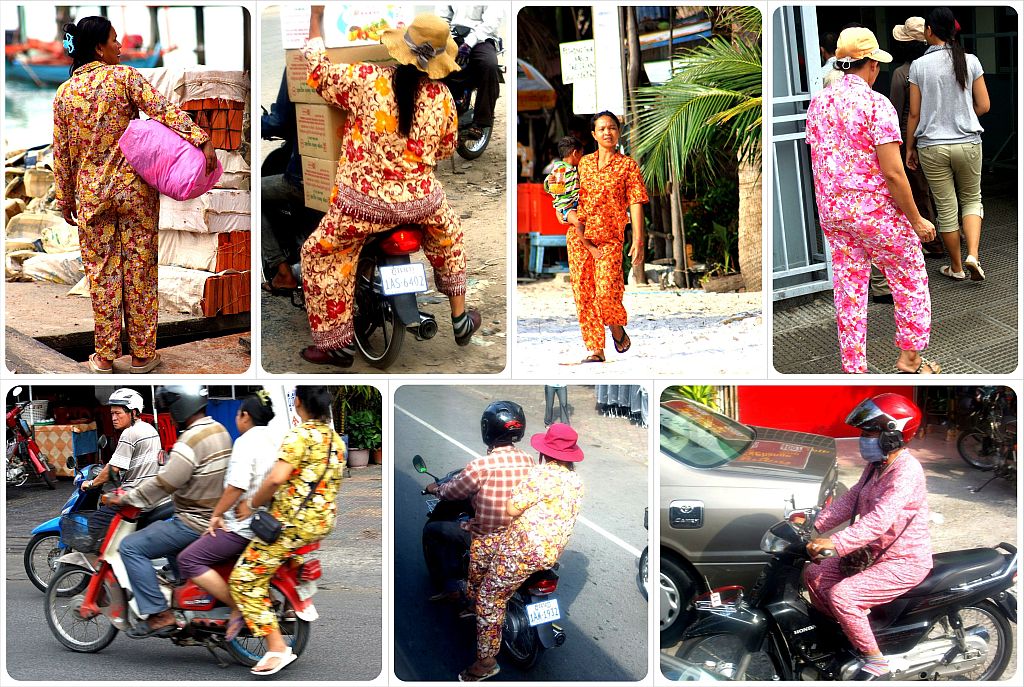
  • Something I love about Cambodia is the style where women where brightly-colored, fully-matching button-down pajama outfits while out and about in the steamy days. Some of them have penguins or flowers, depending I suppose on the person. They are always colorful and look nicely pressed when I see women in the pajama sets. Sometimes I’ve seen children in pajamas, as well, running around and hopping into motorbikes in superhero patterns. My hypothesis is that pajamas are cool and airy enough for the hot tropical weather…and they do have a certain pleasant air to them. It is unsurprising they are colorful, as everyone had to wear black pajamas during the gruesome Khmer Rouge regime.
  • While we drove, we went by countless weddings on the sides of the road, under wedding tents with vibrant colors and upbeat bands playing. Considering the dreadful heat and dust in the dry season, I asked my driver why weddings seemed so popular right now. He explained that people would rather be hot at a wedding than soaked/flooded by the rainy season, so dry season is the only decent time to celebrate marriage.


Tuesday, March 15, 2016

Update on Being Sick

There’s not too much report right now. After a week in bed with a really bad cold, I was in bed for about two more weeks with amoebas battling it out with my GI tract. I will simply say, being sick in a foreign country without anyone around me sucks. Lots.

I got out only a few times while I was sick.

One time was for an evening where I gave a talk about the history of toilets to a large group of nerdy expats in a fancy bar (I stuck to ginger ale). I shared with them my desperate plea for everyone to wash their hands and use the toilet always because of my amoebic afflictions and joked about Thomas Crapper and other fun trivial facts about toilets. People loved the talk and came up to tell me this before I uncomfortably made my way to the bathroom. Despite my abdominal discomfort, the praise was nice while I continue tackling complications with my health and research project (far too many complications to mention in a blog post...also, too discouraging for me to want to explain cogently).

Another time I left my bed, right before I made a second trip to the doctor for more stomach medication, I went for a little walk around one of the parks near the Riverside area of Phnom Penh. It was just after sunset when as I walked slowly down the boulevard, and the air was cooler. I heard a thudding of modern electronic pop music in the park and looked around to see a few lines of people dancing in relative unison with a semi-choreographed jig. I kept walking and came across another group of line dancers, this time mostly young adult men (with some young adult women), bouncing and bounding to the music coming out of the big speakers. I didn’t know it then, but apparently this is a normal ritual for physical activity in the city. It was a lot of fun to see them, but I winced at the idea of joining them in any active movements other than my slow stroll.

I also went out for a few hours to go to a Reiki circle with a great group of local practitioners. I loved getting to know some people through my preferred method of meditation, even if only an hour or so. The group helped me feel more supported than I have felt since I got to Phnom Penh. I don’t mean that my friends and family elsewhere are not supportive (they have been very much so there for me), but it is a different feeling to have people physically with me and being supportive. I really needed that.

I have figured out that there are four types of foreigners here in Cambodia:
  • Tourists – People who are in hotels and passing through within a few days or weeks
  • Short-term expats – Like me, who stay only for a few months for research or a consulting gig
  • Long-term expats – People who have a year or two of a contract here, then leave
  • Lifers – People who move here for an undetermined amount of time and stay for over 2 or 3 years

Being a short-term expat, it is hard for me to figure out my place. I’m here too long to feel inclined to partake in most tourist activities, yet I’m not here long enough for building meaningful friendships, which I want/need. I have a few friends here, of course, and those people are wonderful and fun to talk with, when we have time to see each other (and are well enough). And I rent desk space at the incubator Impact Hub so I can be around other people more often; I enjoy getting to socialize with the group of researchers and entrepreneurs when I work there every few days. But, I had been sick for about 3 weeks and did not really see many people during that time. Those few weeks have definitely taken its toll on my overall pleasant outlook.


I really do like Phnom Penh, and I am not feeling dread staying here like I did in another place I lived in the past. That said, I look forward to being home with supportive loved ones for a while, and being able to eat a gluten free fudgy brownie.

Monday, February 22, 2016

The Life of an Isolated Expat

I’ve been in Phnom Penh about two weeks now. I haven’t had much more to report about my experience here yet, as I’ve locked myself indoors to work on my research for my thesis and my social life here is close to nonexistent (except for my ever-patient roommate Shana). And because I’m currently battling a viral infection that apparently is going around the city. But here is an update.

I am not good at being an expat. This is mostly because I don’t particularly like bars or drinking. I had forgotten that expat communities’ social settings in some countries revolve around bars and clubs. This had been the case in Rwanda, and it seems to be the case in Cambodia, too. I have gone out for a few drinks in the last weeks, but I don’t go out as much as would be useful to help me build up my social network.

And I’m nursing a sore throat, so the idea of pumping alcohol into my body at the moment is about as appealing as volunteering for a mosquito-related study.

Also, when I am around people, it has been almost exclusively the expat community. Part of this I know is because I don’t speak Khmer, and not all Cambodians speak English comfortably enough to have conversations with people like me. The Cambodians I have talked to have been either teaching me Khmer in language classes or pleasantly chatting to me while I purchase a product or service from their business. It’s bizarre to me to be living here and look up from my rental desk at the local incubator and see a sea of faces like mine. To be fair, there are a couple Khmer at the incubator using the facilities.

I went to a Zumba class over the weekend to see if I could better socialize in active settings. The class was inside a mall, Aeon Mall, which was (to me) shockingly fancy and high-end. I kept thinking to myself, Aren’t I in one of the poorest countries in the region? How does this exist here? There were very nice brands (Mango, Yves Roche, etc.) being sold in shiny stores on 3 floors of shopping. It reminded me how palpable growing inequality is in so much of the world (the US absolutely included), where only a few minutes’ drive would bring me towards much less fortunate circumstances. I know there is a growing middle class in Cambodia, and I suspect these areas are built more for them and the ever-present expat communities here…but it still stuns me how many fancy places are built in the city when one in five Cambodians are still in poverty. In fairness, I guess I could complain the same way about many other places, like NYC...and cities are normally not a country's normal, anyway.

The Zumba class was fine, mostly expats wanting to sweat to some meringue songs, and run by a friendly French guy.

Also, I did not realize just how big Phnom Penh really is until this last week. I’ve been sticking to my little area within the city (mostly to save money on travel and get better acquainted with my surroundings). I did venture out a few times, though, and drive through long streets with shops and restaurants for much further than I had anticipated. It’s a far bigger town than I had stomached, and now I realize how foolish I’ve been for my initial analysis of town, and I’m a bit more overwhelmed than before. I guess it’s still vaguely like Queens in some ways, but parts of the Bronx and Manhattan are also mixed in a bit.


Shana invited me out one night to a bar to meet some of her German group of colleagues. The tuktuk ride swept down the long road Monivong and we ended up on the other side of town – scootering past lots of lighted shops and hotel areas to Lakeside. Lakeside was once the hostel backpacker central area and used to have a big lake, apparently, but a few years Cambodia brokered a deal with China for some high-rise development there instead. They filled in the lake and force moved most of the settlements by the lake to other areas of the region (without compensation). The lake is still wet, so no development has occurred yet, but we drove to the one village that remains in the area and has a reggae bar in the middle of many beautiful graffiti pieces on the walls of the surrounding buildings.