Showing posts with label rural. Show all posts

Saturday, March 16, 2019

A Ghanaian Funeral

I didn't go to this funeral.
I was just in Ghana for a few weeks working in the field on a project. During my stay, I was asked to join my team to attend a funeral for one of our colleagues who had passed away, over the weekend. Of course, I agreed to join....but it was clear during the experience that I was wildly unprepared and still prone to culture shock.

According to my Ghanaian colleagues, weekends are for funerals. You attend lots of funerals, here - for people you know or people you knew of from others - so that eventually you'll have a sizable gathering for your own funeral. Because in Ghana, funerals are big deals - much bigger than weddings.  I mean, they're big enough to the point that some think they can be a bit excessive.

Perhaps you've seen on social media one or two videos from a Ghanaian funeral? You know, one of the pallbearers dancing with a coffin bouncing on their shoulders?

I find it almost impossible to explain the Ghanaian funeral I attended by comparing it to anything we have in the US...but I found myself comparing it a bit to Indian weddings. It had a lot of pomps and circumstances (like an Indian wedding) and it was long. And apparently, by Ghanaian scale, this funeral was a very small one.

But I'm ahead of myself.

The funeral was in the Central Region - about a five-/six-hour drive from Accra. My 60 Ghanaian colleagues and I sleepily piled into a VIP bus at 2am (!) on Saturday and started our journey. If you've ever driven down Ghanaian roads, you may recall that speeds are managed via ample speed bumps and potholes (every mile or so?). Sleeping on the bus was difficult.

A few towns before we reached the funeral, we stopped at a guesthouse to dress for the service. Ghanaian funerals are formal events - no jeans or sneakers! The standard colors are black and red (with a few exceptions for those in church groups with costumes - yes, costumes - and etc.). Women wear tailored outfits with a flared blouse paired with a mermaid skirt, while men wear smart kente shirts or elaborate "togas". Apparently, in the Ashanti region, funeral attire is so strict that one can be refused entrance if the outfit isn't up to code. Luckily for me, we weren't in Ashanti and I was allowed to wear simple black pants and a modest shirt.

When we arrived, we had to line up and start a procession to the funeral (women in the back, of course) and around the corpse of our late colleague before sitting down.

Okay, so this is when the culture shock for me started during the funeral. There much to unpack in my culture shock, so I will explain the uniqueness in my favorite format - a list:

  • The (dressed) corpse was laid out in full view on a table in a clear tent. I was not expecting the body to be on display as fully as it was. In Western funerals, *if* the body is on display, it's only from the torso up. This body, however, was not covered at all - I saw the rigid legs leading to the stiff upper body of someone who has been moved into position after Rigor mortis set in. There was no way to deny death at this funeral, for his body was so clearly visible to all who attended at all vantage points.
  • The corpse was a month old. In a country that is hot and so very near the equator, I was baffled to see the body in such a well-preserved state...and that they had taken so long to bury the body. My colleagues explained to me that burial customs in Ghana sometimes prohibit bodies from being buried for quite a long time, which means families and morgues will do what they can keep bodies on ice if there are delays.
    Why would there be delays? One example I heard was that if a local royal died before your loved one, you can't bury them until the royal is. And, since 
    funerals are such big deals in Ghana, funerary ceremonies for royals can last weeks/months/years! Which means you just have to wait to mourn your loss until the royals are buried. I'm not entirely sure why this funeral was a month late, but it was - and that was not abnormal to anyone but me.
  • There were hundreds of people at this "small funeral". In the West, a large funeral may have 100 people or so; in Ghana, large funerals have more like a few thousand. I was in awe that so many people turned up at the funeral, but was even more surprised when I was told that it was a tiny funeral. The reason why thousands of people didn't show up was that my colleague died rather young and before his parents - in Ghana, burying a child requires a smaller, not-very-spectacular funeral.
  • The service had lots of emotions expressed. I'm used to funerals being somber, sad events. Ghanaian funerals have (potentially professional?) wailers and sobbing/moaning family members, of course, but there was also a lot of singing and dancing. The church that ran the service brought the chorus. They banged tambourines, sang joyfully to songs about Jesus (I think? It was in Twi, but "Jesus" sounded the same...), and danced in a parade around the center of the funeral grounds - sometimes even around the body. At some point during the funeral, the corpse was moved discreetly into a coffin, which was then placed in the middle of the compound, and more dancing circled it. Some periods of the funeral had rowdy songs juxtaposed with people crying loudly. I didn't really know how to process the information during this service because I felt overwhelmed with emotions at the moment, but I think I was glad to have some levity in what normally is a dark event...even if the contrast was so stark.

  • The service was quite long. In my world, funerals are for about two hours. Max. We ended up staying at this funeral for six hours before hopping back in the bus to return to Accra...and we had left early! Once again, funerals can last a long time, and apparently, I only got a taste of all that would be included in the ceremonies. To me, it was extremely long; understanding only a smattering of words - mostly being "Jesus" - probably made it feel even longer.
  • We had to go through a lot of formalities. So much of the funeral included people moving around, shaking hands of everyone else attending the funeral. And much else of the funeral were different people making speeches (again, in Twi) in what appeared to have been normal standard operating procedures. I'm not sure most of what happened, but there seemed to have been some kind of formula to go through for the event. We did a lot of standing and sitting for songs and other parts that I didn't understand, as well.
    There was one part of the ceremony that was in English: the eulogies. And it was heartbreaking to listen to several people read out their written eulogies in between sobs.
After the initial religious part of the ceremony and people moved around the coffin a few times, it was time for the pallbearers to lead the hundreds of attendees to the burial. We were in a rural community, so everyone piled onto the road and slowly walked to the cemetery off on the shoulder of the road, at the end of the village.

Did I mention that it was hot out in rural Ghana? It was probably 100F/37.8C outside and as the sun climbed the sky, all of my colleagues and I started to pour sweat (I won't lie...I was comforted to see that I wasn't the only one sweating). There was a point during the day where I wasn't sure my clothing would ever come off again from my sweaty body. I wasn't sure if I'd ever know what it felt like to be cold again, either. There was some cooling wind...but not much.

At some point after the burial, I realized I had an urgent need to urinate. A few of my lady colleagues helped me find a village toilet, which was harder than it sounds as Ghana is known in my sector as having low sanitation coverage. Anyway, somebody showed us to a roofless structure with walls that wrapped around like a spiral and told me to have at it. I walked cautiously through the spiral to find a stained floor and a small hole in the side of the wall that outputted into a divet near someone's home. This was the only toilet in the community apparently, so I took off my pants and squatted...and proceeded to urinate openly and indiscriminately. It was so hot out I couldn't tell where my urine was going, but I would be lying if I said I didn't get any of it on my person. Oh well.

The happenings continued.

Our organization wanted to donate some money to the bereaved family, which meant the formalities continued for us. All 60 of us were ushered into a family compound where we sat and waited for the bereaved family members to greet us. My understanding is that we first had the widow's family leaders come to greet us and asked us our intentions, to which someone on our team represented us and stated our intention to donate money. The widow's family left, satisfied. Afterward, we waited for a while until the bereaved blood family joined us and we went through the same formalities again. Each time a new group or family came to go through this process with us, there was handshaking. Everyone had to give each other handshakes. Which meant I shook a lot of people's hands that day. Many of them seemed quite pleased to have shaken the hand of a foreigner at the funeral - it appears I added some prestige to the funeral and showed that our colleague had had an international network.

Once the handshaking ended, we then had to do the process all over again, this time in public at the official ceremony where donations were publically announced. Again, someone had to state our intentions to give money to the family, and we had to shake hands. The difference with this version was that afterward our team had to dance around the altar that replaced the coffin before we were able to leave the funeral and head home. 

We finally got back to Accra around 9pm - about 20 hours after our days started. But, of course, not without me peeing on myself one last time (this time at a gas station) while we headed back.

Overall, it was a fascinating experience. I wish I had thought to have read up more in what a Ghanaian funeral would entail, and I wish I had prepared myself better to deal with an overwhelming cultural experience in blistering heat. But it is still a memory that I will not forget and is giving me food for thought about my own future funerary experiences and last wishes. I'm sure I got some of the details mixed up or misunderstood, but based on my understanding of what happened that day, the Ghanaians hold their deceased in the highest of esteem and respect.

One last note: I found this article about how some of the funeral calls in Ghana can be quite comedic - enjoy!

Thursday, June 01, 2017

Ghana

Berekum, Ghana
It's been months since I went to Ghana. I've been wrapped up in the grief of losing a parent and the whirlwind of a changing job. I'll try my best to recollect my trip to Ghana, though I'm sure a lot will have been warped with the months. But later is better than never?

I got off of the 10-hour plane ride (riddled with crying babies the whole trip) and found myself walking into a wall of heat. It was like my welcome to the country included an invisible welcome crew who cloaked me in a layer of heat that would stay with me the whole trip. My office's driver met me in the front of a sea of people, looking around confused and tired for their arriving guests. Once he found me, he escorted me to the office truck and shuttled me to the office (because I got in too early to check into my Airbnb).

The office is a large 2-story house, converted into office spaces and hallways for our overwhelmed Ghanian colleagues. It was a similar situation in Rwanda, so I wasn't very surprised that it was a practice elsewhere. People were surprised with me, though, because I was in the office as soon as I landed. I didn't have much choice!

Once I got to the Airbnb place around lunchtime, I did crash into a nap for a healthy amount of time before returning to the office. It was a huge apartment with a few rooms that were rented out to short-term guests like me. The amount of money we were spending per day for such a large (and very polished) place made me feel like we should have insisted on paying more, especially given our living conditions in NYC. The complex where the apartment was had a good-sized gym I paid for every morning so I could sweat on the cardio machines with the other well-to-do Ghanaians and non-Ghanaians before going to work, which was a 5-minute car-ride.

While driving around the area with the office drivers for lunch and dinner, I was highly amused while reading the restaurant names we passed - or rather, most of the storefront names for any kind of business. We got Turkish food that was named DNR (surely, an innocent abbreviation for doner, though still alarming!), God Is Great, and (my favorite) Jesus Made It! Restaurant. This was a constant source of entertainment for me while I floated around Ghana for the 10 days - I was constantly amazed by the inspirational business signs I would see. Apparently, the culture deems shop naming as a way to express religious enthusiasm.

What's more, I was surprised to see numerous healing signs for local witch doctors. These signs were amusing in design (a serious image of a man holding strange objects over people's heads, or simply posing with a drum) as well as the list of ailments that were stated curable by these magical people. The signs would range from topics such as "get rich quick" to "HIV/AIDS problems" or "barrenness". Or even something so medically reasonable as "snake bites".

Foodwise in Ghana, I was always served far more than I could stomach, and the flavors of the country were okay but not always things I enjoyed eating. I went to an upscale local dining place in the center of Accra called Buka for groundnut soup and banku (mashed up/balled up fermented maize) and found that the food was decent, but I am not quite used to the aftertaste from eating gelatinous balls of carbs. This was a common characteristic of the meals I ate. In particular, locals found it especially amusing to watch the random foreigner swallowing down fufu (mashed up/balled up plantains and cassava), which I found rather tasteless.

I quickly found out I was not eating their food appropriately, though - banku and fufu are not made for chewing, they collect flavor from stews and then are supposed to slide down the esophagus in a rather effortless way of filling up. The feeling of not chewing and gulping down something gooey was odd for me (and a bit confusing)...I admit it was not my favorite thing in the world. That said, there was always ample food in my stomach and I was stuffed most of the time.

I didn't spend a lot of time traveling around Accra - I went to field visit some of our stations nearby in outer Accra areas for a day or two, but I didn't tour the city to see what was going there.

In fact, on my weekend I took a domestic flight to Kumasi to visit my graduate classmate Salley and his family. I understood that he lived about a 3-hour bus ride away from Kumasi, but I found out it was more like 6 or 7 hours on the way to his home (closer to the Cote d'Ivoire border than anywhere else) in a rural part of Berekum. It was very hot there in the rural area with chickens and farms hung out. His family was very sweet, and invited me into their house with open arms and hearts. It was simple living there, with unfinished rooms lingering in their newly-purchased plot of land, but we had a nice time.

I will note that foreigners are not a common occurrence in the area, though -we took a trip to the local market to pick up food for dinner, and I turned somewhat into some kind of walking spectacle for the community. People wanted to touch me and interact with me in some way, though I didn't know how to speak with them (they spoke Twee, I don't). I sipped on an apple juice box while we traveled around the area and it seemed to cause quite a reaction with people who stared at the car; some people started to laugh and run with the car, others pointed in shock. I guess it's not common to see random white folk sucking on juice boxes.

On my way back to Accra for another week of work, my plane got canceled due to rain and we got stuck in Kumasi for a night. We walked around the newly-opened mall in the area, which was pretty much the busiest and most chaotic shopping experience I've witnessed outside of Black Friday in the US. We got nearly smothered in a grocery shop - where people were in full gowns there shopping for cheese and tea - and I nearly wept at the number of people who kept on barreling into me as we looked around.

A final note, Ghanaians are some of the nicest people I think I have worked with yet. Whoever I met or approached was extremely pleasant and accommodating to me while I blundered around the hot, new country.

Thursday, April 14, 2016

Field Research Fun

Cow grass
Last week I got into a quintessential expat vehicle (a white Jeep...with a driver) and drove a few hours out of Phnom Penh for interviews with local, rural government staff. Being the child that I am, as soon as the car started pushing out of the city, I fell asleep until my driver kindly nudged me awake in our first area for interviews, Kampong Speu.

During our few days in the field (meaning my friendly driver and me…and when I wasn’t lulled to sleep by the humming of the car), we spent many quiet hours having broken conversations with each other. We drove from Kampong Speu, out to the other side of the country in Kampong Cham, through Tboung Khmum, and back to Phnom Penh.

I’ve tried to learn Khmer while in Cambodia. Normally languages are pretty easy for me to grasp. Par example, je parle français (grossomodo). Some Spanish speakers have thought I can actually hablar español. I can read some Arabic like a first grader. By the end of my month-long stint around Thailand, I could hold basic conversations with people (krup koon kah). In Laos, visit to Isan proved good for me to understand a good amount of things (krup chai de)

But when it comes to Khmer, even though it is of the originating family from which Thai and Laotian stem, I am utterly useless.

Khmer, for me, is incredibly difficult. I cannot for the life of me figure out how to remember the complex pronunciations and complicated consonants that surprise me when I hear people talking. I’ve managed to clutch clumsily around a handful of words - “Hello”, “Thank you”, “Stop”, and “Turn”- but for the most part what words I am taught dribble out of my brain as easily as football statistics. And it infuriates me!

This is especially problematic when in rural Cambodia, where English is not as important as it is in the city. Here, I am in the wrong for not trying to learn more Khmer, and I agree with that – I should be much better at the language by now. Alas, my brain has shut the vaults to Khmer, and my attempts to use Thai words as alternative vocabulary are kind of silly.

One instance while in Kampong Cham that was amusing around my inept Khmer skills was around my breakfast. My driver, bless him, after I rambled on about wanting bobor (aka rice porridge) found a place in the city where I could order it for breakfast. I have discovered a deep love and affection for the comfort food feel I get when eating it. They put ginger and scallions in it, and often meats, which make it basically like eating a nice, creamy, thick soup. 

I go into the restaurant and order a bobor. The waitress, being a good and thorough waitress, started listing off in Khmer the bobor options they had at the restaurant. I panically ask for, “English?”, which gets me a chuckle and more Khmer words thrown at me that lodge into my pride. A meekly repeated request for “Bobor….?” was met with the repeated list of options I couldn’t understand. I started to cluck like a chicken, using my hand to represent a beak, in hope that it would give the effect of my desire to have chicken in my porridge. After a pile of waitresses and patrons finished their giggling at the stupid foreigner’s chicken impression, the waitress gave me a knowing smile and walked away from me.

Soon after, I received my bobor, only with fish instead of chicken. Don’t get me wrong, it was a tasty dish! But after my embarrassing attempt to impersonate a chicken, I felt baffled that my performance was received with an animal that did not make any sounds at all. I went back the next day to try again my request for chicken in my bobor, armed with the word chicken from my caring driver, and I was successful in eating bobor muan.

Another amusing language mishap that happened in the field was a bit more costly for my interviews. Well, I have not confirmed that this is why the complications occurred, but I am assuming that this was the hiccup. 

Anyways. 

So, my name is Kim. Of course, in the Anglophonic world, my name is short for Kimberly, which usually doesn’t cause too much confusion about my identity. In Cambodia, however alarming, I have been mistaken for Korean a couple of times. If you know me, I look in no way Korean, nor Asian by any stretch of the imagination. I burn in 10 minutes, in the shade – my hair is a mix between blond and brown – my hips are most certainly not of their typically sleek physiques. And yet, I have had people ask me to my face if I am indeed Korean, upon hearing my name. It is a phenomenon that floors me every time.

How does this relate to my interviews? My interviews were arranged with the rural districts via email, where my name was indicated as “Kim” (because that is how I identify in correspondences). Kim, it so happens, in addition to being a Korean name, is also a common nickname for a few names in Khmer. It is not, apparently, a common name for visiting Westerners interested in going to rural areas to talk about government. 

Despite my supervisor’s Virak request for a translator for me, I think my name made that important request not register for people. I arrived to each district with a request for translators, and people looked stunned that I was who I was, and that I did not have a translator with me already (or speak fluent Khmer). 

Every district scrambled to find the most English-speaking staff member they had and thrust the poor soul in my direction. Some of the translators were good and knew how to navigate my questions for me in both language. Some of my translators were shaking a little bit as I spoke to them in a very slow, simplified version of English. Some of my translators kept apologizing, which did not boost my faith in their skills. Even so, they all did a decent job in helping me collect my data, and I thanked them for taking time to interpret the conversation between me and groups of government staff.

Oh yes, there’s that other thing, too. I had asked for one-on-one interviews with certain government staff, because it would make my data collection and analysis easier. All of the districts did not understand that, though, and my interview participants would end up collecting a few more relevant staff people to join us in the interview room. Stunned, I decided it was disrespectful to forbid the other people to participate, and my already anxious translators didn’t need to feel more stress with having several different conversations between me and other people (the less I talked, the better). So, in each of my surprise focus groups, I had everyone sign a consent form, and rolled with it. 

By the third surprise focus group, I was hardly surprised.

In the end, I now have twice as many interviews than I had expected, and I was successful in collecting some pretty interesting data from my field visit. Overall, a success.

Other things that I would like to note about my trip into the field for data collection:
  • I am left handed. I know that I am, but I didn’t remember that Obama is, as well. One of my translators remembered that, though, and mentioned it almost immediately after I picked up a pen to write down a note. “OH! You write like Obama!” It took me a few beats to figure out what he meant by that. I remembered some memory from seven years ago when someone mentioned to me that Obama was a southpaw. I wanted to ask him how, in all of the vast ocean of knowledge to remember, did he remember that one pretty obscure fact about POTUS?
  • I was interviewing people about their work around improving rural sanitation. At about half of the places I visited, I was surprised to see male staffers urinating either on/by one of the buildings, or on a neighboring tree on the compound. At one district of these districts I also asked to use the toilet. They hesitated uncomfortably, informing me that their toilet was not working very well. I found this ironic (and unsettling), considering the reason for my visit. I went into the broken toilet and did what I had to do as hygienically as possible. It was an interesting observation to have while working on sanitation-related research.
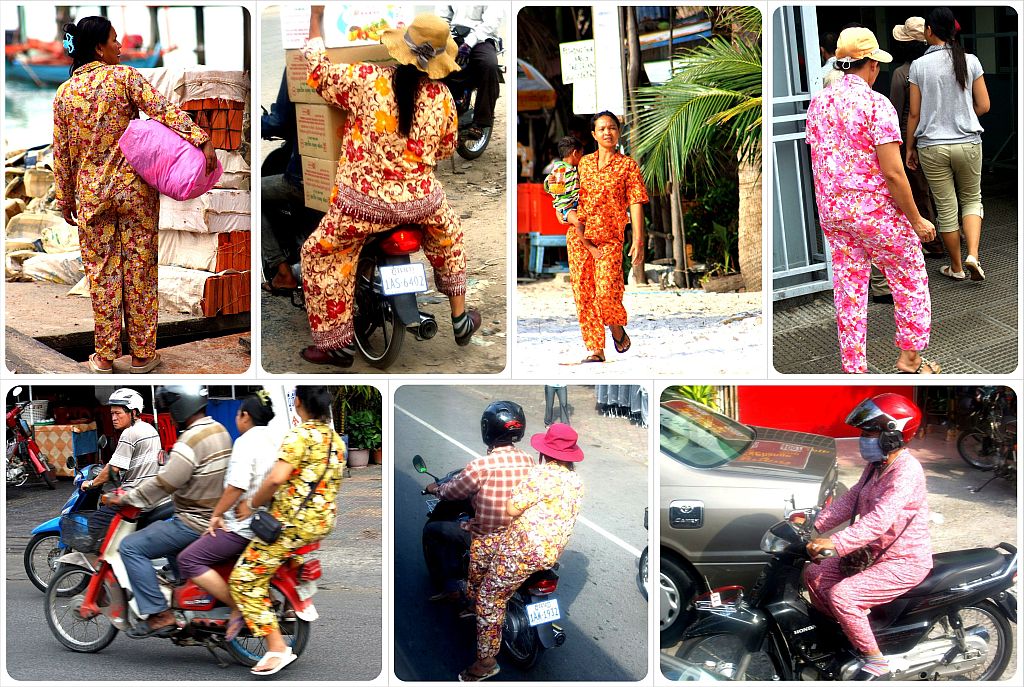
  • Something I love about Cambodia is the style where women where brightly-colored, fully-matching button-down pajama outfits while out and about in the steamy days. Some of them have penguins or flowers, depending I suppose on the person. They are always colorful and look nicely pressed when I see women in the pajama sets. Sometimes I’ve seen children in pajamas, as well, running around and hopping into motorbikes in superhero patterns. My hypothesis is that pajamas are cool and airy enough for the hot tropical weather…and they do have a certain pleasant air to them. It is unsurprising they are colorful, as everyone had to wear black pajamas during the gruesome Khmer Rouge regime.
  • While we drove, we went by countless weddings on the sides of the road, under wedding tents with vibrant colors and upbeat bands playing. Considering the dreadful heat and dust in the dry season, I asked my driver why weddings seemed so popular right now. He explained that people would rather be hot at a wedding than soaked/flooded by the rainy season, so dry season is the only decent time to celebrate marriage.


Wednesday, March 02, 2016

Field Work and Amoebas

Last week, while fighting a really nasty viral infection (in my nose), I got invited to join some development agencies and government officials on a field trip a few hours east of Phnom Penh to the rural areas in Tboung Khmum and Kampong Cham. The field trip was a way for national government guys to come and see how water and sanitation is working on the ground in rural villages (because guys working in Phnom Penh have little context of what’s going on), and talk about ways to improve the sector’s work with local governments. It is really important for national government figures (and researchers like me) to go out and see the action happening because sometimes it’s impossible to fully understand the picture when there are no faces to picture for policies and work being done.

What is your research, Kim? Well, I’ll tell you. The national government here has been giving more responsibility to local governments (read as: decentralizing) around water and sanitation. My focus is sanitation. The problem is that local governments here lack a lot of skills and knowledge needed to do what the national government is (vaguely) telling them. So, I’m trying to figure out what kind of roles the local government needs focus on for improving sanitation in rural areas, and what capacity is needed to do that work. Did you follow that?

Back to the trip, I should point out two complications I had during those two days: (1) I felt like I was dying from the viral infection, as my nose screamed fire and throat scratched with all of the gross internal residues coming out of me; and, (2) I was the only non-Khmer (aka Cambodian native) person in this field trip, so the conversation was mostly in Khmer – some generous development workers took turns translating for me what was happening. So between my spacing out with delirium and translation, I’m almost certain I missed key pieces from the conversations that happened. That said, I did get a pretty good idea of some of what’s going on for my research.

We drove for hours down roads that were dusty and very dry. It is dry season here, but it was very clear that the drought the country currently has is taking a toll on agriculture; fields were charred and crackly with dryness, and gusts of winds blew through the open spaces, pushing dust into swirls in the air. The houses we saw were simple wooden structures, balanced mainly on tall stilts – presumably to avoid floodwaters that are currently unfathomable with how dry it was.

Going through the rural community we visited, I noticed that trash was strewn around the land everywhere; I saw debris in the open well, in the straw-like weeds near the village hall, in front of houses, and in the dried up waterways near some houses. This village also had about half of the population (of about 100 or so households) defecating out in the open, so wasn’t a surprise that trash management was not going too hot. Some people had bought the building blocks for a toilet, but many had the structure pieces lying in piles near their home, unconstructed and abandoned. Buying the toilet itself is pretty cheap – most of these people can buy a toilet for about $25…the problem is the structure in which to build around the toilet, which can be about $200. For a lot of rural families, that is half of a year’s income.

The people were brought together into the village hall so the local government could tell them about the benefits of buying a toilet and play games to highlight the consequences of going out in the open. I told Mr. CT Lawyer about this meeting in more detail earlier; based on his reaction to my story, I will spare you the rest of what was discussed.

I found it interesting that the demographics of the village at the meeting were mostly elderly people and little children. I saw this in rural Thailand as well; the younger people, including parents of babies, set off to cities like Phnom Penh and Bangkok to work in the factories in hopes to send money back to their destitute families in rural areas from their better-paying livelihoods. Grandparents raise grandchildren, and parents try to support families so they don’t starve. The livelihoods of simple rice and other kinds of agrarian farmers just do not provide enough for survival anymore in much of the world, especially as climate change intensifies.

We stayed overnight in the city of Kampong Cham, right on the Mekong. A few of the people helping me with my research and I went out for BBQ at a local restaurant. After BBQ, though I had thought we were done eating, the group moved on to another restaurant for rice porridge (they put salted eggs and fish in the porridge). Cambodians are thin people, but I (with my generous hips) could not keep up with the group’s appetite – I struggled with the porridge while some of them took seconds and thirds of porridge. I asked them how they could pound back the porridge so easily, and they explained that it was more for the socializing around the porridge they enjoyed. Apparently there are lots of restaurants in cities that are open until early the next morning just so groups of friends hanging out late can enjoy some porridge together. They had wanted to go out for Karaoke after porridge, but my ashen face was very clear to them and they (thankfully) put me in a car to go back to the hotel and crumble into my bed.

Many of our meals were held at some tables under a roof held up by a few poles that sat on the side of the road, and were given meals from pots on a table near the road, or from a kitchen hut in the back of the roofed area. For the days we were on this trip, I did not really understand what I was eating most of the time. A lot of it looked like stews or stir fries of some sort, but the contents were beyond my comprehension. My helpful supervisor, WASHy Virak (my trusty translator and key advisor while I’m here), would explain to me what was going into my mouth if he was next to me. When he wasn’t near me, I would squint my eyes and point at things with a look of confusion to nearby eaters. One thing I ate looked like mushroom stems but was much chewier than I had anticipated. I got adamant responses from other people like, “No mushroom!”, but not much explanation of what it actually was. A while later, Virak explained to me it was pig’s intestines. Another thing I thought were mung beans turned out to be squid. I clearly am not good at the guessing game.

It’s been a few days since the educative trip out in the field. Somewhere between there and the rest of my current visit in Cambodia I have eaten something that was unclean, most likely from having some kind of fecal matter on it and not washed off before I ate it. Last night I got a tuktuk to drive me to the International SOS Clinic to figure out if my fever and the amazing amount of pain was from dengue fever or something else. As they hooked me up to an IV drip and took blood and other samples from me, we discovered I am currently suffering from amoebic dysentery (read as: parasites, likely not from the rural trip). I’m glad that I don’t have dengue, but I cannot say that this amoebic infection is any better (nor do I want to find out ever). The doctors pumped me with medicines and handed me over a very fancy bag full to the brim with several different types of medication to help me manage and eradicate the amoebas from my body. I am currently in very close relations with my bathroom.


I told my Australian supervisor (Bronwyn) about this, and she replied with, “Ah yeah, I’ve been there.” I also got a few notes from other development workers recently with similar stories of sickness as a result of being in the field doing work. Dengue fever, malaria, tapeworm, food disease (been there), amoebic dysentery (on it), etc. It seems almost like a rite of passage for people working in development work to get super sick (often)…an occupational hazard. I keep thinking to myself, And we all signed onto this?! I love working and feeling like it makes a difference, I love learning about contexts I normally would never dream of, and I love how interesting it all can be. However, I have been so sick so often in my travels the last few months, I have my doubts about continuing this work for the long haul; I don’t know if my body can handle it forever. It is clearly an easy target for germs.