Showing posts with label hot. Show all posts

Saturday, March 16, 2019

A Ghanaian Funeral

I didn't go to this funeral.
I was just in Ghana for a few weeks working in the field on a project. During my stay, I was asked to join my team to attend a funeral for one of our colleagues who had passed away, over the weekend. Of course, I agreed to join....but it was clear during the experience that I was wildly unprepared and still prone to culture shock.

According to my Ghanaian colleagues, weekends are for funerals. You attend lots of funerals, here - for people you know or people you knew of from others - so that eventually you'll have a sizable gathering for your own funeral. Because in Ghana, funerals are big deals - much bigger than weddings.  I mean, they're big enough to the point that some think they can be a bit excessive.

Perhaps you've seen on social media one or two videos from a Ghanaian funeral? You know, one of the pallbearers dancing with a coffin bouncing on their shoulders?

I find it almost impossible to explain the Ghanaian funeral I attended by comparing it to anything we have in the US...but I found myself comparing it a bit to Indian weddings. It had a lot of pomps and circumstances (like an Indian wedding) and it was long. And apparently, by Ghanaian scale, this funeral was a very small one.

But I'm ahead of myself.

The funeral was in the Central Region - about a five-/six-hour drive from Accra. My 60 Ghanaian colleagues and I sleepily piled into a VIP bus at 2am (!) on Saturday and started our journey. If you've ever driven down Ghanaian roads, you may recall that speeds are managed via ample speed bumps and potholes (every mile or so?). Sleeping on the bus was difficult.

A few towns before we reached the funeral, we stopped at a guesthouse to dress for the service. Ghanaian funerals are formal events - no jeans or sneakers! The standard colors are black and red (with a few exceptions for those in church groups with costumes - yes, costumes - and etc.). Women wear tailored outfits with a flared blouse paired with a mermaid skirt, while men wear smart kente shirts or elaborate "togas". Apparently, in the Ashanti region, funeral attire is so strict that one can be refused entrance if the outfit isn't up to code. Luckily for me, we weren't in Ashanti and I was allowed to wear simple black pants and a modest shirt.

When we arrived, we had to line up and start a procession to the funeral (women in the back, of course) and around the corpse of our late colleague before sitting down.

Okay, so this is when the culture shock for me started during the funeral. There much to unpack in my culture shock, so I will explain the uniqueness in my favorite format - a list:

  • The (dressed) corpse was laid out in full view on a table in a clear tent. I was not expecting the body to be on display as fully as it was. In Western funerals, *if* the body is on display, it's only from the torso up. This body, however, was not covered at all - I saw the rigid legs leading to the stiff upper body of someone who has been moved into position after Rigor mortis set in. There was no way to deny death at this funeral, for his body was so clearly visible to all who attended at all vantage points.
  • The corpse was a month old. In a country that is hot and so very near the equator, I was baffled to see the body in such a well-preserved state...and that they had taken so long to bury the body. My colleagues explained to me that burial customs in Ghana sometimes prohibit bodies from being buried for quite a long time, which means families and morgues will do what they can keep bodies on ice if there are delays.
    Why would there be delays? One example I heard was that if a local royal died before your loved one, you can't bury them until the royal is. And, since 
    funerals are such big deals in Ghana, funerary ceremonies for royals can last weeks/months/years! Which means you just have to wait to mourn your loss until the royals are buried. I'm not entirely sure why this funeral was a month late, but it was - and that was not abnormal to anyone but me.
  • There were hundreds of people at this "small funeral". In the West, a large funeral may have 100 people or so; in Ghana, large funerals have more like a few thousand. I was in awe that so many people turned up at the funeral, but was even more surprised when I was told that it was a tiny funeral. The reason why thousands of people didn't show up was that my colleague died rather young and before his parents - in Ghana, burying a child requires a smaller, not-very-spectacular funeral.
  • The service had lots of emotions expressed. I'm used to funerals being somber, sad events. Ghanaian funerals have (potentially professional?) wailers and sobbing/moaning family members, of course, but there was also a lot of singing and dancing. The church that ran the service brought the chorus. They banged tambourines, sang joyfully to songs about Jesus (I think? It was in Twi, but "Jesus" sounded the same...), and danced in a parade around the center of the funeral grounds - sometimes even around the body. At some point during the funeral, the corpse was moved discreetly into a coffin, which was then placed in the middle of the compound, and more dancing circled it. Some periods of the funeral had rowdy songs juxtaposed with people crying loudly. I didn't really know how to process the information during this service because I felt overwhelmed with emotions at the moment, but I think I was glad to have some levity in what normally is a dark event...even if the contrast was so stark.

  • The service was quite long. In my world, funerals are for about two hours. Max. We ended up staying at this funeral for six hours before hopping back in the bus to return to Accra...and we had left early! Once again, funerals can last a long time, and apparently, I only got a taste of all that would be included in the ceremonies. To me, it was extremely long; understanding only a smattering of words - mostly being "Jesus" - probably made it feel even longer.
  • We had to go through a lot of formalities. So much of the funeral included people moving around, shaking hands of everyone else attending the funeral. And much else of the funeral were different people making speeches (again, in Twi) in what appeared to have been normal standard operating procedures. I'm not sure most of what happened, but there seemed to have been some kind of formula to go through for the event. We did a lot of standing and sitting for songs and other parts that I didn't understand, as well.
    There was one part of the ceremony that was in English: the eulogies. And it was heartbreaking to listen to several people read out their written eulogies in between sobs.
After the initial religious part of the ceremony and people moved around the coffin a few times, it was time for the pallbearers to lead the hundreds of attendees to the burial. We were in a rural community, so everyone piled onto the road and slowly walked to the cemetery off on the shoulder of the road, at the end of the village.

Did I mention that it was hot out in rural Ghana? It was probably 100F/37.8C outside and as the sun climbed the sky, all of my colleagues and I started to pour sweat (I won't lie...I was comforted to see that I wasn't the only one sweating). There was a point during the day where I wasn't sure my clothing would ever come off again from my sweaty body. I wasn't sure if I'd ever know what it felt like to be cold again, either. There was some cooling wind...but not much.

At some point after the burial, I realized I had an urgent need to urinate. A few of my lady colleagues helped me find a village toilet, which was harder than it sounds as Ghana is known in my sector as having low sanitation coverage. Anyway, somebody showed us to a roofless structure with walls that wrapped around like a spiral and told me to have at it. I walked cautiously through the spiral to find a stained floor and a small hole in the side of the wall that outputted into a divet near someone's home. This was the only toilet in the community apparently, so I took off my pants and squatted...and proceeded to urinate openly and indiscriminately. It was so hot out I couldn't tell where my urine was going, but I would be lying if I said I didn't get any of it on my person. Oh well.

The happenings continued.

Our organization wanted to donate some money to the bereaved family, which meant the formalities continued for us. All 60 of us were ushered into a family compound where we sat and waited for the bereaved family members to greet us. My understanding is that we first had the widow's family leaders come to greet us and asked us our intentions, to which someone on our team represented us and stated our intention to donate money. The widow's family left, satisfied. Afterward, we waited for a while until the bereaved blood family joined us and we went through the same formalities again. Each time a new group or family came to go through this process with us, there was handshaking. Everyone had to give each other handshakes. Which meant I shook a lot of people's hands that day. Many of them seemed quite pleased to have shaken the hand of a foreigner at the funeral - it appears I added some prestige to the funeral and showed that our colleague had had an international network.

Once the handshaking ended, we then had to do the process all over again, this time in public at the official ceremony where donations were publically announced. Again, someone had to state our intentions to give money to the family, and we had to shake hands. The difference with this version was that afterward our team had to dance around the altar that replaced the coffin before we were able to leave the funeral and head home. 

We finally got back to Accra around 9pm - about 20 hours after our days started. But, of course, not without me peeing on myself one last time (this time at a gas station) while we headed back.

Overall, it was a fascinating experience. I wish I had thought to have read up more in what a Ghanaian funeral would entail, and I wish I had prepared myself better to deal with an overwhelming cultural experience in blistering heat. But it is still a memory that I will not forget and is giving me food for thought about my own future funerary experiences and last wishes. I'm sure I got some of the details mixed up or misunderstood, but based on my understanding of what happened that day, the Ghanaians hold their deceased in the highest of esteem and respect.

One last note: I found this article about how some of the funeral calls in Ghana can be quite comedic - enjoy!

Thursday, June 01, 2017

Ghana

Berekum, Ghana
It's been months since I went to Ghana. I've been wrapped up in the grief of losing a parent and the whirlwind of a changing job. I'll try my best to recollect my trip to Ghana, though I'm sure a lot will have been warped with the months. But later is better than never?

I got off of the 10-hour plane ride (riddled with crying babies the whole trip) and found myself walking into a wall of heat. It was like my welcome to the country included an invisible welcome crew who cloaked me in a layer of heat that would stay with me the whole trip. My office's driver met me in the front of a sea of people, looking around confused and tired for their arriving guests. Once he found me, he escorted me to the office truck and shuttled me to the office (because I got in too early to check into my Airbnb).

The office is a large 2-story house, converted into office spaces and hallways for our overwhelmed Ghanian colleagues. It was a similar situation in Rwanda, so I wasn't very surprised that it was a practice elsewhere. People were surprised with me, though, because I was in the office as soon as I landed. I didn't have much choice!

Once I got to the Airbnb place around lunchtime, I did crash into a nap for a healthy amount of time before returning to the office. It was a huge apartment with a few rooms that were rented out to short-term guests like me. The amount of money we were spending per day for such a large (and very polished) place made me feel like we should have insisted on paying more, especially given our living conditions in NYC. The complex where the apartment was had a good-sized gym I paid for every morning so I could sweat on the cardio machines with the other well-to-do Ghanaians and non-Ghanaians before going to work, which was a 5-minute car-ride.

While driving around the area with the office drivers for lunch and dinner, I was highly amused while reading the restaurant names we passed - or rather, most of the storefront names for any kind of business. We got Turkish food that was named DNR (surely, an innocent abbreviation for doner, though still alarming!), God Is Great, and (my favorite) Jesus Made It! Restaurant. This was a constant source of entertainment for me while I floated around Ghana for the 10 days - I was constantly amazed by the inspirational business signs I would see. Apparently, the culture deems shop naming as a way to express religious enthusiasm.

What's more, I was surprised to see numerous healing signs for local witch doctors. These signs were amusing in design (a serious image of a man holding strange objects over people's heads, or simply posing with a drum) as well as the list of ailments that were stated curable by these magical people. The signs would range from topics such as "get rich quick" to "HIV/AIDS problems" or "barrenness". Or even something so medically reasonable as "snake bites".

Foodwise in Ghana, I was always served far more than I could stomach, and the flavors of the country were okay but not always things I enjoyed eating. I went to an upscale local dining place in the center of Accra called Buka for groundnut soup and banku (mashed up/balled up fermented maize) and found that the food was decent, but I am not quite used to the aftertaste from eating gelatinous balls of carbs. This was a common characteristic of the meals I ate. In particular, locals found it especially amusing to watch the random foreigner swallowing down fufu (mashed up/balled up plantains and cassava), which I found rather tasteless.

I quickly found out I was not eating their food appropriately, though - banku and fufu are not made for chewing, they collect flavor from stews and then are supposed to slide down the esophagus in a rather effortless way of filling up. The feeling of not chewing and gulping down something gooey was odd for me (and a bit confusing)...I admit it was not my favorite thing in the world. That said, there was always ample food in my stomach and I was stuffed most of the time.

I didn't spend a lot of time traveling around Accra - I went to field visit some of our stations nearby in outer Accra areas for a day or two, but I didn't tour the city to see what was going there.

In fact, on my weekend I took a domestic flight to Kumasi to visit my graduate classmate Salley and his family. I understood that he lived about a 3-hour bus ride away from Kumasi, but I found out it was more like 6 or 7 hours on the way to his home (closer to the Cote d'Ivoire border than anywhere else) in a rural part of Berekum. It was very hot there in the rural area with chickens and farms hung out. His family was very sweet, and invited me into their house with open arms and hearts. It was simple living there, with unfinished rooms lingering in their newly-purchased plot of land, but we had a nice time.

I will note that foreigners are not a common occurrence in the area, though -we took a trip to the local market to pick up food for dinner, and I turned somewhat into some kind of walking spectacle for the community. People wanted to touch me and interact with me in some way, though I didn't know how to speak with them (they spoke Twee, I don't). I sipped on an apple juice box while we traveled around the area and it seemed to cause quite a reaction with people who stared at the car; some people started to laugh and run with the car, others pointed in shock. I guess it's not common to see random white folk sucking on juice boxes.

On my way back to Accra for another week of work, my plane got canceled due to rain and we got stuck in Kumasi for a night. We walked around the newly-opened mall in the area, which was pretty much the busiest and most chaotic shopping experience I've witnessed outside of Black Friday in the US. We got nearly smothered in a grocery shop - where people were in full gowns there shopping for cheese and tea - and I nearly wept at the number of people who kept on barreling into me as we looked around.

A final note, Ghanaians are some of the nicest people I think I have worked with yet. Whoever I met or approached was extremely pleasant and accommodating to me while I blundered around the hot, new country.

Saturday, April 23, 2016

A Quiet New Year

About a week ago was the Khmer New Year. Most of the foreigners (aka expats) fled the country for holidays in cooler climates, and locals headed into the provinces to visit family over the holiday. I, on the other hand, opted to stay in Phnom Penh and work on my research project, furiously coding transcripts and trying (with tired eyes) to interpret my codes into a tangible story. I’m still working on making sense of the data and putting together my analysis, so I’m glad I stayed behind.

People here asked me what the city was like during the week everyone was gone. Honestly, I didn’t venture out too much because of my research, but I did go outside here and there. Simply put, it was hot and empty.

Firstly, it was hot. Of course, this is not an interesting observation; it is consistently in the 30s C / 80s-100s F. But that week was exceptionally hot – most days wavered between 39C / 102F to 40C / 104F (and that is not including the increased degrees for the “RealFeel” measurement). I hid in my bedroom with the aircon  nonstop in order to avoid melting; going outside seemed extremely unappetizing.

Also, Phnom Penh was silent and empty. The quiet meant I could sleep longer into the morning, which I found rather pleasant. And the streets were free of parked cars and people; only a couple cars would be driving down the main roads, whereas normally it’s packed and congested traffic nonstop. The reduced number of people made it easier to walk down the streets because there was no competition for space.

Actually, this walking around on the street was short-lived. Whenever I tried wandering more aimlessly up and down the street, I would get some tuk-tuk drivers’ attention. Normally, this attention includes someone shouting, “Hey lady want a tuk-tuk ride?! Where are you going??”, trying hard to make a transaction. Over the New Year, though, the attention was more tuk-tuk drivers’ adamantly yelling for me to get back on the sidewalk and put my phone away. It seems that some people take the week’s emptiness as an opportunity to speed down empty streets recklessly. Also, someone mentioned that theft goes up in the New Year because people want nice things like smartphones and will ride down the street on their motorcycles to snatch your belongings if you’re too close to the street.

The tuk-tuk drivers weren’t asking to give me rides, they were just genuinely concerned about my wellbeing. Which was a strange change of pace for me, being used to politely declining constantly as I walk down the street.

Despite the emptiness, I did have a little bit of a social life. There may not have been very many things open or people around (every restaurant I like to go to was closed), but I had a few friends who stuck around as well, and we'd go out to enjoy each other’s company over cold beverages (Brown Coffee was open, of course).

One friend had a dangerous allergic reaction to some strange ingredient in a meal while in the city that week. I tried to help that friend find an EpiPen or some allergy help so that they could figure out what happened to them. Just to let you know: Cambodia doesn’t have EpiPens. Try all you might, you will not be able to successfully source EpiPens in this country (and if you magically can, I am going to guess it’ll cost a lot). Luckily, this friend went to an embassy and sourced an EpiPens that way, but otherwise was looking at having to go to a clinic for a stab of adrenaline if anything else happened. This medical mishap was alarming for me in some way. I wonder, if someone has a child who is allergic to some food, what do you do? If someone is deathly allergic to some kind of insect or surprise allergy (and is a baby?!), what happens? It reminded me how some things that work in countries like Australia and the US are far cries from how things work in countries like Cambodia.


Don’t get me wrong! Cambodia is progressing and evolving at lightning speed. There are so many developments happening here, even for the 3 months I’ve been here! And so much is happening that it’s very exciting to be here and watch it change and morph into a new kind of society. That said, I do miss the immediate healthcare of other places. 

Thursday, April 14, 2016

Field Research Fun

Cow grass
Last week I got into a quintessential expat vehicle (a white Jeep...with a driver) and drove a few hours out of Phnom Penh for interviews with local, rural government staff. Being the child that I am, as soon as the car started pushing out of the city, I fell asleep until my driver kindly nudged me awake in our first area for interviews, Kampong Speu.

During our few days in the field (meaning my friendly driver and me…and when I wasn’t lulled to sleep by the humming of the car), we spent many quiet hours having broken conversations with each other. We drove from Kampong Speu, out to the other side of the country in Kampong Cham, through Tboung Khmum, and back to Phnom Penh.

I’ve tried to learn Khmer while in Cambodia. Normally languages are pretty easy for me to grasp. Par example, je parle français (grossomodo). Some Spanish speakers have thought I can actually hablar español. I can read some Arabic like a first grader. By the end of my month-long stint around Thailand, I could hold basic conversations with people (krup koon kah). In Laos, visit to Isan proved good for me to understand a good amount of things (krup chai de). 

But when it comes to Khmer, even though it is of the originating family from which Thai and Laotian stem, I am utterly useless.

Khmer, for me, is incredibly difficult. I cannot for the life of me figure out how to remember the complex pronunciations and complicated consonants that surprise me when I hear people talking. I’ve managed to clutch clumsily around a handful of words - “Hello”, “Thank you”, “Stop”, and “Turn”- but for the most part what words I am taught dribble out of my brain as easily as football statistics. And it infuriates me!

This is especially problematic when in rural Cambodia, where English is not as important as it is in the city. Here, I am in the wrong for not trying to learn more Khmer, and I agree with that – I should be much better at the language by now. Alas, my brain has shut the vaults to Khmer, and my attempts to use Thai words as alternative vocabulary are kind of silly.

One instance while in Kampong Cham that was amusing around my inept Khmer skills was around my breakfast. My driver, bless him, after I rambled on about wanting bobor (aka rice porridge) found a place in the city where I could order it for breakfast. I have discovered a deep love and affection for the comfort food feel I get when eating it. They put ginger and scallions in it, and often meats, which make it basically like eating a nice, creamy, thick soup. 

I go into the restaurant and order a bobor. The waitress, being a good and thorough waitress, started listing off in Khmer the bobor options they had at the restaurant. I panically ask for, “English?”, which gets me a chuckle and more Khmer words thrown at me that lodge into my pride. A meekly repeated request for “Bobor….?” was met with the repeated list of options I couldn’t understand. I started to cluck like a chicken, using my hand to represent a beak, in hope that it would give the effect of my desire to have chicken in my porridge. After a pile of waitresses and patrons finished their giggling at the stupid foreigner’s chicken impression, the waitress gave me a knowing smile and walked away from me.

Soon after, I received my bobor, only with fish instead of chicken. Don’t get me wrong, it was a tasty dish! But after my embarrassing attempt to impersonate a chicken, I felt baffled that my performance was received with an animal that did not make any sounds at all. I went back the next day to try again my request for chicken in my bobor, armed with the word chicken from my caring driver, and I was successful in eating bobor muan.

Another amusing language mishap that happened in the field was a bit more costly for my interviews. Well, I have not confirmed that this is why the complications occurred, but I am assuming that this was the hiccup. 

Anyways. 

So, my name is Kim. Of course, in the Anglophonic world, my name is short for Kimberly, which usually doesn’t cause too much confusion about my identity. In Cambodia, however alarming, I have been mistaken for Korean a couple of times. If you know me, I look in no way Korean, nor Asian by any stretch of the imagination. I burn in 10 minutes, in the shade – my hair is a mix between blond and brown – my hips are most certainly not of their typically sleek physiques. And yet, I have had people ask me to my face if I am indeed Korean, upon hearing my name. It is a phenomenon that floors me every time.

How does this relate to my interviews? My interviews were arranged with the rural districts via email, where my name was indicated as “Kim” (because that is how I identify in correspondences). Kim, it so happens, in addition to being a Korean name, is also a common nickname for a few names in Khmer. It is not, apparently, a common name for visiting Westerners interested in going to rural areas to talk about government. 

Despite my supervisor’s Virak request for a translator for me, I think my name made that important request not register for people. I arrived to each district with a request for translators, and people looked stunned that I was who I was, and that I did not have a translator with me already (or speak fluent Khmer). 

Every district scrambled to find the most English-speaking staff member they had and thrust the poor soul in my direction. Some of the translators were good and knew how to navigate my questions for me in both language. Some of my translators were shaking a little bit as I spoke to them in a very slow, simplified version of English. Some of my translators kept apologizing, which did not boost my faith in their skills. Even so, they all did a decent job in helping me collect my data, and I thanked them for taking time to interpret the conversation between me and groups of government staff.

Oh yes, there’s that other thing, too. I had asked for one-on-one interviews with certain government staff, because it would make my data collection and analysis easier. All of the districts did not understand that, though, and my interview participants would end up collecting a few more relevant staff people to join us in the interview room. Stunned, I decided it was disrespectful to forbid the other people to participate, and my already anxious translators didn’t need to feel more stress with having several different conversations between me and other people (the less I talked, the better). So, in each of my surprise focus groups, I had everyone sign a consent form, and rolled with it. 

By the third surprise focus group, I was hardly surprised.

In the end, I now have twice as many interviews than I had expected, and I was successful in collecting some pretty interesting data from my field visit. Overall, a success.

Other things that I would like to note about my trip into the field for data collection:
  • I am left handed. I know that I am, but I didn’t remember that Obama is, as well. One of my translators remembered that, though, and mentioned it almost immediately after I picked up a pen to write down a note. “OH! You write like Obama!” It took me a few beats to figure out what he meant by that. I remembered some memory from seven years ago when someone mentioned to me that Obama was a southpaw. I wanted to ask him how, in all of the vast ocean of knowledge to remember, did he remember that one pretty obscure fact about POTUS?
  • I was interviewing people about their work around improving rural sanitation. At about half of the places I visited, I was surprised to see male staffers urinating either on/by one of the buildings, or on a neighboring tree on the compound. At one district of these districts I also asked to use the toilet. They hesitated uncomfortably, informing me that their toilet was not working very well. I found this ironic (and unsettling), considering the reason for my visit. I went into the broken toilet and did what I had to do as hygienically as possible. It was an interesting observation to have while working on sanitation-related research.
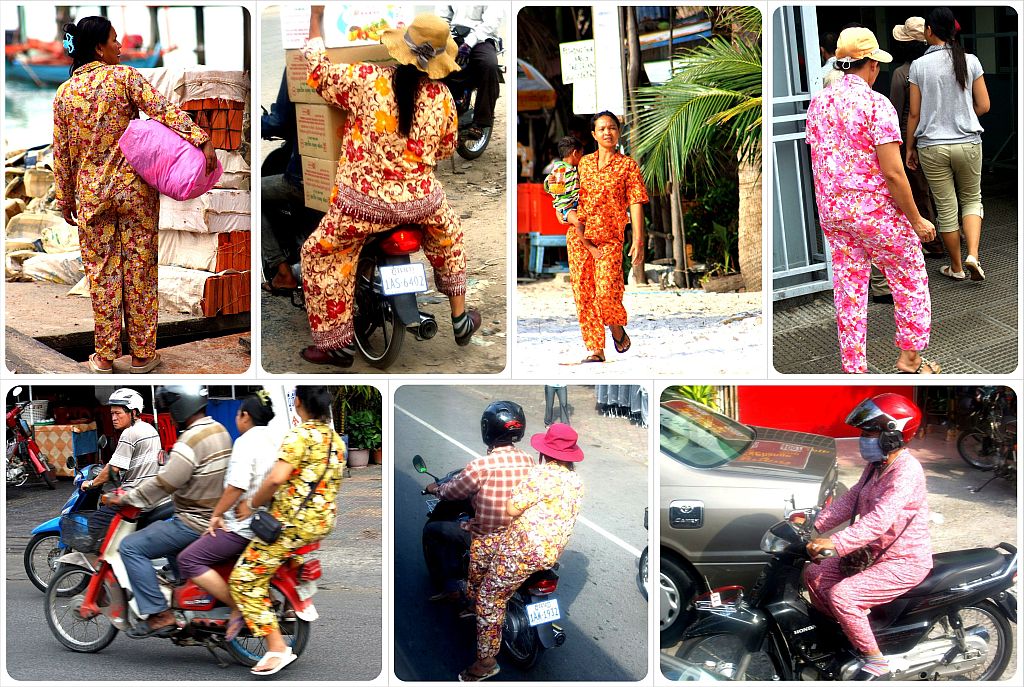
  • Something I love about Cambodia is the style where women where brightly-colored, fully-matching button-down pajama outfits while out and about in the steamy days. Some of them have penguins or flowers, depending I suppose on the person. They are always colorful and look nicely pressed when I see women in the pajama sets. Sometimes I’ve seen children in pajamas, as well, running around and hopping into motorbikes in superhero patterns. My hypothesis is that pajamas are cool and airy enough for the hot tropical weather…and they do have a certain pleasant air to them. It is unsurprising they are colorful, as everyone had to wear black pajamas during the gruesome Khmer Rouge regime.
  • While we drove, we went by countless weddings on the sides of the road, under wedding tents with vibrant colors and upbeat bands playing. Considering the dreadful heat and dust in the dry season, I asked my driver why weddings seemed so popular right now. He explained that people would rather be hot at a wedding than soaked/flooded by the rainy season, so dry season is the only decent time to celebrate marriage.


Tuesday, April 05, 2016

Stopped in Singapore

I went to Singapore for a few days last week. People ask me why I went, and I could give a few answers…truly, it was merely a visa run. I would be lying, though, if I said I wasn’t also eager to explore another nearby country; I could have just as easily booked the visa run in Thailand, but I chose Singapore. And I wanted to meet up with an organization. And I wanted to see an old friend I knew while in Kigali (Singaporean Kiran – who let me crash her couch while there). Lots of reasons.

I arrived in the middle of the night and took a speedy car through the wide highways to Kiran’s home. I then quietly slipped into the couch covers for a brief night’s sleep, before my busy 3-day schedule.

To me, Singapore could fit very nicely as a big city in Australia, if only it was closer. I felt like the city that was a mix of Sydney, Melbourne, and Brisbane. In fact, if Singapore called itself Australian, I don’t think it would have phase me. And yet, it was still very much Asian. It’s hard to adequately explain my feelings.

If I had to sum up Singapore in 3 words, they’d be comprehensive, clean, and baller.

Now, hear me out.

Firstly, Singapore is pretty comprehensive in the sense that it’s a tiny country, yet it packs a punch. One minute I was walking downtown between skyscrapers and the next minute I hopped off a bus and ended up at a bay with gardens. Thirty more minutes and I was in front of a massive reservoir where people were fishing in a densely forested area (only a few blocks away from apartment complexes and restaurants al fresco). Kiran lives in a very sweet suburb area with beautiful little houses and a bunch of charming shopfronts. I was impressed with how much stuff is in Singapore, and such diversity in a small plot of land.

Second, Singapore is clean. Very clean. I know it’s famous for its cleanliness, but I have to verify this truth. In some ways, I felt like in some areas it was the kind of cleanliness you would see at an anal retentive cleaner's area (bleach bottle and all). Some areas were not as immaculate as this, of course, but a lot of it was very well kept. The UNESCO-endorsed Botanic Gardens, as an example, was extremely well managed but not sterile. 

I must admit that it was hard for me to remember all of the rules in Singapore in order to maintain cleanliness, such as no food or drink in many public areas and absolutely no chewing gum. Still, it was a really nice place to walk around because it was so clean in many different ways – I could walk around freely without being worried about getting hit by debris or people (then again, it was a weekday period, not weekend).

Finally, Singapore is baller. I know, this is an odd adjective to describe a city, but I kept thinking it when I was visiting. Singapore is baller because it’s got a lot of fancy things, and it’s super expensive. It’s, of course, the most expensive in the world today, and I choked back some tears when I went out for some meals and electronics shopping (A $35 burger?! really?!). 

But, it also has a lot of very nice things. Very, very nice things. The cars, for one, are fancy. And, the country is kind of like a massive, beautifully designed mall. Malls are omnipresent in Singapore, and a lot of the shops are luxurious. The less-expensive places I went into, even, were done out really glamorously – kind of like there’s a mindset of “go big or go home” to how business works here. 

It’s also baller because it’s clearly got so many model aspects to the country – the economy is a model for some countries like Rwanda, their wastewater treatment is world-renown as the best of the best, and even the gardens are created to be state-of-the-art and award winning. Kiran and I talked about this, and she explained with a sigh that the country is run like a business to the extreme; everything needs to be optimized, and everyone is on board. I could see what she means in the country’s overall aura of almost dogmatic efficiency, but I must say I’m still impressed.

But I did stuff. Let me share.

My first day was a work day. I went to the World Toilet Organization to network with the staff and chat about their role in and perceptions on the future of WASH. Afterward, I traveled to the incubator office called Impact Hub - I often work in the Phnom Penh office, and was able to arrange a desk for a day while in Singapore. The Phnom Penh office is intimate and a lovely space to connect with other entrepreneur spirits; the Singapore office was like being in a member’s only club! They had a nap room with beds and pillow-full couches, a kitchen with free ice-cream, several different areas for working, and a full-on café area where you could eat gourmet food while talking to people on sleek couches (this is also what I mean by baller). I got to network with a bunch of really interesting people doing very similar work to what I hope to do in the nearby future.

Also, I made sure to nap in the designated room after I finished up my working for the day.

I ate at a hawker stall for lunch, too. Hawker stalls are kind of like food court vendors run by small families, (cleanly) crammed into small spaces together. It was tasty and affordable, don’t worry.

A lot of my trip was around shopping for electronics. Part of this was intentional, since I was in need for a charger and some earphones that would last past my trip to Cambodia, and I got those things. I also had to get a new phone because early into my trip my phone decided it had had a good (albeit far too brief) life and pulled its power cord permanently. Many hours between Kiran and me were stuck in Samsung waiting to see if there was any hope of revival. When there wasn’t, we spent more hours hunting down people selling their unused phones on and in local marketplaces. We walked through the labyrinth of massive interconnected malls from one meet-up spot to another, searching for phone sellers. Fortunately, I got the same model as my own phone, but it wasn’t without some suffering (and sweating).

Oh yeah, Singapore was in a heat wave while I was there, so there was much sweating.

On my second day, I walked around the arcades of Burgis Street, roamed a bit of CBD, and walked through Little India for some sightseeing and eating. I also strolled up and down the shopping hub of Orchard Road while hunting for electronics.

I walked around the massive quay called Marina Bay Sands. It’s essentially another massive high-end hotel and mall – with a Venetian-inspired boating experience in the middle of it! – that hosts a lot of water-inspired art throughout the place. I admired the skyline, and ended up going to the Art Science Museum to escape the heat. 

Going to the museum might have been the best decision of the entire trip! The museum had an interactive exhibit full of bright colors and fun creative installations that allowed me to draw my own art and have it become part of the display for a little while. There were walls that changed shapes when touched, and brightly-lit balls that changed colors when rolled to hit each other. I cannot remember the last time I felt such childlike joy.

The museum was followed by a brief visit to the Gardens by the Bay. By this time I was getting tired of walking around and took a bus ride through the major center of the country before heading over to the Singapore Zoo for a tour of the Night Safari. This zoo area is specifically open at night only, where you board a tram that trucks you around the zoo to see the more nocturnal animals in dimly-lit open enclosures chilling out. It was a pretty neat idea, though unfortunately I had the luck of going the one day the zoo was having a children’s overnight party, and there were screaming/crying children surrounding me in this what-should-be-adults-only zoo area at 9:30PM.


A final note: would I live in Singapore? I’m not sure. I loved visiting the place, and I would love to visit again more to explore it in more depth. Living, there, however, would be a different story, I feel, and I’m not entirely sure I’d survive in such a pricey place. Also, I'm not sure my quirky lifestyle and crunchy needs would necessarily fly in such an economic masterpiece. But really, who knows?

Tuesday, March 15, 2016

Update on Being Sick

There’s not too much report right now. After a week in bed with a really bad cold, I was in bed for about two more weeks with amoebas battling it out with my GI tract. I will simply say, being sick in a foreign country without anyone around me sucks. Lots.

I got out only a few times while I was sick.

One time was for an evening where I gave a talk about the history of toilets to a large group of nerdy expats in a fancy bar (I stuck to ginger ale). I shared with them my desperate plea for everyone to wash their hands and use the toilet always because of my amoebic afflictions and joked about Thomas Crapper and other fun trivial facts about toilets. People loved the talk and came up to tell me this before I uncomfortably made my way to the bathroom. Despite my abdominal discomfort, the praise was nice while I continue tackling complications with my health and research project (far too many complications to mention in a blog post...also, too discouraging for me to want to explain cogently).

Another time I left my bed, right before I made a second trip to the doctor for more stomach medication, I went for a little walk around one of the parks near the Riverside area of Phnom Penh. It was just after sunset when as I walked slowly down the boulevard, and the air was cooler. I heard a thudding of modern electronic pop music in the park and looked around to see a few lines of people dancing in relative unison with a semi-choreographed jig. I kept walking and came across another group of line dancers, this time mostly young adult men (with some young adult women), bouncing and bounding to the music coming out of the big speakers. I didn’t know it then, but apparently this is a normal ritual for physical activity in the city. It was a lot of fun to see them, but I winced at the idea of joining them in any active movements other than my slow stroll.

I also went out for a few hours to go to a Reiki circle with a great group of local practitioners. I loved getting to know some people through my preferred method of meditation, even if only an hour or so. The group helped me feel more supported than I have felt since I got to Phnom Penh. I don’t mean that my friends and family elsewhere are not supportive (they have been very much so there for me), but it is a different feeling to have people physically with me and being supportive. I really needed that.

I have figured out that there are four types of foreigners here in Cambodia:
  • Tourists – People who are in hotels and passing through within a few days or weeks
  • Short-term expats – Like me, who stay only for a few months for research or a consulting gig
  • Long-term expats – People who have a year or two of a contract here, then leave
  • Lifers – People who move here for an undetermined amount of time and stay for over 2 or 3 years

Being a short-term expat, it is hard for me to figure out my place. I’m here too long to feel inclined to partake in most tourist activities, yet I’m not here long enough for building meaningful friendships, which I want/need. I have a few friends here, of course, and those people are wonderful and fun to talk with, when we have time to see each other (and are well enough). And I rent desk space at the incubator Impact Hub so I can be around other people more often; I enjoy getting to socialize with the group of researchers and entrepreneurs when I work there every few days. But, I had been sick for about 3 weeks and did not really see many people during that time. Those few weeks have definitely taken its toll on my overall pleasant outlook.


I really do like Phnom Penh, and I am not feeling dread staying here like I did in another place I lived in the past. That said, I look forward to being home with supportive loved ones for a while, and being able to eat a gluten free fudgy brownie.

Sunday, February 14, 2016

Introduction to Phnom Penh

After a few hours of listening to screaming and puking children, we stepped out of the minivan from Siem Reap and into the stream of tuktuk drivers on the streets of the Cambodian capital - Phnom Penh.

While Marion was with me, we shyly explored the town, as the heat kept us hidden away in cooled-off cafes, and I was settling into my new housing here. My roommate, German Shana, kindly helped us get acquainted with the city when we felt brave enough to go out. This included a trip to the grocery store where Marion and I got a bit over-excited from seeing familiar foods imported here for our delicious enjoyment.

We were surprised at the amount of Western food shops and restaurants in the city; we went to posh restaurants with salads and gourmet meals with vegan, paleo, raw, and gluten-free options. As a Celiac, I was particularly pleased to find that I could go to places with dishes specifically catering to the gluten free. Southeast Asia is pretty forgiving for my dietary restrictions, however having specifically gluten free meals can be like going home for my stomach. Raw zucchini pesto pasta? I don’t mind if I do. Tasty home-baked gluten-free bread and pizza? Oh my goodness, yes please!

We stayed at one restaurant for a few hours one day and listened to some talks that were part of a local wellness expo. People talk about essential oils, the meaning of yoga, and the importance of having a personal mission statement. Unfortunately, I missed the talk from the Reiki lady in town, but I connected with her about hanging out (and getting some Reiki).

I hadn’t realized that Phnom Penh was in some ways a hub for yogis interested in living a different lifestyle overseas while eating organic and healthy food (often imported from the West).

Marion and I went to the Tuol Sleng Genocide Museum in order to better understand the horror people had here a few decades ago with the Khmer Rouge revolution that killed so many. The museum is a former school that was turned into a prison during the genocide; the specific location was the most secretive and brutal prison in all of the country’s interrogation units. We were guided by an audio guide through the museum, seeing pictures on walls of the victims who were bludgeoned to death in those rooms we entered and walking through the claustrophobic prison cells, divided by tiny spaces in one room with haphazard brick walls. The museum was very well done and appropriately somber. It was hard for me a little bit to walk through some of the exhibits that were more graphic.

I seem to find myself in developing countries with a recent history of genocide….and I end up living a few blocks away from the genocide museums. How odd.

Marion finally left me for Kabul, and I found myself lonely and with my final project as the sole distraction from a not-so-robust social life here. It has been a week since she left, and I am slowly making my way out and about, discovering the city a more little by little, since the city is more expensive than I had anticipated.

I went to the airy National Museum to admire the history and sculptures of the Khmer Empire. I stuck around the museum until the evening, where I watched a traditional dance show that was beautiful and fun to watch. I don’t know how the dancers can move so slowly with their hands stretched out to curl backward, but they made a magical atmosphere as the band drummed along to their subtle choreography.

With all of the Western bars and restaurants and chic shops, it doesn’t really feel like I’m in a developing country...well, aside from the dirt roads and occasional corrugated shack on the side of the road. I discovered that part of it is because I am in what some people here call the “Expat Bubble” – that is, the thick padding around Westerners in specific areas designed and maintained for Western tastes and expectations, not representative of the true culture or circumstances in the country.  

The city here, as German Shana has described to me, is broken up into different areas depending on the inhabitants: BKK1 (our location) is expat/middle class central, where we have more expensive restaurants and bars, as well as Adidas and coffee shops such as Café Bene; Riverside is where the backpackers and tourists stay, with dirty and cramped streets that house restaurants and clubs with prostitutes; and, Russian Market is where the more hipster expats live cheaply around locals. The local Cambodians who are not fortunate enough to be part of the rising middle class seem to have been pushed out to the sides of the city, often living in overcrowded yet large apartment complexes that look like they haven’t been renovated since the Cold War.

So far, despite these quirks and intolerable heat, I like being Phnom Penh because of the food options and busier life around me. It is like living in a tiny section of NYC for a little bit, where I can go get cheaper food after watching a movie at the expat-run movie house. In Brisbane, for example, things close much earlier.

Friday, February 12, 2016

Siem Reap (Welcome to Cambodia)

Marion and I landed in Siem Reap and were punched in the face with heat. We both had read that Cambodia would be hot, but after the cool (and often cold) climate in Myanmar, we were shocked with just how hot Cambodia is (and it’s only “winter” here). I’ll be here for a while, so I took an internal note that I would have to endure the heat for a long time. We were layered in DEET because of the intense mosquitos and the lingering threat to malaria/dengue fever/chikungunya.

We found our tuktuk driver outside of the terminal and began sweating our way to our guesthouse in Siem Reap.

Siem Reap was a fun and strange initiation into Cambodia, as it is heavily tourist-centric and brimming with foreigners with nice cameras walking through souvenir shops, and expensive backpacks on travelers drinking in bars. Tourists are watched and solicited by tuktuk drivers on every corner, waiting eagerly for some business. Fancy restaurants that look like they are cut out of the streets of Manhattan welcome tourists into air-conditioned comfort. Lounge bars with artistic lighting and plush couches were crammed on the streets. Organic soap shops battle for space with spas and artisanal market spaces, selling goods in strictly USD and speaking good English. It is still clearly a developing country, but it felt like a strange mix of poverty and Disneyland when we walked around.
We had been warned before coming that the abject poverty in the area was depressing and visible, but I was surprised how contained it seemed to be. I had expected to be overwhelmed by begging of all ages, including children for milk (as a lot of tourists have described this phenomenon), but it was not nearly as bad as I had worried. Sure, there were shacks in some places, some naked children running around tourists at bigger jungle temples, some unpleasant smells of poor sanitation, and some beggars here and there, but it was not unbearable to me. Maybe I am too used to the signs of poverty because of my travels and work.

Our trip was not for partying and fraternizing with fellow foreigners; we were there to take in the sights of Angkor Wat and the surrounded ancient Khmer temples. If we hadn’t had our fill of temples in Bagan, we were completely saturated with temples in Siem Reap. Temples are everywhere and gorgeous, just like in Bagan, only completely different in design and architecture and meaning. Hundreds (Thousands?) of years ago, the area had a slow mixing and evolution: from the original beliefs in Animism to Hinduism; then, Hinduism dominating yet cohabiting peacefully with Buddhism; and finally, to Buddhism taking the lead in religious appreciation. The temples, even the main Angkor Wat, had evolved with the beliefs, and Hinduism was mixed and substituted with Buddhism in ways that I only understood by reading a tour book while walking through. The different marriage of religions in the temples renewed my interest in temples for a little bit, and I was fascinated to explore the bas-reliefs. Some of the jungle temples were part ruins (or all ruins) as well, making it particularly mystical and romantic to walk through.

We woke up one morning at 4 AM to get into a tuktuk and join the long parade of tourist tuktuks going to Angkor Wat. We all wanted to get to the temple in time to nab a spot before the other tourists could obstruct our views of the sunrise. With a few hundred tourists all having the same idea, this was a futile effort for most; fortunately, we were early enough to grab a sitting space right on the water, while the other tourists filled in the back of us. It was an annoying few hours of darkness, though, with camera flashes going off in the darkness in vain, blinding us for a few seconds, and the flashlights that never let us truly experience a starry darkness. I was also sad to see almost everyone’s faces tilted down, dimly lit with the glow of smartphones, instead of just being there and enjoying the fact that the sun was slowly rising above one of the most wondrous temples on the planet. I am not completely immune to the lure of the smartphone, but I am able to put it down, especially for experiences like that. Once the sun started coming up, some people looked up to enjoy the silhouette of the temple backlit with the rich and changing colors in the sky.

We visited many temples so it is hard for me to remember all of the names and descriptions, but my favorite was definitely Bayon, with the massive faces smiling peacefully on each side of the temple towers. We climbed to the top of the temple to get a better view of the faces; they were beautiful. The faces were hacked out of the stone after the construction of the temple, making it all the more impressive to me. I mean, someone had to stand up on some kind of ladder for days/weeks/months pounding away at rocks to make smooth godlike faces, times FOUR.

I also really liked Ta Phrom (also known lovingly by tourists and tuktuk drivers as the TombRaider temple). The Wat is in ruins, so it was difficult to get around the place without crawling on big rocks or ducking into a little hole. What was so cool about this temple, though, was how massive trees had taken over the area and had woven themselves into the rocks of the ruins, making the ruins look like something out of LOTR (or, I guess maybe TombRaider).

We tried to get through the temple tours early in the morning because of the unbearable midday heat. I napped in the afternoons once we were done stumbling through old places. We reemerged from our cool room in the evenings to eat good meals and meander through the Night Markets and Pub Street.
We also got a few massages that were quite good from a local spa. I am a very delicate creature, and most of the time massages hurt me more than help. I did get a head massage at this place, though, that felt amazing.


After few days into our Siem Reap, we got ourselves into a minivan with a number of other Cambodians. In the van, we took the 5-hour trek through the drought-ridden countryside, and into Phnom Penh. Here Marion would be leaving me in a few days, while I stay around for some research.

Monday, December 21, 2015

Southern Laos

My entry into southern Laos was a bit curious. I took a bus from Ubon to Pakse. After four rather confusing hours of stopping at check points and other village stops that remain mysterious to me, we ended up in Pakse.

My introduction into Laos at the border was a sharp contrast from Thailand – on the Thai border, it was very ordered and the road was paved and the air was cool, but I went through the border tunnel and came out onto the Laos side with surprising heat and a large, confusing dirt path to a broken building. That broken building was the customs office.

I paid for my visa on arrival with a team of Europeans, but I was the only one that got interrogated about my visit to Laos. A man came out and pointed to my US passport, sternly (and rather loudly) asking me why I was in Laos. Confused and nervous, I stated truthfully that I was just a tourist visiting Pakse and Luang Prabang. Finally, he handed me my passport with visa (in a bit of a huff). I think there is some old hostility in some of those custom guys.

Reading the Lonely Planet SE Asia guide, I was in denial about its description of Pakse not being much. Once in Pakse, though, I learned to not doubt updated tour guides that much. Pakse is a dusty town, with hotel restaurants and enough foreigners to shake a stick at, but not much past that. Luckily, most of my time in Pakse had to be on a laptop for work and assignments anyways (or waiting around doing my laundry in the sink); I felt better knowing that I was not missing anything when I was isolated in my room for long days.

At the start, Laos did not wow me like I had hoped. I struggled for the first few days, trying to get things to work for me and my job – wifi, phone data, etc. Also, getting ointment for a minor skin infection was frustrating as I bounced between shops (and even ended up in the local hospital for English speakers to translate for me what I needed) with some medical creams precariously stashed in glass cabinets, and buying things for rashes I knew I did not have. With the increased heat and frustrating encounters (where English was even more useless here as it is in Thailand), I was sweaty and tired in a matter of minutes. I was irritated with the systems in Pakse early on, but I kept reminding myself that my travels would bring me to other places.

Being a solo lady traveling in Southern Laos (well, Laos in general), people try to help me out and make sure I’m safe. I found that I easily endeared myself to the people around me by using just a word or two in Lao (or ordering a Lao dish). In restaurants, though, this could backfire and instead they would try to prove to me just how spicy their food can be for local people (level: agonizing). I ended up eating at my hotel a bit, to protect myself from vindictive waiters. Luckily, the hotel manager where I was staying was so impressed with my interest in Lao culture and food that he even made me local meals, including grilled frogs, fermented fish, and eggy rice soup. Every time I ate I would have a group of Laotians surrounding me, in awe of my eating of their local foods. Apparently most “falang” don’t bother trying to eat traditional foods from the region; to me that just sounds like missing half of the fun of travel.

A few days in, I made my way further south to the border of Cambodia to stay in the 4000 Islands, on a little yet popular island called Don Det. Getting there, again, was an adventure, as I sat in a packed 40-year-old bus in the extreme heat with a pile of hippy-backpacker youth types that in discussions seemed more interested in partying on questionable substances than relaxing on a remote island.
After the bus, we trudged through a tired town and got onto some long boats that brought us to the banks of the island, which meant we had to quickly problem solve getting off of the boat (or climbing through several boats next to each other) and hope that our balance would get us to dry land before falling into the river with our belongings.

Off of the boat I was met by some locals selling things and more of the same backpackers casually strolling along. One of the downsides of being there was that it was hard to enjoy being in a foreign country because it felt like an extremely tropical western college town. The island is lined with souvenir shops, tourist agencies, and restaurants that cater to foreign mouths. One of the restaurants played “Friends” nonstop – another played “South Park”. A lot of the town was starting to feel a bit like Cancun spring break, if you catch my drift.

Other than that, Don Det is beautiful, as is the rest of the area. I was surrounded by peacefully rolling water and green little islands dotted the waterways, with looming green hills in the distance.

There is bank erosion on the island, which means there are little haphazard bridges made of wooden planks around the island that you (hopefully successfully) walk or ride over. I tried riding a bike to enjoy more of the island, but the roads were treacherous (cliff-side dirt paths with wooden bridges of death) and full of other bikes/animals/motorcycles/people using the same narrow paths. I became full of anxiety and stopped riding soon into the adventure, and decided to relax on the island for my stay. Instead, I’d focus on naps and sunset boat rides.

I got to make some new friends! which is most excellent for the traveling social extrovert I am. I met two Germans on my first night, and we sat in a restaurant having fun talking about foreign policy and academics. They are studying in Bangkok, and helped me understand more of the region than I had known before. I also ended up making good friends with a guy from Belgium (Belgian Elkana), who I get along with famously, and he became my southern Lao travel buddy for a few days. He has traveled through the region quite a bit, as well, and has given me a lot more insights into the culture and quirks of SE Asian travel since we met. We also talked about other things, like life and death and society and other light subjects. He’s great, you should meet him.

I wish I had stayed longer in Don Det, but I had things to do in Pakse (namely, work) and my relaxing and sweltering holiday in the islands came to a swift end.

Fortunately, I had one place to tour when I was back in Pakse – the Wat Phou in Champasack a little further south of the city. Wat Phou means it’s a temple of some sort situated by some natural area like a mountain or trees, I believe. I was told it was a good taster for the beginning of my Khmer Wat visits, and I am glad to hear that as it was enchanting. I met up with travel buddy Belgian Elkana, and we explored the beautiful and hilly area around an ancient temple that predates the Angkor Wat in Cambodia. The ruins were grand and elegant. The only problem was my fear of heights and the Khmer architecture’s sagging steps up a steep hill to the Wat. Luckily Elkana helped me down the stairs as I whimpered and paced like a puppy going down stairs.


After a week of travel and working, I got myself to the tiny airport and made my way to northern Laos, in Luang Prabang.

Wednesday, December 09, 2015

Some Nights in Bangkok

It has been a while since I was in Bangkok, but bear with a very long summary about a few days in Bangkok.

I landed in Bangkok late at night, and quickly got into a cab to Peruvian Lorena’s place. Lorena is doing some work in Bangkok, and she generously offered me to stay with her while I was in town. It was fantastic to catch up with an old friend, and celebrate nine years of our adventurous traveling friendship. We laughed a lot, and talked about all kinds of things, big and small.

The first full day in Bangkok I felt the punch of humid heat again. I have learned my lesson; Southeast Asia is hot! And, as a result, is covered with indoor malls.

Along with the heat, I was overwhelmed with the intensity of Bangkok. Bangkok has a lot of everything (i.e. buildings, people, shops, and cars) and pulses with advertisements (both video and print) that felt like having my brain being pulled like taffy. There is an air of excessiveness that comes with the commercials and inside the malls. Luckily, I forged through the city to discover its vibe, and gratefully bought copious amounts of delicious iced juices from the street corners. It was awesome!

I started the day by going to the Dusit Palace and admire its decadence– mesmerizing beetle wings covered chairs and gold-gilded table pieces decorated the building. Intricately-woven tapestries dazzled the walls. My eyes drank in a lot of things there, but sadly I couldn’t take pictures inside, so it’s hard to describe all that I saw.

Experiencing Bangkok, starting at the palaces, I had two surprises.

One of the surprises I had was realizing I could not walk into many places with my normal tee-shirt and jeans ensemble with a travel bag. I was ping-ponged between buildings and told to put different belongings in lockers in two separate locations. I finally understood that there was a strict dress code, for women: I had to wear a long skirt in order to go inside. I mulled this over for perhaps 30 minutes, confused and overheated. I finally broke down and bought the 50 Baht (US$1.40) sarong they had for sale in the gift shop, wrapped up my legs, and journeyed towards the security line. Happily, the sarong is great quality and is now functioning as pajamas.

The other surprise I had while in Bangkok (and first noticed at the palace) was the shocking number of Chinese tourists everywhere. This was not really a good thing, as Chinese tourists seem to typically come in tour groups by the busloads and have little respect for personal space and museum etiquette. I was jostled and pushed around by hundreds at the tourist sites, and felt suffocated while trying to get through. There were signs in several languages insisting on silence while at the palace, specifically, though they did not much seem to care for that rule and the palace roared with conversation. It was frustrating, to say the least.

After the adventure at the palace, I went to the MBK center (it’s huge - 6 floors I think!) for some headphones and a peek at souvenirs. I waited for Lorena with a matcha green tea ice cream float; it was so delicious I realized that I would like Bangkok just fine.

The allegations of food in Thailand being incredibly delicious are all true. It’s often extremely spicy, but many times the level of heat I endured was my own (silly) doing. The diverse food that line the streets are amazing (and super cheap), and the restaurant food tastes like joy. I did not have very many times I didn’t like the food I was eating while in Thailand.

Lorena and I met up and got a massage. At this point, it became clear to me that English would not get me very far in Thailand. Most people don’t speak a lot of English, if any, and it’s more helpful to pick up some of the Thai/Isan that is spoken in the area. I learned this because my massage was great and thorough – a bit too thorough for my sensitive self. I cringed and clutched onto the bed while thinking to myself how it was a great time to learn phrases like “please be much lighter I’m sensitive” and “I have an injury there!” Instead, I yelped and whimpered loud enough for the lady to stop and reconsider her strength a few times. But it was still a great way to help my swollen travel ankles recuperate.

The second day I worked for a while in a coffee shop called MyCoffee. There, I was distracted by a pet fox licking ice in the back of the café that was fluffy and pitifully adorable. I also went to another mall further out of town called JJ Mall. There, I was trying to find some cotton pants my size. This has proven to be a horrible area of the world for big people with big hips (aka me) to find clothing that fits them. Shopkeepers would look at my backside and just shake their heads dramatically, giving me the impression that they’d never seen anyone like me before.

I also saw an outdoor market that sold fish (both pet and edible) in rows of plastic bags outside, next to bags of living crickets (for eating), next to other strange shops full of peculiar finds. I felt stunned to go through the market, and felt kind of bad for all of the fish.

At night Lorena and I took a boat to Asiatique (which is like a night market/mall that has anything you could ever dream of eating or buying) to enjoy the sacred Loy Krathong Festival. During Loy Krathong, people give offerings to the goddess of water at the end of the rainy season to thank her and apologize for polluting the rivers and lakes. It’s also seen as a purification ceremony for some. Overall, it was bright and a lot of fun. It felt a bit like being in Times Square on New Year’s Eve with all of the people tightly packed in the area, but there was music and food everywhere to easily enjoy. I had bought Lorena and me a krathong offering, and we participated in the ceremony; I think the goddess heard us, as it started to pour soon after we offered our krathong.

In the third day I took a long tail boat on the river that went to the Grand Palace. The boat ride was harrowing; as it literally flew in the air and crashed back into the river, I wondered whether I had made a horrible foreigner choice taking the questionable boat to the site. I made it out alive, and that’s all that matters now.

The Grand Palace was, of course, loaded with the aforementioned tourists, but I was impressed with the beauty of the palace grounds and the intricate designs on the buildings around me. I couldn’t stay long because of the crowds and toxic heat, but I am glad I got to see it for a little bit.

Nearby is the Wat Pho with the big Reclining Buddha, and I went over to see the temple for a while and relax in some shade. It was gorgeous, and I felt like I could have stayed there for days in its peaceful fortress. There weren’t many tourists there when I went to visit, which was a relief, so I took my time loving every sculpture and spire. I have been trying to show respect to Buddha while in Southeast Asia, and I went in to pray a few times in some of the rooms. One time I felt like I was having a real connection with Buddha – either due to the intense heat or an actual connection with the Buddha – which blew my mind for a while.

Afterwards, I hid from the heat in anther mall (Terminal 21) and waited for a friend - Counselling Roshni – to meet up with me for dinner. She is from Bangkok, and I was looking forward to hearing some more context from a local about this amazing city. Once the sun went down, we walked around the central area and she explained to me things, such as that the homeless people there are run by the mafia, which is why one should not tip them. I was shocked.

We ended up eating at a restaurant called Cabbage & Condom, which is a restaurant that advocates safe sex in a big way. It was founded by a guy who wanted to help Thailand manage its concerning population rate and a national AIDS epidemic through advocacy and education. The restaurant is part-workforce development and advocacy, and I think it does its job well. The decorations and lamps are covered in condoms, and after eating a great meal with Roshni they gave us condoms to take home. I really recommend the place.

On my last day in Bangkok before going to Isan/Ubon for class, I woke up early for a cooking class, called Cooking with Poo! The woman’s name is Cham poo, which means rose apple, but her nickname has gotten her some global popularity. Knowing my passion for sanitation and food, Roshni recommended the class; seeing the title of the class, of course I signed up. It started by walking through one of the local markets that is mostly for locals, which means it wasn’t all cleaned up and sterilized like many tourist places can be. Instead, we saw the dirty and grimey and fascinating face of Bangkok that I don’t think many get to see so clearly. In the market, we saw filleted and stuffed frogs, all kinds of edible insects, boiled chicken feet, and an array of fruits and vegetables I’ve never heard of! They warned us that some of us might be disturbed by what we saw, but I found I was more impressed and captivated than anything!

We ended up at Poo’s home in a poorer community, where she taught us how to make simple yet tasty Thai food, such as pork larb, thom ka soup, and garlic chicken. The cooking space was colored with fun colors and I bonded with some of the older British students there. Poo also made us her mango sticky rice, which may have actually changed my life to a certain amount (I can’t express how delicious it was!).


After the epic cooking class, I met up with some fellow classmates who arrived to Bangkok for our intensive in Ubon the next day. We went to a riverside hotel for drinks and headed out for dinner at Asiatique. It was a lovely way to finish a memorable few days in Bangkok. I look forward to returning in a month.

Friday, November 27, 2015

Layover in Kuala Lumpur

So much is happening! But I have such little time to write everything down.

Sunday night I got on a flight and took a red eye to SE Asia. My intention was to sleep on the plane the entire time; my neighbors, however, drank enough alcohol to supply a college dorm floor and were not eager to permit my rest. By the time the flight ended I was deliriously tired.

On Monday I had a 15-hour layover in Kuala Lumpur, Malaysia, so of course I left the airport to explore the city, despite my depleted energy.

My flight landed at 4:30am, so it was dark out and nothing was open for a few hours while I confusedly tried to get my bearings in the big city. Needless to say, the first few hours were quiet and not terribly eventful while I nervously waited for the sun to show itself and give me an idea of where on earth my exhausted body was.

When the sun lifted, it was beautiful. But, with the sun came an oppressive heat that was further weighted with humidity. I have to admit that I will remember Kuala Lumpur by its immense heat. Malaysian Denise mentioned how intense it can be there, but for some silly reason I didn't understand her fully, until now. I am a fool.

When the sun came up and the city began to wake up, I started to hunt for food joints. By the Petronas Towers, I found an outdoor Indian-influenced restaurant called Pelita. After hungrily wandering the restaurant with a pathetic face, the servers compassionately sat me down and brought me a masala dosa that was fantastic.

I walked around KLCC for a little bit in the heat and admired the Petronas Towers, which really are impressive in person.

I also took the train to Pasar Seni - the Chinatown area of the city that hosts a popular Central Market. It was still very early, but I managed to explore the area's temples and appreciate the early morning smells of the market. I went to an old Hindu temple and quietly breathed for a few minutes in the open space. I then shuttled over to the nearby Sze Ya Temple, and grounded myself a little bit in its earthy building smelling of gentle incense. One of my favorite parts of travel is going to temples and relishing the spiritual areas - thin places - of the region.

I also looked at the architecture of the buildings in the area. There's clearly a Moorish influence on some of the designs, with minarets and intricate wall designs.

Later in the day, I went back to the center of town. Under the Petronas Towers in KLCC is a massive multi-storied mall called Suria KLCC that hosts fancy shops and a large food court full of local food. The mall is overwhelming, especially for me since I don't shop much and get over-stimulated easily. I understand why they have such large malls, though - the debilitating heat gave me a lot of motivation to stay indoors in the air conditioned shops for the day.

Denise's boyfriend, Taya, met me in the towers for lunch. Having a nice conversation with Taya over delicious nasi lemak fueled me for the rest of my trip to Thailand later on. He walked me around the mall and outside park and educated me on some cultural nuances in Malaysia. I shared my appreciation by buying him a cookie.

In a country that is predominantly Muslim (61.3%), I was surprised to see Christmas vibrantly displayed in the malls. Taya explained to me that it was Malaysia's way of recognizing and appreciating its diversity in the country. A bit more than 9% of the population is Christian, after all.

The overall feeling I got of KL was a big, bustling city where you can hide in cooler areas while the weather slays ignorant tourists. But I may have felt something a bit strict about the city. I am not entirely sure what I mean, but I felt something there I'd like to understand more.

Now I'm in Thailand! More on that later.