Showing posts with label research. Show all posts

Saturday, April 23, 2016

A Quiet New Year

About a week ago was the Khmer New Year. Most of the foreigners (aka expats) fled the country for holidays in cooler climates, and locals headed into the provinces to visit family over the holiday. I, on the other hand, opted to stay in Phnom Penh and work on my research project, furiously coding transcripts and trying (with tired eyes) to interpret my codes into a tangible story. I’m still working on making sense of the data and putting together my analysis, so I’m glad I stayed behind.

People here asked me what the city was like during the week everyone was gone. Honestly, I didn’t venture out too much because of my research, but I did go outside here and there. Simply put, it was hot and empty.

Firstly, it was hot. Of course, this is not an interesting observation; it is consistently in the 30s C / 80s-100s F. But that week was exceptionally hot – most days wavered between 39C / 102F to 40C / 104F (and that is not including the increased degrees for the “RealFeel” measurement). I hid in my bedroom with the aircon  nonstop in order to avoid melting; going outside seemed extremely unappetizing.

Also, Phnom Penh was silent and empty. The quiet meant I could sleep longer into the morning, which I found rather pleasant. And the streets were free of parked cars and people; only a couple cars would be driving down the main roads, whereas normally it’s packed and congested traffic nonstop. The reduced number of people made it easier to walk down the streets because there was no competition for space.

Actually, this walking around on the street was short-lived. Whenever I tried wandering more aimlessly up and down the street, I would get some tuk-tuk drivers’ attention. Normally, this attention includes someone shouting, “Hey lady want a tuk-tuk ride?! Where are you going??”, trying hard to make a transaction. Over the New Year, though, the attention was more tuk-tuk drivers’ adamantly yelling for me to get back on the sidewalk and put my phone away. It seems that some people take the week’s emptiness as an opportunity to speed down empty streets recklessly. Also, someone mentioned that theft goes up in the New Year because people want nice things like smartphones and will ride down the street on their motorcycles to snatch your belongings if you’re too close to the street.

The tuk-tuk drivers weren’t asking to give me rides, they were just genuinely concerned about my wellbeing. Which was a strange change of pace for me, being used to politely declining constantly as I walk down the street.

Despite the emptiness, I did have a little bit of a social life. There may not have been very many things open or people around (every restaurant I like to go to was closed), but I had a few friends who stuck around as well, and we'd go out to enjoy each other’s company over cold beverages (Brown Coffee was open, of course).

One friend had a dangerous allergic reaction to some strange ingredient in a meal while in the city that week. I tried to help that friend find an EpiPen or some allergy help so that they could figure out what happened to them. Just to let you know: Cambodia doesn’t have EpiPens. Try all you might, you will not be able to successfully source EpiPens in this country (and if you magically can, I am going to guess it’ll cost a lot). Luckily, this friend went to an embassy and sourced an EpiPens that way, but otherwise was looking at having to go to a clinic for a stab of adrenaline if anything else happened. This medical mishap was alarming for me in some way. I wonder, if someone has a child who is allergic to some food, what do you do? If someone is deathly allergic to some kind of insect or surprise allergy (and is a baby?!), what happens? It reminded me how some things that work in countries like Australia and the US are far cries from how things work in countries like Cambodia.


Don’t get me wrong! Cambodia is progressing and evolving at lightning speed. There are so many developments happening here, even for the 3 months I’ve been here! And so much is happening that it’s very exciting to be here and watch it change and morph into a new kind of society. That said, I do miss the immediate healthcare of other places. 

Thursday, April 14, 2016

Field Research Fun

Cow grass
Last week I got into a quintessential expat vehicle (a white Jeep...with a driver) and drove a few hours out of Phnom Penh for interviews with local, rural government staff. Being the child that I am, as soon as the car started pushing out of the city, I fell asleep until my driver kindly nudged me awake in our first area for interviews, Kampong Speu.

During our few days in the field (meaning my friendly driver and me…and when I wasn’t lulled to sleep by the humming of the car), we spent many quiet hours having broken conversations with each other. We drove from Kampong Speu, out to the other side of the country in Kampong Cham, through Tboung Khmum, and back to Phnom Penh.

I’ve tried to learn Khmer while in Cambodia. Normally languages are pretty easy for me to grasp. Par example, je parle français (grossomodo). Some Spanish speakers have thought I can actually hablar español. I can read some Arabic like a first grader. By the end of my month-long stint around Thailand, I could hold basic conversations with people (krup koon kah). In Laos, visit to Isan proved good for me to understand a good amount of things (krup chai de)

But when it comes to Khmer, even though it is of the originating family from which Thai and Laotian stem, I am utterly useless.

Khmer, for me, is incredibly difficult. I cannot for the life of me figure out how to remember the complex pronunciations and complicated consonants that surprise me when I hear people talking. I’ve managed to clutch clumsily around a handful of words - “Hello”, “Thank you”, “Stop”, and “Turn”- but for the most part what words I am taught dribble out of my brain as easily as football statistics. And it infuriates me!

This is especially problematic when in rural Cambodia, where English is not as important as it is in the city. Here, I am in the wrong for not trying to learn more Khmer, and I agree with that – I should be much better at the language by now. Alas, my brain has shut the vaults to Khmer, and my attempts to use Thai words as alternative vocabulary are kind of silly.

One instance while in Kampong Cham that was amusing around my inept Khmer skills was around my breakfast. My driver, bless him, after I rambled on about wanting bobor (aka rice porridge) found a place in the city where I could order it for breakfast. I have discovered a deep love and affection for the comfort food feel I get when eating it. They put ginger and scallions in it, and often meats, which make it basically like eating a nice, creamy, thick soup. 

I go into the restaurant and order a bobor. The waitress, being a good and thorough waitress, started listing off in Khmer the bobor options they had at the restaurant. I panically ask for, “English?”, which gets me a chuckle and more Khmer words thrown at me that lodge into my pride. A meekly repeated request for “Bobor….?” was met with the repeated list of options I couldn’t understand. I started to cluck like a chicken, using my hand to represent a beak, in hope that it would give the effect of my desire to have chicken in my porridge. After a pile of waitresses and patrons finished their giggling at the stupid foreigner’s chicken impression, the waitress gave me a knowing smile and walked away from me.

Soon after, I received my bobor, only with fish instead of chicken. Don’t get me wrong, it was a tasty dish! But after my embarrassing attempt to impersonate a chicken, I felt baffled that my performance was received with an animal that did not make any sounds at all. I went back the next day to try again my request for chicken in my bobor, armed with the word chicken from my caring driver, and I was successful in eating bobor muan.

Another amusing language mishap that happened in the field was a bit more costly for my interviews. Well, I have not confirmed that this is why the complications occurred, but I am assuming that this was the hiccup. 

Anyways. 

So, my name is Kim. Of course, in the Anglophonic world, my name is short for Kimberly, which usually doesn’t cause too much confusion about my identity. In Cambodia, however alarming, I have been mistaken for Korean a couple of times. If you know me, I look in no way Korean, nor Asian by any stretch of the imagination. I burn in 10 minutes, in the shade – my hair is a mix between blond and brown – my hips are most certainly not of their typically sleek physiques. And yet, I have had people ask me to my face if I am indeed Korean, upon hearing my name. It is a phenomenon that floors me every time.

How does this relate to my interviews? My interviews were arranged with the rural districts via email, where my name was indicated as “Kim” (because that is how I identify in correspondences). Kim, it so happens, in addition to being a Korean name, is also a common nickname for a few names in Khmer. It is not, apparently, a common name for visiting Westerners interested in going to rural areas to talk about government. 

Despite my supervisor’s Virak request for a translator for me, I think my name made that important request not register for people. I arrived to each district with a request for translators, and people looked stunned that I was who I was, and that I did not have a translator with me already (or speak fluent Khmer). 

Every district scrambled to find the most English-speaking staff member they had and thrust the poor soul in my direction. Some of the translators were good and knew how to navigate my questions for me in both language. Some of my translators were shaking a little bit as I spoke to them in a very slow, simplified version of English. Some of my translators kept apologizing, which did not boost my faith in their skills. Even so, they all did a decent job in helping me collect my data, and I thanked them for taking time to interpret the conversation between me and groups of government staff.

Oh yes, there’s that other thing, too. I had asked for one-on-one interviews with certain government staff, because it would make my data collection and analysis easier. All of the districts did not understand that, though, and my interview participants would end up collecting a few more relevant staff people to join us in the interview room. Stunned, I decided it was disrespectful to forbid the other people to participate, and my already anxious translators didn’t need to feel more stress with having several different conversations between me and other people (the less I talked, the better). So, in each of my surprise focus groups, I had everyone sign a consent form, and rolled with it. 

By the third surprise focus group, I was hardly surprised.

In the end, I now have twice as many interviews than I had expected, and I was successful in collecting some pretty interesting data from my field visit. Overall, a success.

Other things that I would like to note about my trip into the field for data collection:
  • I am left handed. I know that I am, but I didn’t remember that Obama is, as well. One of my translators remembered that, though, and mentioned it almost immediately after I picked up a pen to write down a note. “OH! You write like Obama!” It took me a few beats to figure out what he meant by that. I remembered some memory from seven years ago when someone mentioned to me that Obama was a southpaw. I wanted to ask him how, in all of the vast ocean of knowledge to remember, did he remember that one pretty obscure fact about POTUS?
  • I was interviewing people about their work around improving rural sanitation. At about half of the places I visited, I was surprised to see male staffers urinating either on/by one of the buildings, or on a neighboring tree on the compound. At one district of these districts I also asked to use the toilet. They hesitated uncomfortably, informing me that their toilet was not working very well. I found this ironic (and unsettling), considering the reason for my visit. I went into the broken toilet and did what I had to do as hygienically as possible. It was an interesting observation to have while working on sanitation-related research.
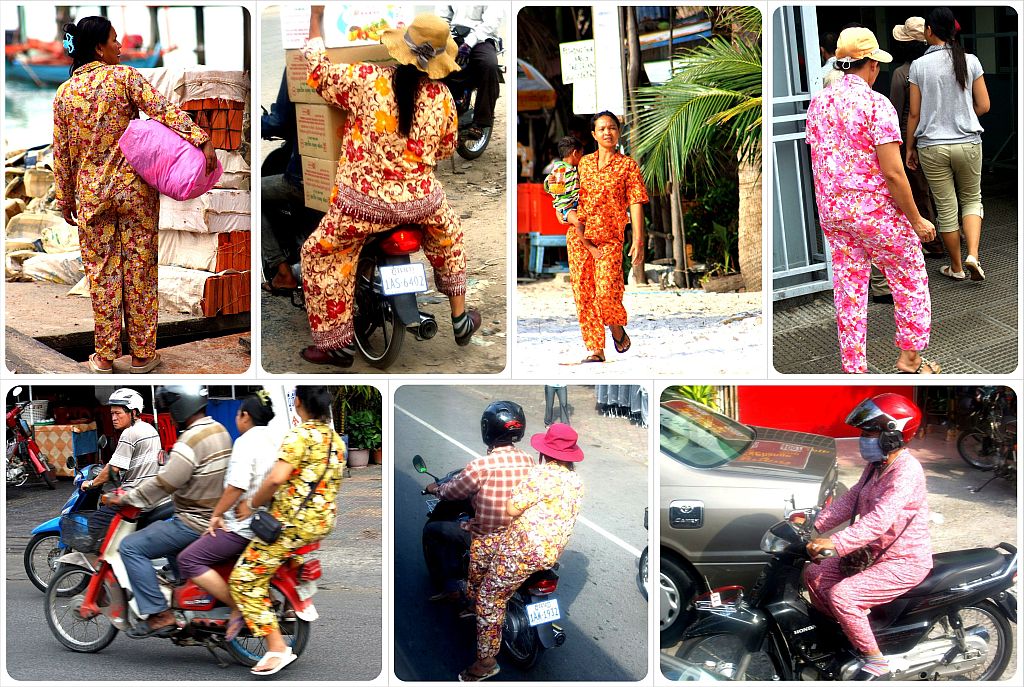
  • Something I love about Cambodia is the style where women where brightly-colored, fully-matching button-down pajama outfits while out and about in the steamy days. Some of them have penguins or flowers, depending I suppose on the person. They are always colorful and look nicely pressed when I see women in the pajama sets. Sometimes I’ve seen children in pajamas, as well, running around and hopping into motorbikes in superhero patterns. My hypothesis is that pajamas are cool and airy enough for the hot tropical weather…and they do have a certain pleasant air to them. It is unsurprising they are colorful, as everyone had to wear black pajamas during the gruesome Khmer Rouge regime.
  • While we drove, we went by countless weddings on the sides of the road, under wedding tents with vibrant colors and upbeat bands playing. Considering the dreadful heat and dust in the dry season, I asked my driver why weddings seemed so popular right now. He explained that people would rather be hot at a wedding than soaked/flooded by the rainy season, so dry season is the only decent time to celebrate marriage.


Wednesday, March 02, 2016

Field Work and Amoebas

Last week, while fighting a really nasty viral infection (in my nose), I got invited to join some development agencies and government officials on a field trip a few hours east of Phnom Penh to the rural areas in Tboung Khmum and Kampong Cham. The field trip was a way for national government guys to come and see how water and sanitation is working on the ground in rural villages (because guys working in Phnom Penh have little context of what’s going on), and talk about ways to improve the sector’s work with local governments. It is really important for national government figures (and researchers like me) to go out and see the action happening because sometimes it’s impossible to fully understand the picture when there are no faces to picture for policies and work being done.

What is your research, Kim? Well, I’ll tell you. The national government here has been giving more responsibility to local governments (read as: decentralizing) around water and sanitation. My focus is sanitation. The problem is that local governments here lack a lot of skills and knowledge needed to do what the national government is (vaguely) telling them. So, I’m trying to figure out what kind of roles the local government needs focus on for improving sanitation in rural areas, and what capacity is needed to do that work. Did you follow that?

Back to the trip, I should point out two complications I had during those two days: (1) I felt like I was dying from the viral infection, as my nose screamed fire and throat scratched with all of the gross internal residues coming out of me; and, (2) I was the only non-Khmer (aka Cambodian native) person in this field trip, so the conversation was mostly in Khmer – some generous development workers took turns translating for me what was happening. So between my spacing out with delirium and translation, I’m almost certain I missed key pieces from the conversations that happened. That said, I did get a pretty good idea of some of what’s going on for my research.

We drove for hours down roads that were dusty and very dry. It is dry season here, but it was very clear that the drought the country currently has is taking a toll on agriculture; fields were charred and crackly with dryness, and gusts of winds blew through the open spaces, pushing dust into swirls in the air. The houses we saw were simple wooden structures, balanced mainly on tall stilts – presumably to avoid floodwaters that are currently unfathomable with how dry it was.

Going through the rural community we visited, I noticed that trash was strewn around the land everywhere; I saw debris in the open well, in the straw-like weeds near the village hall, in front of houses, and in the dried up waterways near some houses. This village also had about half of the population (of about 100 or so households) defecating out in the open, so wasn’t a surprise that trash management was not going too hot. Some people had bought the building blocks for a toilet, but many had the structure pieces lying in piles near their home, unconstructed and abandoned. Buying the toilet itself is pretty cheap – most of these people can buy a toilet for about $25…the problem is the structure in which to build around the toilet, which can be about $200. For a lot of rural families, that is half of a year’s income.

The people were brought together into the village hall so the local government could tell them about the benefits of buying a toilet and play games to highlight the consequences of going out in the open. I told Mr. CT Lawyer about this meeting in more detail earlier; based on his reaction to my story, I will spare you the rest of what was discussed.

I found it interesting that the demographics of the village at the meeting were mostly elderly people and little children. I saw this in rural Thailand as well; the younger people, including parents of babies, set off to cities like Phnom Penh and Bangkok to work in the factories in hopes to send money back to their destitute families in rural areas from their better-paying livelihoods. Grandparents raise grandchildren, and parents try to support families so they don’t starve. The livelihoods of simple rice and other kinds of agrarian farmers just do not provide enough for survival anymore in much of the world, especially as climate change intensifies.

We stayed overnight in the city of Kampong Cham, right on the Mekong. A few of the people helping me with my research and I went out for BBQ at a local restaurant. After BBQ, though I had thought we were done eating, the group moved on to another restaurant for rice porridge (they put salted eggs and fish in the porridge). Cambodians are thin people, but I (with my generous hips) could not keep up with the group’s appetite – I struggled with the porridge while some of them took seconds and thirds of porridge. I asked them how they could pound back the porridge so easily, and they explained that it was more for the socializing around the porridge they enjoyed. Apparently there are lots of restaurants in cities that are open until early the next morning just so groups of friends hanging out late can enjoy some porridge together. They had wanted to go out for Karaoke after porridge, but my ashen face was very clear to them and they (thankfully) put me in a car to go back to the hotel and crumble into my bed.

Many of our meals were held at some tables under a roof held up by a few poles that sat on the side of the road, and were given meals from pots on a table near the road, or from a kitchen hut in the back of the roofed area. For the days we were on this trip, I did not really understand what I was eating most of the time. A lot of it looked like stews or stir fries of some sort, but the contents were beyond my comprehension. My helpful supervisor, WASHy Virak (my trusty translator and key advisor while I’m here), would explain to me what was going into my mouth if he was next to me. When he wasn’t near me, I would squint my eyes and point at things with a look of confusion to nearby eaters. One thing I ate looked like mushroom stems but was much chewier than I had anticipated. I got adamant responses from other people like, “No mushroom!”, but not much explanation of what it actually was. A while later, Virak explained to me it was pig’s intestines. Another thing I thought were mung beans turned out to be squid. I clearly am not good at the guessing game.

It’s been a few days since the educative trip out in the field. Somewhere between there and the rest of my current visit in Cambodia I have eaten something that was unclean, most likely from having some kind of fecal matter on it and not washed off before I ate it. Last night I got a tuktuk to drive me to the International SOS Clinic to figure out if my fever and the amazing amount of pain was from dengue fever or something else. As they hooked me up to an IV drip and took blood and other samples from me, we discovered I am currently suffering from amoebic dysentery (read as: parasites, likely not from the rural trip). I’m glad that I don’t have dengue, but I cannot say that this amoebic infection is any better (nor do I want to find out ever). The doctors pumped me with medicines and handed me over a very fancy bag full to the brim with several different types of medication to help me manage and eradicate the amoebas from my body. I am currently in very close relations with my bathroom.


I told my Australian supervisor (Bronwyn) about this, and she replied with, “Ah yeah, I’ve been there.” I also got a few notes from other development workers recently with similar stories of sickness as a result of being in the field doing work. Dengue fever, malaria, tapeworm, food disease (been there), amoebic dysentery (on it), etc. It seems almost like a rite of passage for people working in development work to get super sick (often)…an occupational hazard. I keep thinking to myself, And we all signed onto this?! I love working and feeling like it makes a difference, I love learning about contexts I normally would never dream of, and I love how interesting it all can be. However, I have been so sick so often in my travels the last few months, I have my doubts about continuing this work for the long haul; I don’t know if my body can handle it forever. It is clearly an easy target for germs.